
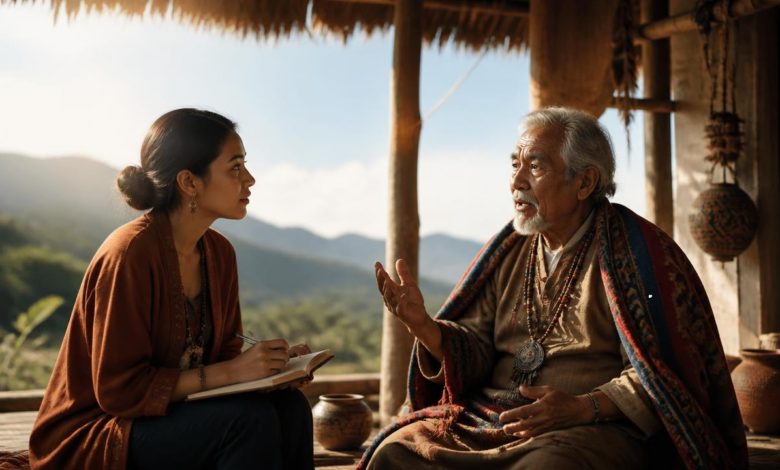
Oral traditions resonate through the human voice, carrying community memory long before written records existed. Across many Indigenous societies, these forms are far more than entertainment; they preserve law, ethics, geography, spirituality, and a deep sense of belonging for future generations. Listening closely reveals that indigenous storytelling is a living practice, shaped by responsibility, protocol, and collective memory, connecting people to their origins, kinship, and ancestral lands.
The Enduring Power of Indigenous Oral Traditions
The true strength of storytelling lies in its ability to convey multiple truths simultaneously. A single tale can explain a mountain’s formation, guide a child’s behavior, record significant migrations, and articulate a people’s profound relationship with the sacred. This rich, layered quality underscores the immense cultural significance of oral traditions within Indigenous communities worldwide.
These ancestral narratives, while often deeply localized, address universal human inquiries: Who are we? Where do we come from? How should we respectfully coexist with each other and the land? Within Indigenous knowledge systems, these are not abstract philosophical questions, but practical, moral, and communally vital considerations that guide daily life.
For those seeking a more respectful cultural understanding, this topic naturally connects with engaging with local storytellers for authentic cultural insights. Stories are not merely content to consume; they represent relationships that demand humility and respect. Approaching them with an open heart fosters genuine connection.
According to UNESCO’s work on Intangible Cultural Heritage, oral traditions form a vital component of living heritage. This distinction is crucial because living heritage adapts through use, evolving with new realities while safeguarding core values. This dynamic nature ensures spoken word heritage remains both enduring and relevant.
Unpacking the Core of Oral Narratives
Memory, History, and Cultural Identity
Oral traditions are frequently described as oral history, yet this phrase captures only a fraction of their expansive scope. They encompass epic narratives, praise poetry, lullabies, ceremonial speeches, place-based songs, genealogies, and profound origin accounts. Together, these elements form intricate memory systems through which communities interpret the past and navigate the present.
Within many Indigenous societies, cultural identity is profoundly intertwined with storytelling traditions. Communities often comprehend clan relationships, inherent obligations, territorial connections, and spiritual teachings through narratives passed down across countless generations. The impact on identity is deep, as stories do not just describe belonging, they actively forge it.
These narratives also challenge conventional, narrow definitions of history. Written archives can often be incomplete, biased by colonial perspectives, or selectively recorded. Oral records may preserve vital perspectives frequently ignored by official documents, especially in regions where Indigenous voices were systematically excluded from state institutions. They are acts of continuity and resistance.
Transmission of Knowledge Across Generations
The process of passing down Indigenous stories is rarely straightforward. Some narratives are shared publicly, while others are seasonal, ceremonial, gender-specific, or restricted to initiated community members. Transmission occurs in diverse settings: family gatherings, during harvests, on journeys, within ritual ceremonies, or through apprenticeships with revered Elders.
Therefore, oral traditions are best understood as sophisticated traditional knowledge systems. They adeptly encode detailed environmental insights, crucial survival skills, intricate governance principles, and foundational ethical teachings. Preserving Indigenous languages through these stories is paramount, as meaning, humor, rhythm, and entire worldviews are deeply embedded within the original tongues.
The role of storytelling in Indigenous communities often includes education, without being formally separated from daily life. A child might learn patience from a trickster tale, navigation skills from a chant, and social responsibility from a family narrative. Knowledge is not always delivered as direct instruction; rather, it is often invited through careful listening and personal reflection.
Performance, Ritual, and Community Bonding
Storytelling is not always a static exchange between a speaker and a seated audience. In many oral traditions, meaning comes alive through dynamic performance. Gestures, strategic silences, purposeful repetition, songs, dances, and audience responses all contribute significantly. A story delivered within a ceremony often carries a profoundly different resonance than the same words merely written on a page.
This performative aspect powerfully strengthens social bonds. Communities gather not solely to absorb information, but to collectively renew their connections and shared understanding. This explains why oral traditions remain central even in highly connected modern societies; they foster shared attention, collective memory, and a vital sense of communal responsibility and unity.
Readers interested in ethical cultural encounters may also find our guide on supporting Indigenous arts and crafts globally insightful. Respect begins with recognizing that not every story is intended for outsiders, recording devices, or potential commercial exploitation. Cultural sensitivity is paramount.
A Global Perspective on Indigenous Storytelling Forms
North America: Rich Traditions and Trickster Tales
Across North America, examples of Indigenous storytelling display remarkable diversity and depth. Many nations share intricate creation stories that illuminate the emergence of land, animals, waters, and human responsibilities. Trickster figures, such as Raven or Coyote, may appear playful, disruptive, or even foolish, yet their narratives frequently impart complex lessons about balance, consequence, and survival.
These narratives also serve as invaluable ethnohistory, preserving detailed migration routes, treaty agreements, kinship obligations, and accounts of encounters with newcomers. These spoken forms act as vital historical archives. They offer perspectives often missing from written records, providing a rich tapestry of historical understanding unique to each community.
Australia: Dreaming, Songlines, and Landscape
Among Aboriginal Australian communities, what is widely referred to as Dreaming or Dreamtime signifies much more than myth in a casual sense. These profound stories articulate creation, law, moral order, and intricate relationships to Country itself. Songlines, in particular, connect narrative deeply with the landscape, mapping ancestral routes, responsibilities, and enduring presence.
This renders oral tradition intrinsically inseparable from specific places. A particular hill, a vital waterhole, or a desert track can be an integral part of a living story network. In this profound sense, storytelling becomes simultaneously geography, law, and memory. These global Indigenous narrative forms powerfully remind us that landscapes can be culturally read, not just physically observed.
Africa: Griots, Wisdom in Fables, and Proverbs
In various parts of West Africa, griots have historically served as revered historians, praise singers, musicians, diplomats, and crucial keepers of collective memory. Their captivating performances often preserve elaborate genealogies, intricate political histories, and expansive epic cycles, such as the compelling story of Sundiata. Here, the spoken word carries profound authority, far beyond mere description.
Elsewhere across the African continent, proverbs and animal fables expertly teach social intelligence with remarkable economy and wisdom. A concise saying can encapsulate generations of observation and collective experience. These forms vividly demonstrate that oral traditions do not need to be lengthy to be incredibly powerful. Brevity itself can become a potent tool of cultural preservation.
South America: Cosmovisions and Ecological Wisdom
In South America, many Indigenous peoples maintain narratives that intricately weave together cosmology, ecology, and community memory. Quechua and other Andean traditions, for example, often connect mountain spirits, agricultural cycles, principles of reciprocity, and guidelines for human conduct. Stories effectively teach when to plant, how to relate to the non-human world, and why ceremonies hold deep significance.
Across Amazonian regions, storytelling can also convey invaluable medicinal knowledge, insights into animal behavior, and robust moral frameworks for living. These ancestral narratives powerfully reveal how folklore and practical knowledge are frequently inseparable. What might sound symbolic to an outsider can, within a specific community context, be precise and vital instruction.
Oceania: Navigational Lore and Deep Roots
Across the vast expanse of Oceania, storytelling traditions frequently traverse the sea itself. Origin stories explain the formation of islands, the arrival of ancestors, and sacred relationships, while sophisticated navigational lore preserves knowledge of winds, stars, currents, and ancient voyaging routes. In Māori contexts, kōrero tuku iho encompasses stories transmitted through speech, song, genealogy, and performance.
These intricate narrative systems illustrate how oral traditions can both sustain movement across oceans and deep rootedness to land. They help communities remember their origins while expertly guiding their future journeys. Engaging with these traditions offers a powerful window into living cultures shaped by profound performance and collective memory.
Challenges and Pathways to Preservation
Threats to Oral Heritage
The immense importance of oral traditions becomes even more evident when considering the threats they face. Colonial boarding schools, forced displacement, religious suppression, and aggressive assimilation policies severely disrupted intergenerational transmission globally. In numerous communities, these devastating impacts are not historical footnotes but remain deeply lived contemporary realities, affecting cultural continuity.
Language loss stands as one of the most critical concerns. When an Indigenous language weakens, oral heritage often loses its natural, vibrant home. While translation offers some aid, it frequently cannot preserve the unique sound patterns, layered meanings, nuanced humor, or ceremonial precision embedded in the original language. Linguistic preservation is inseparable from cultural survival.
Modern societal pressures also significantly reshape traditional storytelling spaces. Urban migration, rigid school schedules, pervasive mass media, and economic hardships can reduce vital time available for communal gatherings and the sharing of narratives. Climate change adds another critical layer of threat, particularly where stories are tied to specific territories, seasons, or species now imperiled.
Cultural appropriation creates further harm when sacred or community-specific stories are extracted, simplified, or commercially exploited without proper consent. A respectful traveler should always ponder not only, “What can I learn?” but also, “What is not mine to access or share?” This mindset aligns profoundly with responsible global understanding.
Revitalization Through Community Action
The narrative is not solely one of loss. Indigenous communities worldwide are spearheading remarkable revitalization efforts. Language nests, immersion schools, youth camps, intergenerational workshops, and community media projects are all actively helping to renew storytelling traditions in innovative forms that resonate powerfully with the present generation.
Digital tools can effectively support this vital work, provided communities maintain full control over them. Platforms like Mukurtu (content management system for Indigenous cultural heritage) were specifically designed with Indigenous cultural protocols in mind, empowering communities to manage access, context, and ownership of their recorded materials. Preservation without sovereignty risks becoming another form of cultural extraction.
Community radio, podcasts, subtitled recordings, and school-based storytelling initiatives also help younger generations connect with ancestral voices through familiar formats. However, the most robust revitalization efforts invariably combine innovative technology with essential human relationships. Digital archives are valuable, but the wisdom and guidance of living teachers remain far more crucial.
Support can also come from visitors, if offered with thoughtful care. Choosing community-led tours, language-focused museums, or Indigenous-run cultural programs can ethically direct attention and resources where they are most needed and impactful. Engaging in this way ensures that support truly benefits the communities preserving these precious traditions.
The Contemporary Relevance of Ancestral Narratives
Lessons for Sustainability and Land Connection
One of the most compelling reasons these stories matter today is their deep, inherent relationship to the land. Many oral traditions convey rich traditional ecological knowledge: acute observations of animals, seasonal cycles, water systems, plant uses, and principles of reciprocal stewardship. This invaluable knowledge emerged over extended periods of profound interaction with specific environments.
This does not imply that every story should be merely ‘mined’ for data. Rather, it means environmental wisdom is often profoundly embedded within narrative forms. Stories may teach crucial lessons on when not to harvest, how to detect ecological imbalances, or why humans are accountable to their more-than-human relatives. In an era of environmental disruption, this perspective feels especially pertinent.
Fostering Cultural Understanding and Empathy
Indigenous storytelling also greatly expands intercultural dialogue and mutual respect. It invites readers and listeners to encounter diverse philosophies of time, kinship, responsibility, and collective memory. Instead of simplifying differences, careful listening reveals profound complexity, encouraging individuals to move beyond limiting stereotypes and engage with Indigenous peoples as vibrant, contemporary communities, not historical subjects.
This enriched understanding can profoundly influence how people travel, study, and teach. It can also shape how families discuss history and cultural heritage at home. Embracing these narratives contributes to a more nuanced global perspective, fostering greater empathy and connection in an interconnected world.
Inspiring Modern Art and Literature
The pervasive influence of ancestral narratives is also clearly visible in contemporary literature, film, visual art, and performance worldwide. Indigenous creators globally continue to draw inspiration from rich storytelling traditions while innovatively reshaping them into modern forms. This creative evolution is not a contradiction; oral traditions have always possessed a dynamic, adaptable nature.
What remains paramount is who holds the authority over these stories, who genuinely benefits from their sharing, and whether established cultural protocols are rigorously respected. When Indigenous artists articulate their own narratives, they frequently challenge outdated representations and unlock expansive new creative possibilities for all. Audiences are invited to appreciate both cultural depth and aesthetic innovation.
Engaging Respectfully with Indigenous Storytelling
For readers eager to learn more, a profoundly respectful approach is absolutely essential. It is vital to remember that not every story is public, not every ceremony is shareable, and not every image should be photographed or indiscriminately posted online. While curiosity is a valuable trait, informed consent remains an inviolable principle in all interactions.
A constructive starting point involves prioritizing Indigenous voices, supporting community-run institutions, and engaging with ethically governed archives. The World Oral Literature Project offers broader context on the global significance of oral literatures, while community-specific sources often provide the most appropriate and nuanced guidance for engagement.
You can also keep these fundamental principles thoughtfully in mind when engaging with Indigenous narratives:
- Listen with an open mind before forming interpretations.
- Always seek explicit permission before recording or reposting any content.
- Clearly distinguish between public education and sacred, restricted knowledge.
- Actively support language revitalization and community-led initiatives.
- Credit living cultures directly, avoiding vague generalizations about ‘folklore’.
These seemingly simple steps reflect a deeper, more transformative shift: moving beyond treating stories as mere collectible experiences. Instead, they encourage fostering relationships built on genuine reciprocity and mutual respect. This approach immensely benefits travelers, students, educators, and anyone genuinely interested in the profound cultural significance of ancestral tales.
Conclusion: The Living Legacy of Voice
Oral traditions endure because they are inherently useful, deeply meaningful, and cherished by communities. They help people remember who they are, where they belong, and how to navigate change without losing their essential identity. Indigenous storytelling remains one of humanity’s richest forms of cultural expression precisely because it is not static, nor frozen in the past.
Its vibrant future depends significantly on living languages, robust community authority, attentive ethical listening, and the genuine willingness of others to approach with profound care and respect. As readers, travelers, and dedicated learners, we do not need to possess these stories to deeply value them. Sometimes, the most respectful response is simply to listen well.
If this topic has ignited your curiosity, we encourage you to explore more of our cultural content. Feel free to share your thoughts in the comments section, and continue your journey of learning about the countless ways memory travels through the power of voice, the essence of place, and the strength of community.