
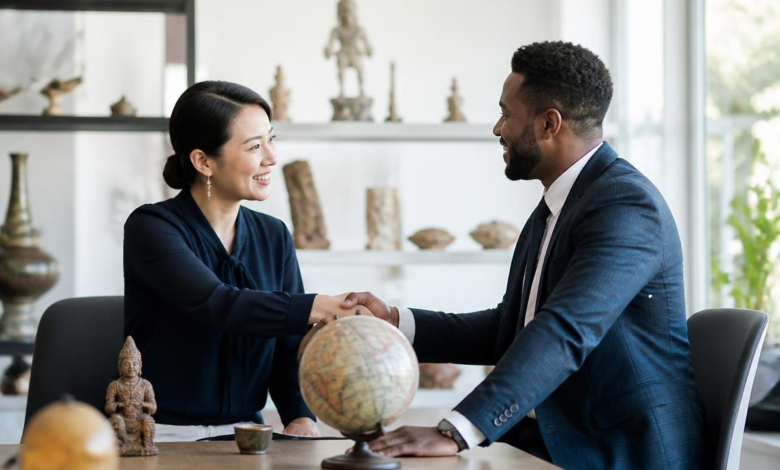
Global etiquette often presents a complex puzzle. Customs like a bow, a handshake, or a kiss on the cheek are not random occurrences. Instead, the history of etiquette reveals profound connections to power, religion, trade, family structures, and even survival.
When exploring the diverse nature of manners, their origins often trace back through time. Understanding how history shapes global etiquette helps us see present-day customs as reflections of past social landscapes. This perspective shifts etiquette from a list of rules to an interpretation of historical human behavior.
This historical lens offers practical benefits. For those who observe gestures during travel, our companion guide on essential non-verbal cues for global travelers provides deeper insights. Non-verbal habits frequently retain historical meanings, even as their initial contexts evolve.
The Enduring Influence of History on Global Etiquette
The history of global etiquette is not a straightforward progression from ancient to modern. It’s a rich tapestry woven from ancient beliefs, courtly rituals, colonial influences, industrial discipline, and digital communication. Each layer leaves unique traces, with some customs evolving while others solidify into national symbols.
Even a simple greeting can illuminate centuries of social transformation. Acts like bowing, handshakes, avoiding touch, removing shoes, or using formal titles often reflect fundamental assumptions about respect, hierarchy, purity, safety, or intimacy. These are not arbitrary choices, but rather instances of cultural etiquette evolution shaped by historical experiences.
For contemporary audiences, this historical viewpoint offers dual benefits. Firstly, it mitigates judgment by providing context instead of stereotypes. Secondly, it enhances communication, as comprehending the historical roots of modern etiquette encourages patient, informed responses rather than surprise.
Ancient Civilizations: Pioneering Social Codes
Long before contemporary global interactions, ancient societies established intricate behavioral rules. Numerous ancient civilizations’ etiquette practices aimed to maintain order, honor leaders, safeguard community ties, and clearly define an individual’s societal role.
Egyptian Protocols: Deference and Hierarchy
In ancient Egypt, etiquette directly mirrored social rank. Society was profoundly hierarchical, and behavior often communicated one’s relationship to divine, royal, or administrative authority. Deference to superiors was not mere politeness; it was crucial for upholding cosmic and political stability.
This ancient link between manners and hierarchy persists globally today. Formal greetings, precise titles, and overt respect for senior individuals often echo systems where societal stability relied on clearly delineated roles.
Roman Customs: Public Life and Private Interactions
Roman society highly valued status, reputation, and public performance. Banquets, legal settings, and household visits all required specific forms of speech and conduct. While hospitality was important, so were outward display, personal influence, and managing appearances.
Contemporary dining rituals retain elements from these historical patterns. Seating, host-guest dynamics, and the concept that meals convey power alongside camaraderie all reflect a lengthy evolution of social customs. For insights into meal meanings, consider immersive culinary experiences through global cooking classes.
Confucian Principles: Harmony in East Asia
Few traditions have shaped East Asian etiquette as profoundly as Confucian thought. Its values stressed harmony, elder respect, proper conduct, and relational awareness. Etiquette thus transcended mere social convenience, becoming a deeply moral practice.
This legacy persists in address forms, gift-giving, seating protocols, group sensitivity, and indirect communication. In the context of cross-cultural communication history, Confucianism elucidates why preserving harmony often surpasses direct self-expression in various settings.
Medieval & Renaissance Europe: Formal Protocol Emerges
While ancient societies laid social groundwork, medieval and Renaissance Europe honed etiquette into distinct formal systems. Courts, noble families, and religious bodies molded behaviors that continue to inform Western concepts of refinement and protocol today.
Courtly Love and Chivalry: Shaping Elite Behavior
Chivalric culture fostered restraint, measured speech, ritualized courtesy, and symbolic expressions of respect. Despite a often harsh medieval reality, courtly ideals helped delineate ‘civilized’ elite conduct.
This era significantly advanced medieval European social graces, subsequently disseminated through manuals, education, and emulation. The expectation for refined individuals to manage emotions, speak tactfully, and elegantly display respect largely originates from these aristocratic environments.
The Rise of Dining Etiquette and Table Manners
European dining etiquette formalized as elite households viewed the table as a realm of discipline and identity. Rules for utensils, posture, serving, and conversation distinguished the ‘cultivated.’ These standards gradually expanded beyond courtly circles into wider society.
This clarifies why table manners often carry moral weight beyond mere practicality. Across cultures, dining tables serve as stages where class history endures through subtle habits. For a practical complement, explore a global guide to local gratuity etiquette, illustrating diverse dining norms worldwide.
Colonialism, Trade & Exploration: Global Etiquette
Discussions on the international manners historical context must include trade and empire. Merchants, missionaries, diplomats, and colonizers disseminated not only goods but also expectations regarding dress, speech, punctuality, hospitality, and bodily conduct.
The Silk Road’s Influence on Greetings
The Silk Road transcended a mere trade route; it served as a conduit for cultural exchange. Travelers learned to approach strangers, exchange gifts, build trust, and show respect across linguistic divides. Greetings frequently evolved into hybrid forms, adapting to local customs and foreign interactions.
This historical aspect is crucial because etiquette often emerges at points of contact. People establish rituals to mitigate risk and enhance predictability. Thus, etiquette across cultures through history also narrates the management of uncertainty when disparate worlds converge.
European Expansion: Imposing and Adapting Norms
European colonial expansion brought strong assumptions about ‘proper’ behavior. Western dress, handshakes, dining styles, and administrative etiquette spread across Africa, Asia, and the Americas. Often, indigenous practices were suppressed, ridiculed, or relegated to private spheres.
However, colonialism did not solely result in one-way imitation. Local societies adapted, resisted, and reconfigured foreign norms. The enduring colonialism impact on global manners is evident in multilingual politeness, mixed dress expectations, and the blend of Western protocol with profound local customs.
This underscores the importance of respectful travel. Our article on ethical tourism and supporting local communities examines how visitors can prevent perpetuating historical unequal cultural dynamics.
Industrial Age to Modernity: Rapid Transformations
Industrialization reshaped etiquette by transforming daily life. With urban growth and increased stranger interactions, societies required new rules for privacy, public conduct, punctuality, noise, queuing, and professional behavior. Etiquette transitioned from courtly to urban forms.
Urbanization and New Public Conduct Rules
In bustling cities, manners minimized social friction. People learned appropriate times to speak, wait, and regulate behavior in public spaces, including transport, and how to share space with strangers. Many now-ordinary habits arose from modern urban living.
Today, local transport etiquette still reveals much about history. Silence on trains in some regions signifies respect for shared space, while elsewhere, conversation feels natural. These distinctions are better understood through the lens of urban history, not just individual preference.
World Wars and Diplomatic Etiquette Evolution
The World Wars profoundly altered alliances, identities, and official protocol. Post-conflict, international diplomacy necessitated standardized forms of address, ceremony, and negotiation. This era significantly shaped the 20th century changes in international protocol, evident in current summits, embassies, and multinational bodies.
Contemporary diplomatic conduct also embodies symbolic lessons. Seating arrangements, flag positioning, interpreter utilization, and greeting styles can convey political significance beyond mere manners. Historical precedent remains vital, as illustrated by resources from organizations like UNESCO.
Globalization’s Impact on Etiquette
Globalization has fostered a partially shared etiquette, particularly in airports, hotels, international schools, and multinational corporations. Email politeness, business attire, and conference behavior often exhibit common patterns. Nevertheless, local expectations retain significant importance.
This dynamic highlights the utility of understanding modern business etiquette through history. While a ‘global standard’ might appear superficial, it often masks deeper historical values concerning authority, time, gender, hospitality, and trust. Misunderstandings arise from assuming the surface reveals everything.
Understanding Today’s Global Etiquette Historically
Examining modern etiquette historically does not imply cultural stagnation. Customs are constantly evolving. However, historical awareness clarifies why certain behaviors are perceived as respectful in one context, yet cold, intrusive, or careless in another.
Case Study: Japan’s Bowing Culture
Japanese bowing reflects centuries of hierarchy, discipline, and relational awareness, molded by court culture, warrior codes, and Confucian ethics. The precise angle and context of a bow can signify gratitude, apology, greeting, or deference.
While bowing may seem straightforward to outsiders, it’s part of a wider system of role-conscious behavior. It closely intertwines with silence, personal space, and nuanced non-verbal communication, making historical context vital for its interpretation.
Case Study: French Dining Etiquette
French dining etiquette embodies aristocratic refinement, later influenced by bourgeois culture and national culinary pride. Meals are often structured social experiences, emphasizing pacing, presentation, and conversation.
These habits extend beyond mere luxury. They reflect a long-held belief that the dining table is a space of culture and identity. For travelers, this historical understanding can transform restaurant experiences into something less daunting and more meaningful.
Case Study: Middle Eastern Hospitality
Hospitality in much of the Middle East stems from tribal survival patterns, religious ethics, and family honor. Generously welcoming guests was historically a moral imperative, and in challenging environments, sometimes crucial for survival.
This legacy endures in tea and coffee rituals, the emphasis on food sharing, and the symbolic value of guest reception. Informed visitors are better equipped to respond graciously. Understanding local customs is key for respectful behavior in culturally significant spaces.
Navigating the Future: Digital & Diverse World Etiquette
Contemporary etiquette is influenced by video calls, instant messaging, migration, tourism, and diverse workplaces. Remarkably, even digital habits show historical roots. Some cultures favor formal email greetings, while others swiftly adopt first names and concise messages.
This is precisely where the cultural anthropology of manners gains prominence. Etiquette is dynamic, not static. It adapts to technological advancements while retaining foundational ideas about social standing, respect, authority, and belonging.
Practical Lessons from Etiquette History
A few practical lessons emerge from this extensive history:
It is wise to inquire before assuming any custom is universally understood or accepted.
Observe whether emphasis is placed on hierarchy or on principles of equality in interactions.
Recognize meals, greetings, and silence as significant cultural signals, conveying deeper meanings.
Differentiate between formal, official protocols and informal, everyday local practices.
Acquire sufficient historical knowledge to transform discomfort into genuine curiosity.
Travelers and professionals adopting this approach tend to communicate more effectively. They avoid perceiving etiquette as merely a collection of peculiar rules, instead recognizing it as historical memory actively shaping behavior.
For those intrigued, exploring how respectful interaction builds trust across borders offers further insights. This adaptable mindset applies equally, whether entering a boardroom, a family home, or a casual neighborhood café.
Conclusion: The Timeless Relevance of Historical Etiquette
The most profound insight from global etiquette history is straightforward: manners are seldom arbitrary. They are sculpted by ancient authority, religious doctrines, trade routes, aristocratic ideals, colonial interactions, industrial discipline, and modern globalization.
Once we grasp the historical roots of modern etiquette, contemporary differences become clearer. A simple greeting, a conversational pause, a seating arrangement, or a hospitality ritual can unveil centuries of cross-cultural communication history beneath the surface.
For travelers, expatriates, students, and international professionals, this knowledge offers a distinct advantage. It cultivates humility, enhances communication, and deepens cultural intelligence. In our interconnected world, understanding etiquette’s origins is a powerful way to demonstrate present-day respect.
Consider: how has history influenced your own cultural interactions? Explore additional content on global customs, travel behavior, and respectful communication to further enhance your understanding of the world.