
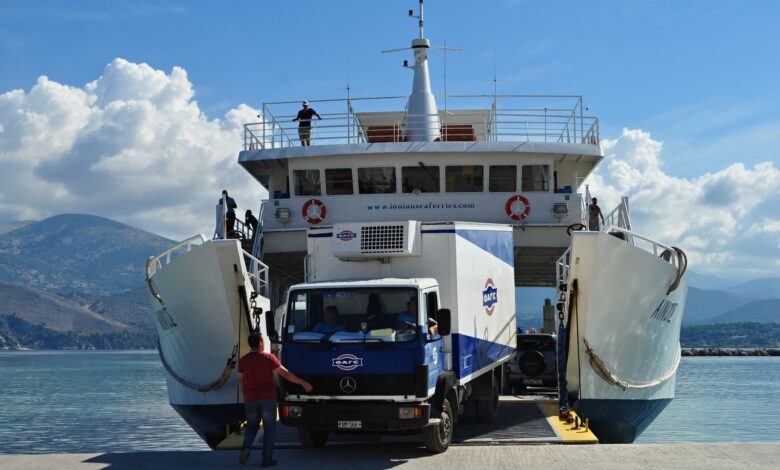
Almost everyone taking a ferry from Athens to Santorini should leave from Piraeus, and every sailing on the route ties up at the same island dock, Athinios. The real decision is which boat — and the honest answer is to compare the actual crossing time on your own date, because the fast one is not always much faster. For sailings on 21 September 2026, Ferryhopper’s route timetable listed a five-hour high-speed crossing and a seven-hour-forty-five conventional one on the same morning, then two afternoon departures whose crossing times were ten minutes apart.
Speed is not the only thing you trade, either. A large conventional ship handles wind better and lets you stand outside on deck, while a high-speed boat keeps you in an assigned seat and is the first service to drop when the Aegean turns rough. And with some companies the payment isn’t the last step, because the confirmation sitting in your inbox still has to become a boarding pass before anyone waves you up the ramp. Before you compare prices, it pays to know what the port names on the booking screen actually mean.
What the Athens–Santorini Ferry Route Actually Includes
Search this crossing and the results come back under four or five different names. The destination shows up as Santorini on one engine, Thira on another, Athinios or New Port on a third. They all point at the same working quay on the island’s south-west coast: every passenger ferry from the mainland ties up at Athinios, because Santorini’s other harbour, the Old Port below Fira, handles cruise tenders and excursion boats only. Nothing on this page is fixed, either — schedules, fares and island bus times were checked on 20 September 2026 and are set by the ferry companies and by Santorini’s own bus operator, any of whom can change them, so the page that governs your sailing is always the operator’s own.
At the Athens end there are two possible ports instead of one, and that is the only genuine fork in the route. Piraeus carries the service all year and takes the overwhelming majority of sailings; Rafina has a seasonal high-speed link that only exists for part of the year. Whether that matters to you depends entirely on where you start your travel day, which is the next section’s job.
Why does one route have no single crossing time?
Because there is no such thing as the Athens–Santorini ferry. Booking engines are honest about the spread and then bury it: Direct Ferries lists the same route under three companies with published crossing times of roughly 5 hr 35 min, 7 hr 45 min and 10 hr 35 min, and its own route guide flattens all of that into an average of about six and a half hours. Nobody sails the average.
Two separate things stretch the clock. Hull class sets the floor — high-speed craft are built to cross in around five hours and large conventional ships are not — but it does not set the ceiling, because a conventional ferry’s time also depends on how many Cycladic islands that particular sailing calls at on the way south. More stops means a longer day and more chances to fall behind, as the port-and-route guidance on Santorini Dave spells out. That is why the operator’s name tells you much less than you think: on the 21 September 2026 listing, one Blue Star departure was timetabled at 7 hr 45 min and another Blue Star departure the same day at 6 hr 20 min.
The same logic governs the money. A deck seat on a slow conventional ship and a business seat on a high-speed one are different products at very different prices, so any single figure you have seen quoted for this crossing describes one of them and not the other.
That spread is also the real answer to whether the ferry is the best way to get from Athens to Santorini. It is not, if what you are optimising is clock time — the flight is under an hour in the air. What the ferry competes on is the rest of the journey: Piraeus sits closer to central Athens than the airport does, you carry your own bags on board instead of checking them, and on a conventional ship you can stand on an open deck as the caldera comes into view. Two nights on the island and an afternoon landing at Athens airport? Fly. A free day and real luggage? The ferry stops looking slow.
So what you are buying is one sea crossing to one dock, sold by several companies, on ships that move at different speeds and stop in different places. Read every search result as three facts rather than one price — which Athens port it leaves from, how long that specific sailing takes, and what class of ship it is. The first of those three is the one you can settle before you look at a single timetable.
Piraeus or Rafina: Which Departure Port Fits Your Day
For this crossing the answer is Piraeus, and it is not close. There is an exception, but it is far narrower than most Athens ferry guides make it sound, and the reason has nothing to do with distance.
The advice you meet everywhere is that Rafina is the port for people arriving at Athens airport: it sits on the same side of Attica, so you skip the drive across the city. As general Cyclades guidance that is sound — Rafina is the natural gateway to Mykonos, Tinos and Andros. Applied to Santorini it runs straight into the timetable. On Direct Ferries’ Rafina–Santorini page, checked on 20 September 2026, the route was showing a single Golden Star Ferries departure at 07:20, listed as both the first and the last sailing of the day, around six times a week and explicitly subject to seasonal change.
Hold that against a flight arrival and the exception closes itself. A 07:20 boat has to be caught by someone who is already in Rafina, because airport metro service does not start much before half past six and the regional bus runs on a seasonal schedule. Land in the afternoon and there is no later Rafina sailing to fall back on. By contrast, a ferry from Piraeus to Santorini left roughly 29 times a week across three companies on the same site’s Piraeus listing, from about 07:00 until the early evening. Frequency is the whole argument here: a port with one departure a day gives you no second chance, and a port with four gives you several.
How long does it actually take to reach Piraeus?
From central Athens, not long. Metro Line 3 runs Syntagma to Piraeus in roughly 22 to 25 minutes, and Line 1 or Line 3 covers Monastiraki to Piraeus in about 20 to 25, on Santorini Dave’s figures, updated in August 2026. A taxi does the same trip in anywhere from 25 to 50 minutes depending on traffic — and that gap, not the average, is the thing worth planning around.
From the airport the arithmetic changes. The same guide puts Metro Line 3 at about 60 minutes to Piraeus at €9, with airport trains every 30 minutes and airport service running roughly 06:30 to 23:30; the X96 bus at 60 to 90 minutes for €5.50, around the clock; and a taxi at 40 to 75 minutes for €55 to €75, with no flat fare on this stretch because the fixed airport rate only covers the central ring.
Those numbers are the easy part. What catches people is the buffer they leave on top. In an r/GreeceTravel thread posted about a year before this was checked, someone landing at 06:00 with a 09:15 sailing from Piraeus was urged by commenters not to take a taxi into the morning rush; they moved to a later boat anyway, cleared the airport around 07:15, reached the port by 08:30 on the metro, and wrote afterwards that they could have made the original ferry — “We got lucky that all the timing worked out in our favor.” The mechanism behind that advice is unglamorous: the train’s journey time is fixed and its departures are half an hour apart, so missing one costs you thirty minutes, while a bad traffic morning on the same road can cost you two hours.
So the decision is smaller than it first appears. Sleeping in Athens the night before? Search Piraeus and stop thinking about it. Flying in and hoping to sail the same day? Put your actual travel date into a schedule search with Rafina as the departure port before you build anything around it — if nothing comes back, or the only result leaves at breakfast time, that is your answer, and Piraeus with a generous buffer is the plan. Either way, the port is settled. The ship is not.
Blue Star vs SeaJets: Conventional, High-Speed, and When Slower Wins
Three companies run the Piraeus crossing, and they are not really selling the same product. One sells hours back to you. One sells a ship you can walk around. One sells the lowest fare and takes most of your day for it. The trick is knowing which of those you actually need on the date you are travelling, because the gap between them narrows and widens from sailing to sailing.
Here is how the three compared on the Piraeus–Santorini listings checked on 20 September 2026, with crossing times and starting fares taken from the published schedules for September through December of that year.
| Ship and port | Crossing time | Economy fare from | What you give up |
|---|---|---|---|
| Blue Star, conventional, Piraeus | about 5 hr 40 min to 7 hr 45 min | about €46.50–€59 | up to two hours against the quickest jet; unreserved seating fills up |
| SeaJets, high-speed, Piraeus | about 5 hr to 6 hr 10 min | about €82.70–€89.70 | roughly double the fare and no usable open deck |
| Fast Ferries, conventional, Piraeus | about 10 hr 30 min | about €48 | most of a day, and the most island stops |
Read the first two rows together and the usual framing falls apart. The premium for SeaJets is close to the fare again, and what it buys on a good day is around an hour and a half — sometimes far less, as the intro’s ten-minute pair showed. That is a clean trade if your Santorini stay is short and every hour of daylight counts. It is a poor one if you were mainly buying the word “fast.” The third row is the honest budget option and the one most people should think twice about: a Fast Ferries sailing can cost barely more than Blue Star and still put you at Athinios near midnight. Worth knowing too: the company books as Fast Ferries on its own site, but several search engines list the identical sailings under Cyclades Fast Ferries, so check the ship name rather than the brand if you think you are comparing two options.
Why the same crossing feels different to two people
Hull size changes the odds of a rough ride. It does not decide one. Large conventional ships sit deeper and roll more slowly than a high-speed catamaran, which is why the standard advice points motion-sensitive travellers at the biggest available ferry — and on the same r/GreeceTravel discussion from about four weeks before this was checked, one person described having “just spent 4hrs vomiting from Athens to Naxos on SeaJets.”
The same thread is the reason to distrust any flat rule. Another traveller, self-described as prone to seasickness, took a large SeaJets vessel on the same route and was fine; another said flatly that they “felt way more sick on the big slow ferry than the small fast one.” What those accounts have in common is not the company. It is the sea state on the day and the size of that specific hull, which is why SeaJets’ own fleet spans very different boats and a booking that says “high-speed” tells you almost nothing about how it will ride. If this matters to you, the useful move is to look up the vessel name in your search result rather than the operator, and pick the longest ship going. Whether to take anything for motion sickness is a question for a pharmacist or a doctor, not for a travel guide.
Strong wind does more than make people uncomfortable — it decides whether some of these boats sail at all. That belongs to the later section on booking timing, because it changes what you should do months before you board, not which seat you pick.
Which seat you are actually buying
On a conventional ship, the fare classes are genuinely different experiences rather than upgrades. An economy deck ticket is unreserved: you sit wherever there is room, indoors or out, and you can use the whole ship. A numbered airplane-type seat is reserved in your name, with luggage racks near the garage entrance. Business and VIP put you in a restricted upper-deck lounge with its own bar. That taxonomy is set out on Go-Ferry’s Blue Star guide, and it is the reason a reserved seat is worth more on this route than on a short hop: six hours in an unreserved lounge in August is a different day from six hours in a seat with your name on it.
Cabins are the one upgrade that is easy to buy for the wrong reason. They earn their cost on an overnight or a very late sailing, where the alternative is arriving at Athinios exhausted after dark. On a 07:25 morning departure they mostly buy you a room you will not use. A high-speed ferry from Athens to Santorini does not offer them at all, and the trade there is the opposite one: an assigned indoor seat for the whole crossing, no deck to escape to, and the caldera approach seen through a window.
So the decision is a two-parter. Work out whether the time saving on your specific date is genuinely worth the premium, then work out whether you want to be outside for the last half hour. Once you have a sailing in mind, the next problem is the one that actually strands people at the port: turning a payment into something the crew will scan.
How Athens–Santorini Ferry Tickets and Boarding Passes Actually Work
Paying for the crossing does not produce the thing the crew scans. What arrives at purchase is a reservation — a booking reference, a sailing, a fare — and on the Greek operators running this route that email is not what gets you up the ramp. Ferryhopper’s help pages say it about as plainly as a booking site can: the confirmation email “is not your e-ticket.” The document you actually board with is issued later, by the ferry company itself, in a window that only opens two days before you sail.
That window is the single most useful thing to know about this route. Blue Star states that its web check-in runs from 48 hours up to 2 hours before scheduled departure. SeaJets publishes the same window on its own check-in site. Fast Ferries runs a check-in page on the same pattern. All three were checked on 20 September 2026, and the convergence is genuinely useful: one rule covers whichever boat you settled on in the last section.
What each company asks you to type in differs just enough to catch people out. Blue Star’s form wants a reservation number and a separate access code. SeaJets and Fast Ferries both want the booking reference plus either a passenger surname or the phone number on the booking. Dig those out of the confirmation email before the window opens rather than at the port, because a mistyped email address at purchase is one of the few mistakes here that is genuinely hard to undo.
What you are actually holding at the ramp
The output is a boarding pass with a QR code, and the naming is where the confusion starts. SeaJets calls it an e-ticket in some places and a boarding pass in others; a traveller on the Tripadvisor Cyclades forum worked through exactly this, finding the check-in page greyed out ahead of the window and eventually concluding that “the e-ticket Seajets refer to is actually the boarding pass.” They are the same document. If your operator’s site offers you one and not the other, you have not missed a step.
A phone screen is fine. SeaJets says a successful check-in delivers the pass by email or as a mobile boarding pass, and Fast Ferries tells passengers they can simply have the tickets available on the phone. One practical refinement from the same forum thread is better than it sounds: open the QR code, enlarge it, and screenshot it so it sits in your photo gallery instead of four taps deep in an email attachment you are opening one-handed in a queue. Bring your ID as well — Fast Ferries states that an ID card or passport is necessary at all times, and this is an operator condition rather than any kind of border check, since Piraeus to Santorini never leaves Greece.
Two failure modes are worth planning around. If you check in but the pass never arrives — a typo in the email address, a spam filter, a company that only lets you check in once — Ferryhopper’s guidance is unambiguous: you will need to collect a printed copy or you will not board. The same fallback applies if you sail through the two-hour cutoff without checking in. Every operator keeps ticket offices at the departure port for exactly this, and on the Tripadvisor thread a Destination Expert noted that having prebooked tickets printed at a desk typically costs “an extra fee of 1 or 2 €.” That is a trivial sum and a non-trivial queue in August, which is the real cost.
None of this changes on the way home. A ferry from Santorini to Athens runs on the same reservation-then-check-in mechanics, with one asymmetry worth respecting: Athinios has far fewer ticket desks than Piraeus, and they get busy when several departures cluster. Check in from your hotel the night before rather than from the port. With the pass on your phone, the remaining problem is physical — finding the right berth in a port the size of a small city.
Getting to the Port, Finding Your Gate, and Boarding
Plan to be at Piraeus 45 to 60 minutes before departure, and understand what that time is actually for. It is not queueing time in the airport sense — there is no security theatre and no bag drop. It is walking time. Piraeus is a working commercial port rather than a terminal building, the berths are spread along kilometres of quay, and the single most common way to miss a Greek ferry is to arrive on time at the wrong end of it. Thirty minutes is enough if you have done it before and already know your berth; first-timers should take the hour, on the port guidance published by Santorini Dave and updated on 25 August 2026.
Why “the Santorini gate” is the wrong thing to search for
Berths are assigned to ships, not to destinations, and this is where most guides quietly mislead people. Blue Star’s own Piraeus port map, checked on 20 September 2026, shows the company running Santorini sailings from two completely different parts of the port: Blue Star Chios departs for Santorini from Gate E1, while Blue Star Naxos and Blue Star Delos serve Paros, Naxos, Ios and Santorini from Gates E6 and E7. Same company, same island, gates at opposite ends of the quay.
The same map is a useful check on advice you will meet elsewhere. Several popular guides name a single fixed gate for Santorini — E9 is the usual candidate — but on Blue Star’s own map E9 is where its Aero high-speed boats leave for the Saronic Gulf, for Aegina, Poros, Hydra and Spetses. A guide naming one permanent Santorini gate has photographed one operator’s berth on one day and called it a rule. Your own ticket is the authority: the e-ticket you generated at check-in prints the departure gate for your specific sailing, and the electronic boards at the port carry the final word if a ship is reassigned, which happens most in high summer.
Getting from the metro to the right quay
Piraeus station sits directly opposite the main port entrance, near gates E5 and E6, reached by a pedestrian overpass with lifts at both ends. That geography decides how easy your walk is. E6 and E7 are close enough that most people simply walk; E9 and E10 are further but manageable; E1, E2 and E3 are far enough that hauling suitcases there on foot is a genuinely bad plan. The port runs a free shuttle between the main passenger areas for exactly this reason, and taxis are allowed inside the port and can drop you close to your ship — worth the fare if you are travelling with heavy bags, small children, or a tight connection.
Boarding itself is refreshingly low-ceremony. You walk up the vehicle ramp at the stern alongside cars and lorries, a crew member scans the QR code on your phone, and you are on. Wheeled luggage goes on the racks just inside the garage entrance rather than to your seat, which is standard practice and saves you dragging a case up several flights of stairs — take anything valuable, anything you want on the crossing, and your documents up with you, because the vehicle deck is closed and unreachable once the ship sails. If you want to confirm which ships are working which berths before you set off, the Piraeus Port Authority publishes its own arrivals and departures board.
Keep 15 minutes of that buffer in reserve for the last stretch. Boarding usually closes a little before the advertised departure time, the ramp is busy with vehicles, and the walk from the port entrance to a distant berth takes longer with luggage than the map suggests. Once you are aboard and moving, the next thing worth having settled is what happens when the ship ties up at the other end — because Athinios is not a place you want to improvise.
After You Dock at Athinios: Bus, Taxi, or Pre-Booked Transfer
Decide how you are leaving Athinios before you sail, because the port gives you no good way to improvise. It is a working quay wedged under a cliff, with a switchback road as the only way out and no town attached to it. The island bus company’s own price list puts the Fira–Athinios run at 18 km, which settles the question people quietly wonder about: you are not walking anywhere from this port.
The cheapest exit is the public bus, and it is genuinely good value. On the KTEL Santorini price list, last updated on 19 May 2026, the port-to-Fira fare is €2.70, with the same €2.70 in the other direction. Coming from elsewhere on the island the fares are lower still — Messaria, Karterados and Perissa to the port all sit at €2.20 on the same list. Buses pull up on the quay itself, and you pay the conductor on board rather than buying ahead, but the climb out is slow going — 18 km of switchbacks rather than a straight run. One figure worth noting if you are on a late sailing: the same price list applies a 25% night supplement between 00:30 and 05:00, which turns the €2.70 into €3.40.
The catch is capacity, not price. A large conventional ferry unloads a great many people onto one small quay at once, and the buses meeting it are not sized for all of them to board the first departure. If you are travelling with heavy luggage, small children, or anyone who cannot stand in a crowded aisle on a winding road, treat the bus as a good option that you might not get onto immediately.
If you dock after dark
This is where an arrival plan stops being optional. KTEL’s published summer timetable, last updated on 18 May 2026, runs Fira to Oia roughly every half hour with a final departure at 21:00. A Fast Ferries sailing of around ten and a half hours out of Piraeus can dock late in the evening, and if your hotel is in Oia you may reach Fira only to find the connecting bus has finished for the night. The timetable also publishes fixed clock departures for the village routes but no equivalent clock schedule for the port itself, because port departures are built around ferry arrivals rather than a published hourly pattern — so the bus you catch depends on when your ship actually ties up, not on when it was supposed to.
Taxis are the obvious fallback and the least reliable one. Santorini runs a famously small licensed fleet — commonly reported by travellers as fewer than about forty cabs for the entire island — against a summer arrival pattern that concentrates thousands of people at one quay within a few minutes. Queues at Athinios after a big ferry are long, and the wait is worst exactly when you most want it to be short.
That leaves a pre-booked transfer, and here we should be straightforward about our own position: Happy Day Turismo is a travel agency and arranges private transfers, so treat this as a recommendation with a commercial interest attached. It is worth the money in specific circumstances — a late-evening arrival, a party with several suitcases, a hotel in Oia or Imerovigli, or anyone travelling with reduced mobility — because a named driver waiting on the quay removes the only genuinely stressful part of the day. It is a poor use of money in others. If you are arriving on a morning or early-afternoon sailing, travelling light, and staying in or near Fira, the €2.70 bus does the same job for a fraction of the cost, and booking a transfer for that trip buys you very little. You can also book a transfer directly with a local operator rather than through any agency, and the price is often much the same.
Whichever you choose, arrange it before you leave Athens. Which raises the question the whole plan actually rests on: how far ahead should you have booked any of this, and what happens when the weather decides your ferry is not sailing at all?
When to Book, What Sells Out, and What Wind Does to Fast Ferries
For a June-to-September crossing, book two to three months out. That is the window Go-Ferry’s Greek ferry guide, published on 7 July 2026, gives for peak-season travel on popular routes including Athens to Santorini, and it is the right instinct for a different reason than most people assume. You are not racing to get a seat on the boat. You are racing for the specific product you want on the boat.
What sells out, and in what order
The order is the useful part. Economy deck tickets on the big conventional ships rarely sell out, because those vessels are big and their unreserved lounges absorb the overflow. What disappears first is everything else: cabins go earliest, then vehicle spaces, then high-speed seats, and the same guide notes that early-bird discounts on this route often vanish by the end of February. In August it suggests booking a cabin as much as four months ahead.
Read that against the choice you made earlier and the planning becomes concrete. If you settled on a conventional Blue Star sailing in a deck-class seat, leaving the booking until a few weeks out is a survivable mistake. If you want a reserved seat, a cabin for a late arrival, or a place on one of the quicker jets in August, the gap between booking in February and booking in June is the difference between having the option and not.
What actually happens when the wind wins
The decision is not made by the ferry company, and this is the part almost every guide leaves out. Greek port authorities can impose a sailing ban, and when they do it applies to a whole area rather than to one operator’s timetable. A traveller on r/GreeceTravel posted the notice they had received on a September morning about a year before this was checked, quoting the operator’s wording that “a sailing ban has been imposed today, September 19th, for the entire Aegean Sea, including the Cyclades, due to adverse weather conditions.”
Vessel class changes your odds, and only your odds. Smaller high-speed craft reach their operating limit in lower winds than a large conventional ferry, which is the mechanism behind the standard advice to book Blue Star if your itinerary is fragile; the Go-Ferry guide puts the sailing-ban threshold in the region of 8 to 9 on the Beaufort scale and notes that catamarans are affected before the big ships. But the same discussion carries the correction that makes the advice honest. As one commenter put it, “Even Blue Star ferries can be cancelled or delayed in adverse weather, because docking can be tricky in some ports due to wind and currents. Less likely, yes, but always possible.” Another traveller in the thread pushed back on the pile-on entirely, saying they had used SeaJets repeatedly without trouble. Both are right: choosing a big ship buys you a better probability, not a guarantee, and no booking decision makes you weatherproof.
What does protect you is slack in the itinerary. Never schedule the Santorini–Athens leg for the same day as an international flight home; put a night in Athens between them. If a ban does hit, affected tickets are normally eligible for a refund or rebooking onto the next available sailing, so the money is usually recoverable even when the day is not. One date to avoid outright if you have any flexibility is 1 May, which the Piraeus port guidance cited earlier flags for ferry and public-transport strikes.
Your booking checklist
Run through these seven before you pay, in this order:
- Fix the date and check the specific sailing, not the route average — crossing times on this route range from about five hours to more than ten.
- Choose the vessel class deliberately. Conventional for stability, deck access and weather resilience; high-speed only where the time saving on your actual date justifies roughly double the fare.
- Book two to three months ahead for June–September, and earlier still if you need a cabin, a vehicle space or a reserved seat in August.
- Confirm the Athens port on the booking, since “Athens” in most search engines means Piraeus and a Rafina sailing may not exist on your date.
- Complete the operator’s web check-in in the 48-hours-to-2-hours window and save the QR boarding pass to your phone — the payment confirmation alone will not board you.
- Plan to reach the port 45 to 60 minutes before departure, or 60 to 90 minutes if you are bringing a vehicle, and check your gate on the e-ticket and again on the port screens.
- Arrange your exit from Athinios before you sail, and if you are heading to Oia on a late ferry, check the last connecting bus of the evening before you rely on it.
Antes de Fechar a Reserva
Everything in this guide reduces to one step that has a deadline attached to it. You can pick the right port, the right ship and the right seat, and still be turned away at the ramp because the email in your hand is a reservation rather than a boarding pass. Once the sailing is booked, set a reminder for the day before you travel, complete the ferry company’s own web check-in inside its 48-hours-to-2-hours window, and save the QR code somewhere you can find it one-handed in a queue. Do that, and the rest of the day is just a boat ride.
Frequently asked questions
Do ferries from Athens to Santorini run in winter?
Ferries from Athens to Santorini run year-round, but the winter timetable thins out sharply. Go-Ferry’s guide lists roughly three to four weekly departures in the off-season, against daily conventional and high-speed sailings from April to October. Check your specific date rather than assuming a daily service.
Can I take a car or a motorbike on the ferry?
You can carry a vehicle on the conventional ships and most large high-speed vessels, but garage spaces are strictly limited and need booking well ahead alongside your passenger ticket. Present the vehicle at the port gate 60 to 90 minutes before departure rather than the usual 45.
Where can I leave bags in Piraeus before a late ferry?
Staffed luggage-storage services sit around the Piraeus metro and railway station, a few minutes from the passenger port — the usual answer for anyone checking out of an Athens hotel at noon for an evening sailing. Book ahead in summer and check the closing time first.
