
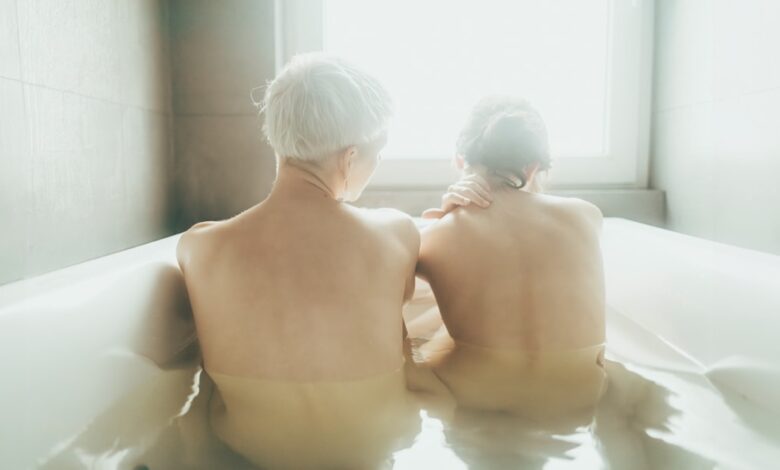
Most onsen visits in Japan follow a similar pattern: complete undress, clean yourself while seated beside the bath, soak with your towel and hair above the water line, then dry off before entering the changing room. This aspect of onsen etiquette is fairly uniform. Tanabe City’s tourism bureau outlines four primary steps and, following that, provides a reminder of a few things that differ between locations.
Most onsen etiquette is learned once and is relatively consistent across the board. However, the onsen protocols that will spoil your first experience are specific to that site and will not be answered by any general guide. For example, whether tattoos are acceptable at a particular bath, whether a bathing suit qualifies as a clothing item, whether the bathhouse sells towels or provides them free of charge, and whether the washing area includes showers. Each of these factors will differ based upon the facility’s policies and can be verified prior to your visit. There are only four questions that will cover the majority of what you need to know, and those can all be included in a single e-mail.
Before Your First Onsen: Check Tattoos, Bath Options and What to Bring
Hakone Kowakien Yunessun published three different responses concerning if you can bathe at its facility if you have tattoos, which may all be right because these are for three distinct portions within the same facility. According to the published FAQs of Hakone Kowakien Yunessun, as a general rule, guests with tattoos cannot use its facilities; however, if a guest chooses to wear a rash guard, they may use the swimsuit zone; however, guests who wish to use the Mori no Yu must cover their tattoos with two tattoo stickers/patches and have access to eight private baths exclusively as an alternative. It is not a uniquely overwhelming facility, and “look up the facility’s policy” is a solid source of comparison after checking out an actual facility’s policy.
Everything stated in this section was verified directly through the various facilities’ sites in September 2026, therefore, every facility sets its own specific guidelines; thus, please ensure that you contact the facility directly for confirmation on your specific situation before making your booking.
Select the actual type of bath that you will use, all other answers will rely on that selection. A communal bath is the standard option; typically shared water between men and women, no clothing required before entering. A Private Bath, more commonly called kashikiri (meaning “for your own use only”), is a room that you reserve for a specific time at the facility. Japan’s National Tourism Organisation lists Private Baths separately as two different choices in terms of participation, not merely as an option for consolation if you cannot access the communal bath. A third option is a Swimsuit Area, which is totally different from either type of bathing. For example, at the Hakone Yuryo facility, the guide for visitors makes it clear that guests are not allowed to wear swimsuits inside the tubs. Conversely, Yunessun operates a separate Swimsuit Area, requiring a separate ticket for entry, away from the nude bathing area. Therefore, both facilities are located within an hour of each other but offer two opposing positions on what you can access while bathing at their facilities currently.
Therefore, the only meaning a tattoo can convey, is that it was attached to a specific bath. As of April 1, 2025, Hakone Yuryo will no longer be enforcing any tattoo policies, therefore, you will have no issues hiding a tattoo, nor will you have to explain anything while going there. Each zone at Yunessun has different tattoo policies, and whether or not you will be able to hide your tattoo will depend on which zone you purchased your ticket for. In addition, hiding your tattoo does not guarantee you will be allowed entrance to any bath; for example, in a popular r/JapanTravelTips thread from 2025, a user with experience living in Japan stated that there are several onsen (Japanese hot springs) that flat-out prohibit the use of tattoos or stickers to cover tattoos, and the original poster detailed his friend’s experience of being denied entrance to a bath after being told to wait outside because he had full tattoo coverage on both arms, both legs, and his whole back. Essentially, the establishment, not the tattoo, determines the acceptability of a tattoo. Therefore, if a facility establishes a rule that “No tattoos will be allowed” with no exceptions, that facility has made clear that any type of sticker used in an attempt to hide a tattoo will also be deemed unacceptable.
Keep in mind that the company that publishes this guide- a travel agency that sells vacations- has a vested interest in selling travel packages, and thus, their recommendation is to contact the specific bath with questions about your individual tattoo. The individual you communicate with via email will be responsible for making that decision at the bath entrance.
The quiet bath (onsen) is the aspect of a ticket for the bath that actually comes with it. As such, the term towel is used very often, yet “often” and “available” are both extremely broad terms, and both do not provide the consumer with any form of value. Take, for example, Hakone Yuryo’s FAQ. They have a section on “towels,” and it clearly states to consumers that they do not rent them out at all. Instead, people must purchase them from reception at the following prices: 550 JPY (bath towel) and 300 JPY (face towel). This was verified on September 2026. Additionally, Hakone Yuryo mentions on its website that bath towels and face towels are provided for free to guests who reserve private outdoor baths. In other words, in the same building, on the same day, someone would pay to use a public bath and have to buy a towel, while if that person was using a private outdoor bath reserved by Hakone Yuryo, they would receive a towel when they checked in.
The four questions to send before you book
When contacting a facility for any information, contact them directly and specify your intent to use their baths. If you provide vague information you will receive vague responses.
- Do you admit guests with tattoos, and does that answer apply to the specific bath I have named? A facility with a public bath, a private bath and a swimsuit zone can answer differently for each.
- If covering is required, what exactly counts — stickers, a rash guard, tape — and is any of it sold or rented on site? This is the question that stops a covered tattoo turning into a refusal at the counter.
- Is a private bath available on my dates, how far ahead must I reserve it, and can I book online? Hakone Yuryo, for one, publishes a one-month booking window that closes at 15:00 the day before, so “we’ll sort it out when we arrive” is not always an option.
- What is included with my ticket, and what must I bring or buy — towels, indoor wear, soap, a swimsuit? Ask it as a list, because facilities answer this one item by item.
When you wear a bathing suit manufactured specifically for covering a surgical scar, you should add this to the previous list. Do not assume because Yunessun says you can use one while bathed, that they are providing a bathing suit; you will have to provide one yourself via your own personal storage. The above is all the preparation that you will need prior to entering the building. The next thing that will happen starts at the entrance to the building, which you will need to ensure you read correctly.
Arriving at the Onsen: Shoes, Changing Rooms and Getting Undressed
The entrance to a ryokan (Japanese inn) is the first place where being overly confident will get you into more trouble than being slow. Many ryokan will change the gender of the bath from the night to the morning so that the curtain you walked through for your evening bath will be the opposite gender’s curtain in the morning. Therefore, the Tanabe City Tourism Bureau recommends that the first thing to do when entering a bath is to confirm which one you will be using.
The colour system will not protect you. Blue indicates men’s baths and red indicates women’s baths are the colours you will see most frequently, but the bathing procedure from Japan Guide warns that this is not always so. The only thing that remains the same no matter what ryokan you go to in Japan is how they write the words for “men’s” and “women’s.” The Japan National Tourism Organisation recommends that you go by the kanji (Japanese characters) instead of the colours; 女 = women’s, 男 = men’s. It’s worth taking 30 seconds to remember these two characters before you leave for Japan, and there is a third character to know: 湯 = hot water. However, this character does not help you because you will see it on both sides of the curtain. If you see only 湯 on a curtain, it does not tell you which bath is for men or women.
An r/JapanTravelTips post from April 2025 illustrates how much this actually costs. In the post, a customer of an onsen ryokan explained that he was standing in the men’s changing room after his morning bath when a woman walked into the same room, and he stopped her. He noted that if he had not been in the changing room at that time, the woman would not have had any reason to look at all because that room had been designated as a woman’s changing room the previous day. In another comment on the same post, a long-time resident reported that he had experienced this same incident and that it happens to both Japanese and foreign guests who arrive early in the morning without reading the sign. A third commenter described an incident that occurred to his wife at a Kinosaki ryokan many years ago when the noren (curtains) were neither red nor blue, rather they were light brown and dark brown.
Thus you should focus on the habit and not the fact. You should read the characters at all entry points, including the second visit to the same building. When the bath rotates, the schedule is usually posted either at the entry of the changing room or at the front desk, and it is not unreasonable to ask about it during check-in as opposed to going to the changing room at 06:00 in a towel.
The sequence inside of both spas is very quick. You can take your shoes off at the front and usually place them in a shoe locker before entering the change room. Once inside the change room, you will place your clothes and valuables into either a basket or locker. Your phone will also go into a basket or locker — Hakone Yuryo has house rules against using phones and cameras within the change rooms and bath areas of their public baths, while Yunessun prohibits photography in the change room and Mori no Yu bathing area. These two spas are not unique in this regard — consider every bathing facility to have these rules and you won’t be the person who has to place something away because you forgot. In addition to your clothes and valuables, leave any rings, watches, or necklaces in the locker, as the mineral content of the bath water may discolour them.
Next, you will remove all of your clothes and take only one item with you through the door to the bathing area — a small towel. This towel will serve three purposes throughout your visit — wash, modesty, and first-dry-off. The large towel is left in the change room; this is the key difference between the two towels as explained by japan-guide. If you have long hair, you should tie it back now instead of waiting until you are at the side of the bath.
When it comes to being modest, this is a question that many people ponder about, and there is certainly an answer. In June 2015, a person who was considering a visit to a Hakone Onsen asked on the japan-guide forum “I am uncomfortable with the idea of being completely naked around so many strangers,” and wondered how they would handle the small towel they would carry with them to the bath area. The most informative post on the forum outlined the difference between the two aspects that many first time users of hot springs mix up; for example, it is normal to hold a small towel in front of your body as you walk through the bathing area, but once you step into the water, you cannot use the towel to cover yourself. The City of Tanabe has the same guidance but describes the other direction, i.e. it allows you to walk between the changing areas and the baths while using your small towel to shield yourself. No one expects you to walk around uncovered; however, you must keep the towel out of the water.
The towel does not provide modesty as you enter the bath; instead, the towel represents the hygienic aspect of using a hot spring, which occurs at the bathing station a short distance from the bath.
Washing Before You Soak: What to Do at the Shower or Wash Basin
Different agencies have explained the cleaning process before entering a communal bathing area in different ways. The advice given from the Tourist Association of Hakone is that before entering the bathing area you should also wash your body thoroughly with soap; and afterwards rinse off all soap before entering the communal bathing area. The Guidance Page for Japan Guide opened with this step by advising individuals who entered the communal bathing area to thoroughly rinse their bodies with soap before entering. The Guidance from Tanabe City gave a short, simple three-word description of the process: rinse or wash.
Although the advice given by all three agencies appear contradictory; in fact they are describing a similar threshold from two very different distances. The identification is you must enter the shared bathing area clean, and not having any residue from the soap you used while washing yourself. To provide rationale for cleaning yourself out of respect for the cleanliness of the bathwater and bathers that will follow you, Hakone gives this rationale in one line, while Tanabe provides the same concept as an operating principle. In fact the whole operation of the cleaning/washing mechanism is the same. The bath is not a cleaning mechanism; it is a container for clean water. Everything that occurs at the cleaning/washing station is intended to keep your dirt and soap from entering the bath.
Once you look at the wash-or-rinse question as a function of the circumstance, the answer will be self-evident. When you arrive at the onsen for the first time after traveling all day, you should wash thoroughly, which includes soap and shampoo if you would like to use it, and then rinse thoroughly. When you arrive at the onsen for a second or third visit, having already been washed thoroughly, sources refer to rinsing again. The pattern for how to do that is spelled out in the guidance provided by Tanabe City: a few people will do a quick rinse, then have a brief soak and then perform a full washing.
What you aren’t prepared for is that there are no set standards for the washing area. Most have shower stations with chairs and removable heads, with both a basin and stool, and other facilities may have taps and buckets and no showers. In a November 2025 thread on r/JapanTravelTips, one user described her first onsen experience at an old-fashioned public bath with no shower facilities. She said that she was forced to crouch next to the bath on the floor, using a bowl to scoop water from the bath to wash herself with. She described this method as awkward for a person new to using onsen. Tanabe City’s guidance clearly states that if there is no shower, use the above method: fill the basin from the tap or scoop water from the bath, crouch beside the bath, and start at your feet and work up; let the used water fall away toward the drain instead of returning to the bath.
Two practicalities that people often feel too ashamed to ask about – the first being that Tanabe City suggests you wash yourself while seated on the stool, because standing over the area of your neighbour allows water from your body to be sprayed onto them and their bathing areas. The people involved in that discussion, including a lady who described herself as Japanese, stated that it’s perfectly normal for you to lift off the stool to properly wash yourself or stand for a short period of time, and nobody will care, as no-one is looking. Both sides are absolutely correct; the key to reconciling both positions is the splash created from water hitting the floor (not the sitting position). To stay clean, just keep your body at a low water level, aim your wash splashes down toward the floor, then return to a seated position when finished. The second issue is hair, where washing it is optional, but keeping it out of the water is not. The hair should be tied up or secured when washing or soaking in water.
Two other routines complete the washing step. First, be sure to rinse off all soap from your body, before standing up, because any soap remaining on your body is going to follow you into the tub. Second, rinse off the stool and the bowl before you leave the area and clean it up, so that the area looks as if you found it when you entered the bathing area. This is an act of consideration for others, and clearly distinguishes a visitor who simply looked up the rules, from a visitor who actually took the time to learn the reasons for the rules.
Clean, soap-free and dry-haired, you are ready for the water itself — where the rules stop being about hygiene and start being about the fact that other people are in there with you.
In the Bath: Towels, Hair and Onsen Etiquette
The one thing that everyone who has written about bathing etiquette in Japan agrees upon is this: You should never bring a towel into the water when bathing; therefore, you should place the towel either on your head or beside the tub. The Ministry of the Environment has even gone so far as to make this an explicit instruction when providing guidance on safe use of baths, making it clear that there is only one acceptable place for the towel to be—either on your head or beside the tub. In addition, the Japan Onsen Association adds that the purpose for this instruction is to maintain a hygienic condition in the bath.
What makes it easier to remember all of the other rules related to bathing etiquette in Japan is the fact that not all of them have the same purpose. Some of them are intended to protect the water, some are intended to protect other bathers, and others are intended to protect you. Although they are presented in an undifferentiated manner, if you can separate them into three categories, you will be able to determine the answer to every question that was never written down.
The water regulations are strict in Beppu City, and a very thorough version of these regulations can be found in the English living guide Beppu City provides its residents on page 43 of the guide. A few important points include, there are no bath towels in the tub; please make sure that long hair is tied back, it cannot be in the water; do not swim or dive; food and drink are not allowed in the bath; no washing your clothes in the bath; whatever has been on your body or in your bag cannot go in the water that others are using — this is why there is no list of rules, because once you understand this logic, you won’t need any other regulations.
Then, there is the issue of towels accidentally falling into the tub; this is something that is very common and somewhat embarrassing, however, most guides do not include information about towel accidents. The Tanabe City Tourism Office states it directly has directly stated what to do if a towel falls into the tub; to simply take the towel out of the tub and wring it out before placing it back into the tub. This must be done outside the tub, not over the water, and not back into it. After pulling the towel out of the tub, move away from the tub and wring out the towel over the floor near the drain, and then you are done. The mistake is when someone wrings the towel out where it fell, and that is what makes it a mistake.
The second group of bathhouse rules (the rules that protect people) are softer than those described previously. Beppu City has framed these rules in a way that I have never seen in any of the commercial guides: “Some people like their baths hot or warm; you can enjoy your experience with others while keeping the peace.” This also means that being quiet or still is not required; it expresses a general awareness that all patrons share the same bath. In very specific terms, from that same page: “Don’t leave your possessions in the washing area while saving a spot for you. Do not cause a distraction for others. When you are in a bath, speak softly. Do not rush. Provide enough room for others to sit comfortably. If a bath is full, do not try to take up too much space.”
This is the third group and it pertains to your body, so the tone needs to change since this is the only part of your visit to an onsen that could potentially cause harm. The March 2019 booklet published by the Japanese Society of Balneology, Climatology and Physical Medicine on behalf of the Ministry of the Environment clearly states the following cautions regarding bathing: Don’t bathe just before or within 30 minutes after eating or drinking alcohol; drink water before and after; and don’t go in after being overly fatigued or working out. The booklet also provides a list of conditions that would prevent an individual from bathing altogether and states that those with disabilities, children, and the elderly should not bathe alone. Additionally, Beppu City has a warning you may want to take into account for your first visit: When entering a hot spring, it is a good idea to rinse off and enter the pool slowly. A sudden entry can make you feel lightheaded or dizzy.
There are practical implications of this: if you are feeling sick or dizzy while in the bath, get out. Tanabe City’s recommendations clearly say to do that, while the Japan Onsen Association describes how to safely get out of the bath: by exiting slowly and keeping your head down, and getting assistance from other bathers. When getting out of the bath, do so slowly because if you get up too quickly you can make yourself faint. When bathing, do not consider your amount of soak time the goal. Both the Ministry and Beppu City give an approximate timeline of 3 to 10 minutes, depending on the bath temperature, and your experience; therefore, they are providing guidance to help you adapt to the temperature of the bath, not how long you are expected to be in the bath. No one is timing your stay in the bath, so when your body feels warm, you may wish to sit on the edge of the bath and return to the water if you wish to bathe more.
If you have any type of cardiovascular problem, respiratory problem, high blood pressure, are pregnant, or are taking a prescription medication, then you should read the entire cautions and contraindications regarding onsen bathing in full before you travel, and the determination of whether or not hot-spring bathing is appropriate for you should be made by your primary care physician rather than a travel guide. The only information that etiquette has for you is what happens before you reach this point and up until you have left the bath.
After Soaking: Rinsing, Drying Off and Cooling Down
The cue to exit from the bath does not come from a clock. Instead of a clock, the Unzen Tourist Association publishes its own bathing guidance for its sulphur springs, using a physical cue of perspiration: if you start to feel a moist forehead when bathing, exit the bath for a rest. This instruction is far superior to any number you could mention, because this cue accounts for not only the water temperature, but also for the time of day and for yourself.
The one question about bathing that divides opinion is whether or not to rinse the minerals from your skin after you bathe. Almost every English language guide will give you the same answer — Do not rinse, leave the minerals on your skin. They state it as a rule, but the Ministry of the Environment has defined this issue more narrowly. In its onsen booklet, the Ministry states that it is best not to rinse the onsen constituents off the body, but to simply wipe moisture off the skin with a towel, in order to keep the onsen constituents on your skin. However, the Ministry offers a second position on this same topic: if you have sensitive skin or if the onsen you are bathing in contains stimulating constituents, such as acidic or sulphur springs, it is better to rinse off.
Unzen is an excellent example of how to apply the Exception Principle. In this case, Unzen’s hot springs contain sulphur and are very acidic; therefore, in the same document that tells visitors that normal practice wouldn’t require them to rinse off, they advise people with sensitive skin to rinse off with regular tap water. This presents two standards from one place that do not contradict one another. To put it in more pragmatic terms: do not rinse off unless your skin has a reaction to the acidity or sulphur; or unless you’d like to avoid carrying the sulphur odour to your dinner reservation. One of the posters on the Japan guide thread specifically cited these reasons for using the sulphur to rinse off as his final step before driving home after a day of soaking at Unzen; both of these are excellent reasons to do so.
Drying is also where much of the confusion seems to stem. The drying part primarily comes from 2 actions that get rolled together when it comes to washing your body. An original poster on a forum thread from 2015 asked the questions directly; “After I wash myself in the wash area can I then simply wipe myself off to get out?” All responses were very similar. When you are still in the bathing area you should wipe your body down using your small towel and then properly dry yourself off using your large bath towel when you arrive at the locker room. One of the responses noted that you should wipe your body and hair before leaving the bathing area as it is considered to be bad manners to be dripping wet all over the floor of the locker room. Another noted the process that makes it possible to remove excess water from the small towel. When drying with the small towel it is suggested that you wring it out first so that it is dry enough to absorb the excess water from your body hence preventing dripping when you get to your locker.
It is not only a courtesy but also a rule of Beppu; Beppu states on its printed policies that residents cannot come into the changing area from the bathing area with a wet body. The reason is quite clear. The changing room contains all your personal items and everyone else’s ordered in a way to maintain a dry floor.
What many people ignore is what travelers skip because they have places to go. There are various reasons that both Beppu City and the Unzen Association warn people about getting cold and resting. The Unzen Association suggests that you take time (around 30 minutes) to remain seated and calm to allow your blood pressure to return to normal. In addition to resting, the Unzen Association stresses the importance of replacing lost fluids after sweating. Bathing several times in one day will also increase your level of tiredness more than most people expect. The Ministry of Health booklet includes reminders about rehydrating before and after bathing. If there is a tatami lounge or a communal seating area with a drink vending machine at the ryokan or hotel, it was likely intended for your use.
Your first visit, in order
- Read the characters on the curtain — 女 women, 男 men — and check again on every later visit, because many places rotate the baths.
- Shoes off at the entrance. Clothes, valuables, phone and jewellery in the locker.
- Undress completely. Take only the small towel. Tie up long hair.
- Sit at a washing station and wash, working upwards from your feet. Rinse off every trace of soap.
- Get in gently. Towel on your head or on the side, never in the water.
- Get out when your forehead starts to perspire. Sit out, cool down, go back in if you want to.
- Wipe down with the small towel before you leave the bathing room; dry properly with the large towel at your locker.
- Rehydrate and sit for a while before you go anywhere.
Where First-Timers Actually Slip Up
People generally do not have any issues with the steps of the cycle because it consists of eight steps, which are the same in almost every location, and now you have a copy of the steps. Most visitors do, however, arrive with an answer to a general question that is specific to each bathhouse, and they will find out how their answer differs when they arrive at the counter and are holding their bag. The best way to prevent this problem is to do what this entire guide recommends: send an email to the facility that you want to use, with four specific questions about that facility, before you make your reservation. You will be able to gather everything else you need to know on the day of your visit, even if you do not get everything exactly right.
Frequently asked questions
Is it ok to visit an onsen while menstruating? The answer is no according to published information from both Beppu City and Tanabe City, but it should be noted that this is not a legal prohibition, but rather a house rule set by the facility. As stated in the Beppu City bathing etiquette for residents guide, women should avoid bathing during their period, and the Tanabe City tourism office has also stated that menstruation is one reason why women should refrain from using communal baths. Although most facilities do not check your period status, and they do not commonly post this information in English so the information often gets confused and added as negative advice on travel forums, the official position from both a municipal government and a regional tourism authority is consistent. Therefore, if you can predict when you will be menstruating, this is probably your best opportunity to book a private bath where the water will not be shared.
Is an onsen a sento? No, the main difference is that sento’s use regular heated water while onsen’s must meet strict legal definitions. The Japan National Tourist Organisation (JNTO) states that the water in sento typically came from an ordinary hot water source, and that any facility calling itself an onsen must derive a significant portion of its water from naturally occurring hot springs with mineral content. The etiquette provided in this guide applies to both types of bathing facilities. The main difference in practice is that the rinsing issue after soaking only arises at an onsen; at a sento, no spring minerals are left on your skin after you soak.
Is Hot Spring Water Safe to Drink? The Ministry of the Environment’s brochure indicates that drinking hot spring water is generally limited to only those hot springs in Japan where it is specifically allowed, and it also indicates that drinking water from hot springs should be limited to approximately 100-150 ml (3-5 oz) per instance, and a maximum of approximately 200-500 mL (7-17 oz) per day. In addition, you cannot carry hot spring water away from the location where it was collected. The City of Beppu provides a great deal of information on hot springs in their community. However, they were able to distill the information published by the Ministry of the Environment regarding drinking hot spring water into a single sentence stating “Only drink from hot springs that are approved for drinking”. The Ministry of the Environment brochure also contains additional guidelines for people with specific medical conditions and that those interested in drinking hot spring water for medical purposes should seek the advice of their physician.
May I Bathe in an Onsen While Pregnant? The Ministry of the Environment’s brochure says clearly, “Pregnant women can bathe in Onsen”. However, the brochure makes some recommendations, such as limiting the time that you bathe in a hot spring and not bathing in a hot spring that is above 45 degrees Celsius (113 degrees Fahrenheit), and also being mindful of the slippery floor when you are going to bathe in a hot spring. This is the official position of the Japanese government, but it is not a specific clearance for your unique case. If you are pregnant or have any other medical conditions, you should read the complete set of warnings and contraindications contained in the Ministry of the Environment’s brochure and consult your physician.