
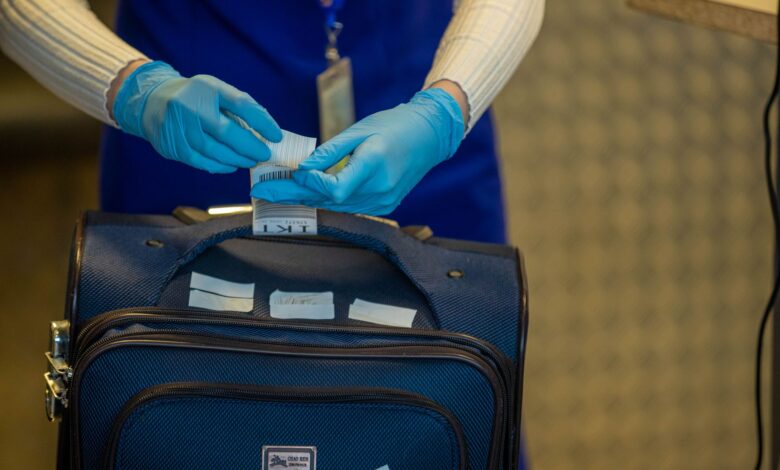
The 23 kg printed on your ticket is not your packing allowance. It is the most the whole bag may weigh when it goes on the scale, and your empty suitcase is already spending part of it before a single shirt goes in. The standard baggage allowance published by Air Canada states a maximum weight per bag of 23 kg (50 lb) — with wheels and handles counted in the size measurement, which shows the limit is a property of the closed bag, not of the contents. A large hard-shell case can weigh five kilos on its own, which is why a bag that feels comfortably full still reads over at the counter.
The number itself moves too. A checked bag weight limit is set by your fare and your route rather than by one global standard: on the conditions Emirates published in September 2026, some economy fares get 20 kg for every bag combined, while a ticket to the Americas gets two separate bags at up to 23 kg each. Guess wrong and the case you chose becomes the reason you are kneeling on the terminal floor moving shoes into a tote. Which makes the real question not how much you can pack, but what the scale is actually weighing.
What the 23 kg Checked Bag Limit Actually Counts
Ask at a check-in desk and the confusion usually comes out in one sentence: “but the suitcase is empty.” The scale does not care. It measures the object you lift onto it — the case, the packing cubes, the shoes, the souvenir you were handed at the last minute — and that total is what your ticket compares against the limit.
None of these rules is universal, and each belongs to a specific authority and a specific date, so the figures in this guide were checked on 20 September 2026 against the airline or regulator that sets each one. Fares and allowances change on those bodies’ own schedule, and the figure that governs your trip is the one in your own booking or on your airline’s baggage page.
The 23 kg figure comes from the people who lift bags all day. IATA’s guidance on passenger baggage rules says that allowances vary by airline and route, but that “from an occupational health and safety perspective, international guidelines recommend individual checked bags should not exceed 23 kg (50 lb).” The same page sets the maximum permitted weight for a single checked bag at 32 kg (70 lb) in many regions, including the European Union and the United States, and notes that baggage allowances and conditions of carriage remain airline specific.
That origin explains the number’s shape. The United Kingdom’s Health and Safety Executive, which regulates workplace safety in Great Britain, lists the weight of the bags handled among the main baggage handling risks, alongside the main risk factors in baggage handling, alongside stacking inside the hold and lifting below knee height. Writing in an aviation trade publication, the HSE’s head of transportation was blunter: there is no “safe” weight for handling bags repeatedly under turnaround pressure, even at 23 kg or less. The 23 kg figure is a compromise between what a handler can safely manage and what airlines are willing to give away.
So the limit counts the whole bag. On a route where the allowance is expressed per piece, the scale reads each piece on its own. On a route where it is expressed as a total weight, each bag has its own measurement but the totals combine. Emirates describes the difference on its checked baggage page: “Your free baggage allowance is based on either the total amount of weight or on how many pieces of luggage you have. This is called the weight or piece concept.” Under its weight concept you can check as many bags as you like up to the class allowance, but each individual bag must not weigh more than 32 kg.
That is why “my bag looks full, not heavy” is the trap. Density, not volume, decides. A case filled with knitwear and towels reaches 23 kg long before it is visually full; a case filled with coats and nothing else may look stuffed at 14 kg. The scale is the only thing that knows.
If that number is the whole bag, the next question is which number applies to your specific ticket — because it is not always 23. It depends on the airline, the fare you bought, and the route you are flying.
Checked Bag Weight Limits by Airline, Fare, and Route
There is no global limit. There is a standard that many airlines converge on, and a contract that governs your trip. The contract is what the counter applies.
Brazil’s civil aviation regulator frames this for departures from the country. On its passenger baggage page, updated in April 2026 and read on 20 September 2026, the Agência Nacional de Aviação Civil explains that since Resolution No. 400 of 13 December 2016, airlines may sell tickets with different checked baggage allowances, or with none at all, for passengers who choose not to use the service. The same page adds that the rules of the contract apply to every ticket, whatever the flight date — so what you compare when shopping is what you get. For domestic Brazilian flights there is no single statutory figure for the checked piece; the allowance is whatever the fare states. What is fixed is the cabin, where the page sets a floor of 10 kg of carry-on at no extra cost, and notes that oversized or overweight cabin baggage may be charged as excess.
The table below collects the published weight rules for five carriers that appear frequently on long-haul routings from Brazil and Europe. Every figure is the airline’s own published condition, verified on its own site on 20 September 2026.
| Airline and route context | Standard per-bag weight | Upper weight band | Fee reference point |
|---|---|---|---|
| Delta Air Lines, US domestic | 50 lb (23 kg) | 51–70 lb: US$100; 71–<100 lb: US$200; 100 lb or more not accepted | Third bag US$200, charged each way |
| Delta, Americas to Europe | 50 lb (23 kg) | 51–70 lb: US$100 (€85 when exiting Europe); over 70 lb not permitted | Separate fee for each limitation exceeded |
| American Airlines, most regions | 50 lb / 23 kg (62 in / 158 cm) | 50–53 lb: US$30; 53–70 lb: US$100; over 70 lb not accepted to Europe, Israel or Qatar | Business and First free bags up to 70 lb / 32 kg |
| American Airlines, to or from Australia or New Zealand | 70 lb / 32 kg for free bags | The 50–70 lb band applies to excess charged bags | Oversize US$30–US$200 by region |
| Air France, intercontinental economy | 23 kg per piece | Overweight band 23–32 kg: US$55–US$100 by route | Online pre-purchase earns a 20% reduction |
| LATAM, published cabin rules | 23 kg (51 lb) per checked piece | 158 cm linear maximum per piece | Fare decides how many pieces are included |
| Emirates, weight concept routes | Total for all bags, from 20 kg in Economy Special | Each individual bag capped at 32 kg | Cabin allowance varies by fare |
Several of these columns need reading carefully, because the same airline behaves differently depending on where you are.
Delta charges by weight band and then adds a separate fee for each limitation a bag exceeds — overweight, oversized, and over-count are three different charges, and the airline states on its excess baggage page that they compound. On round trips to South America from the United States or Canada, bags three through ten cost US$200 each, charged each way. Delta’s baggage conditions also carry a rule worth knowing before you pack a box: cartons are not permitted to or from Brazil, Mexico, or Chile at any time of the year, and oversized items from Brazil are charged US$100.
American’s structure is a good example of why the 50 lb line is not the end of the story. Its published weight and size rules set the standard allowance at 50 lbs / 23 kgs for all regions except Australia and New Zealand, with a higher 70 lb / 32 kg limit for free First and Business bags. The separate overweight schedule has a narrow band between 50 and 53 lb charged at US$30, a wide band from 53 to 70 lb at US$100, and a top band above 70 lb at US$200 that is refused outright on routes to Europe, Israel, and Qatar. The airline also notes that when one item exceeds both the weight and the size standard, the higher of the two fees applies on top of the checked bag fee.
Air France expresses the allowance as a per-piece rule and its published baggage fees state that “each piece of checked baggage must not exceed” 23 kg or 32 kg according to the class of travel, with a heavy bag over 23 kg and under 32 kg priced by route between about US$55 and US$100. Two further details from the same conditions matter for planning. Pooling of bag numbers is allowed for families or groups checking in together to the same destination, but weight pooling is not. And on trips whose first flight departs from Brazil, economy passengers are entitled to two pieces at 23 kg each, for tickets purchased in Brazil.
Emirates shows the piece-versus-weight distinction at its sharpest. On piece-concept routes — flights to and from the Americas and from Africa — you get a fixed number of bags with a weight ceiling on each. On weight-concept routes you get a total, and the number of bags is your business. A traveller who reads “23 kg” and assumes it is per bag on a weight-concept ticket has misread the contract.
Fares break the pattern further. An economy “Light” or basic ticket can include no checked bag at all, which means the relevant limit is zero until you buy an allowance, and buying it before departure is normally cheaper than buying it at the airport. This is where the checked baggage weight limit stops being a number you memorise and becomes a number you look up.
That lookup takes about a minute and prevents most of the trouble in this article. Open your booking, or the airline’s own baggage page, and check three things: the number of pieces included, the weight allowed for each, and the maximum weight per piece the airline will accept at all. Air Canada states that bags exceeding 32 kg (70 lb) must go through cargo instead. On Delta, bags of 100 lb or more are not accepted on US domestic flights, and anything over 70 lb cannot fly to or from Europe. The number on your ticket is your allowance; the number in the hard cap is the ceiling. Both matter, and they are different.
How Much of Your 23 kg Allowance the Empty Case Already Uses
Weigh a hard-shell checked case before you pack it and the result is usually between four and six kilos. That is not a defect. It is the price of wheels, a telescopic handle, a polycarbonate shell, and a locking mechanism, and it is weight the airline will bill you for.
Consumer guidance quantifies the effect. A published empty suitcase guide puts large checked cases at 8–13 lb, or 3.6–5.9 kg, and medium checked cases at 7–11 lb, or 3.2–5 kg. The same guide makes the arithmetic explicit: if your airline allows 50 pounds and the suitcase weighs 10 pounds empty, you have about 40 pounds left for clothes, shoes, toiletries, and souvenirs. Treat those as shopping ranges rather than measured standards — the only figure that governs your trip is the one you get by weighing your own case.
Put the arithmetic in one place. A 28-inch hard-shell case at 5 kg, packed for a two-week trip, leaves 18 kg of payload against a 23 kg limit. The same case at 7 kg leaves 16 kg. That difference is a pair of boots, a hairdryer, or an extra outfit — and it was decided in the shop, months earlier, by a specification printed on a hangtag.
Travellers describe the same effect from the other direction. On the Rick Steves travel forum, a poster opening a 2023 packing thread reported a wheeled carry-on weighing 7.38 lb empty and worried about getting the packed bag under 20 lb; a respondent replied that many brands come in around the 3 kg mark, and another noted that the difference between two bags is “a pair of sandals and two shirts OR a pair of leggings, a shirt and a cashmere sweater.” That is the exchange in miniature: two kilos of case equals two kilos of clothing you cannot bring.
The material and the shape drive the number more than the brand does. Hard shells protect better and weigh more. Two-wheel cases with a single T-bar handle usually weigh less than four-wheel spinners of the same volume. Expandable zips, external pockets, built-in locks, and heavy interior linings all add grams that become kilos once they are multiplied by the opportunity cost of what you leave behind. A lighter case is not automatically the better buy — a cheap bag that fails at the wheel in another country costs more than the kilograms it saved — but the weight specification belongs in the decision, next to the price.
The practical move is a one-time audit rather than a permanent purchase. Weigh the case you already own, empty, on any scale that reads in kilograms. Write the figure on a luggage tag or a strip of tape and leave it there. From then on, every reading you take of the packed bag is a payload figure, and the arithmetic in your head gets simple: payload ceiling equals your limit minus the case minus your margin.
How to Weigh Your Checked Bag at Home (and the Margin You Need)
There are two ways to do this without buying anything, and one of them is more accurate than the other.
The hanging scale is the direct method. Clip the hook through the case handle, lift until the bag is clear of the floor, and hold it steady until the reading settles. Digital luggage scales are the tool the market sells for this job, and they are small enough to travel with for the return leg.
| Method | What you need | How it works | Accuracy |
|---|---|---|---|
| Hanging luggage scale | A digital hook scale | Clip to the handle and lift clear of the floor | Direct reading; depends on the individual scale’s tolerance |
| Bathroom scale, subtraction | Any body-weight scale | Weigh yourself, then weigh yourself holding the bag and subtract | Workable, but the bag sits off-centre, which is not what the scale is designed for |
| Bathroom scale, bag alone | Any body-weight scale | Put the bag on the platform and balance it | Often impractical for a large case on a small platform |
The bathroom-scale subtraction method is what most people reach for first, and the way to use it is straightforward. Step on the scale alone and note the figure. Step on again holding the closed bag, with the bag’s weight centred over your feet rather than hanging off to one side. Subtract. The method works, with the caveat that a bathroom scale is a domestic appliance rather than a calibrated instrument, and the further the bag sits from the middle of the platform, the more the reading drifts.
That comparison matters more than most travellers expect, because home and airport scales do not always agree. A traveller posting on r/travel in August 2023 reported that a bag weighed two to three kilos more at the airport than at home across three airlines. The thread’s more experienced commenters were sceptical of the home measurement and pointed at the off-centre bathroom-scale technique, but one reply contains a detail that survives the scepticism in either direction: “In Gatwick I noticed the scale was already reading 1.5kg before I put the bag on. I just asked the checkin agent to subtract that.” A scale that reads above zero before your bag touches it is a mechanical fault, and asking for it to be zeroed is a reasonable request rather than a confrontation.
Another commenter in the same thread described the counter experience from the other side, reporting that most scales are within about 0.5 kg of each other and that some airports have scales you can use before check-in. Where the reading itself is in doubt, there is a formal layer underneath it: in the United States, the National Institute of Standards and Technology explains that scales used to compute a charge for a service — its example is, literally, the luggage scale at the airport — are legal metrology devices, and that before a scale can be used for commercial applications it must be inspected and approved by an authorised body of the state it is used in. That is the standard a counter scale is supposed to meet, and it is the reason a zero-check is a fair thing to ask for.
The margin you should keep, then, is no smaller than half a kilogram. Two reasons. First, none of the airline conditions checked for this guide publishes a tolerance above the stated limit — Delta, American, Air France, Air Canada, and Emirates all state a weight and then a fee schedule that begins immediately above it. Whether a bag at 23.2 kg is actually charged comes down to the scale, the agent, and whether you are at a staffed desk or a self-service bag drop, and none of those is something you control. Second, the physical difference between your kitchen floor and an airport counter is real, and half a kilogram absorbs it.
Weighing the bag again after you reach the airport is the last check, and it does not require joining the bag-drop queue. At many airports the scales at empty check-in desks stay switched on, and self-service bag-drop totes will weigh a bag as part of the process. If a self-service machine quotes a weight that is clearly out of step with your home reading, the counter is the next stop rather than a second attempt at the same machine.
The one thing not to do is treat the limit as a target with room above it. The margin protects against measurement error and nothing else. It is not a licence to pack 23.4 kg and hope.
What an Overweight Checked Bag Actually Costs
The scale goes red, and the number on the screen becomes a number on a bill. The size of that bill depends on the airline, the route, and how far over you are.
Delta’s published band structure is the clearest example of how quickly the cost escalates. On flights within the United States, Canada, and Puerto Rico, a bag between 51 and 70 lb costs US$100, a bag between 71 and under 100 lb costs US$200, and a bag of 100 lb or more is not accepted. The same US$100 band applies on flights between the Americas and Europe or North Africa, but above 70 lb the bag is not carried at all. Because these figures are published as “each way,” a round trip on which you are over on both legs doubles the exposure.
American charges similarly shaped bands with an extra wrinkle at the bottom. Between 50 and 53 lb the fee is US$30, from 53 to 70 lb it is US$100, and above 70 lb it is US$200 to many destinations — but not to Europe, Israel, or Qatar, where bags over 70 lb are refused. American also states that oversize and overweight fees compound, and that they are charged on top of the checked bag fee itself.
Air France prices the overweight band by route and by class, presenting a heavy bag over 23 kg and under 32 kg in a schedule that runs from roughly US$55 on short-haul and intra-Caribbean routes to around US$100 on other long-haul routes, with the airline’s own note that buying additional allowance online earns a 20% reduction while a heavy bag must be purchased at the airport with no discount. That last sentence is the whole strategy in one line: the discounted channel closes exactly when you need it.
Two structural facts make the fee exposure larger than the headline number suggests. First, weight fees are normally charged per direction, so an overweight outbound bag and an overweight return bag are two separate charges. Second, if a bag is both overweight and oversized, the airline applies both fees; Delta states that separate fees apply for each limitation exceeded, and American applies the higher of the two on top of the bag fee. A single badly-packed case on a Brazil–Europe routing can therefore produce three charges at once.
The alternative to paying is usually buying. Delta charges US$200 for a third checked bag on many international routings, which is the same as its 71–100 lb overweight fee and twice its 51–70 lb band — so on Delta the arithmetic frequently favours paying the lighter overweight charge over adding a bag, unless the second bag is already included and unused, in which case redistribution costs nothing at all. On carriers where the only excess is a modest overweight band, prepaying a larger allowance online can beat the desk rate, because the discount for buying ahead has usually expired by the time you are standing at the counter. The direction of the answer depends on the airline and the fare, which is why it belongs on a comparison rather than in a rule.
| Airline and route | Overweight charge | Extra-bag alternative | Which is cheaper |
|---|---|---|---|
| Delta, US domestic | 51–70 lb: US$100 | Third bag: US$200 | Overweight charge |
| Delta, Americas to Europe | 51–70 lb: US$100 / €85 | Third bag: US$285 / €240 | Overweight charge |
| American, Europe and Qatar | 50–53 lb: US$30; 53–70 lb: US$100 | Third bag: US$200 | Overweight charge below 70 lb |
| Air France, long-haul | Over 23 to 32 kg: about US$100 | Second piece: about US$100; 20% off online | Depends on whether you buy ahead |
| Emirates, weight concept | No overweight fee within the allowance | Additional allowance purchased in advance | Buy the allowance |
Read the table’s last row against the others and a pattern appears. Where the allowance is a total weight rather than a set number of pieces, the cheaper move is almost always to buy more allowance before departure rather than to arrive over. Where the allowance is a fixed number of pieces with a per-piece ceiling, the cheaper move depends on how far over you are and whether a second bag is even included.
One more cost is worth naming because it is not a fee. A bag that arrives at the counter over the limit takes time to fix. Air France’s own conditions describe a bag over 23 kg and under 32 kg as something that must be purchased at the airport, which means a queue, a payment, and a receipt; Delta and American both charge at the desk. Every minute spent repacking is a minute not spent in the security line, and at some airports a bag that needs repacking also has to be re-tagged and re-screened.
Fixing an Overweight Bag Before Check-In
If the home scale says over, you have five levers and about twenty minutes. Acting on them at home rather than at the counter is the difference between a free fix and a paid one.
The first lever is weight transfer to the cabin. Most long-haul tickets include a carry-on with its own weight limit and a personal item beneath the seat, and any allowance that is not yet full is free capacity. Removing a laptop, a pair of boots, a jacket, and a toiletry bag from a checked case and putting them in a backpack can move two or three kilos without changing what you are bringing. If your fare does not include a carry-on weight allowance, the transfer loses its value, so check that first.
The second lever is what you wear. Coats, boots, and bulky knitwear weigh what they weigh whether they are in a case or on your body, and wearing them through check-in and security is an ordinary practice rather than a trick. On r/onebag’s weight-limit discussion, one traveller described piling on clothes in front of the agent until she waved them through, and another recommended a jacket with large pockets for heavy small items; a neck pillow with a zip that holds clothing instead of foam appears in the same thread.
The third lever is redistribution across bags, and it is the reason to know whether your ticket uses the weight concept or the piece concept. On a weight-concept ticket, moving kilos from a heavy bag into a second bag does not change your total, so the only question is whether a second piece is permitted and whether a per-piece cap exists. Emirates’ rule is the useful one here: under the weight concept you may check as many bags as you like up to the total, but each individual bag is capped at 32 kg. That means splitting a 26 kg case into two 13 kg cases fixes an overweight problem on a weight-concept ticket and does nothing at all on a piece-concept ticket with a per-bag limit.
The fourth lever is the nested bag, and it is the fastest of the five. A soft duffel or tote rolled inside the main case takes almost no space and no weight when empty, and when the scale reads over you open the case, move dense items — shoes, chargers, books, cosmetics — into the duffel, and carry the duffel on as your personal item. Travellers on r/Flights describe exactly this: a rolled duffel inside one of the suitcases that you fill with soft items until the main case is under. It converts a counter crisis into a two-minute operation, and it works because the personal item is a separate allowance from the checked bag.
The fifth lever is arithmetic rather than packing: decide whether to buy. Air France’s own published schedule gives the comparison in one line, offering a 20% reduction for additional baggage allowance purchased online, and the same page notes that a heavy bag must be bought at the airport where no discount applies. That asymmetry is the general rule. With a few days’ notice, buying an extra allowance online is normally cheaper than paying an overweight fee at a desk; with no notice, you are paying the airport rate whichever route you choose.
Which is why the decision has to be checked against your specific airline rather than assumed. On Delta, the third-bag fee and the heavier overweight fee are both US$200 on many international routings, so a traveller at 72 lb is choosing between two identical charges and might as well take the simpler one. On American, where the first band over the limit is only US$30, packing to 52 lb and paying thirty dollars is a rational decision rather than a failure — and the airline’s own note that the higher of the overweight and oversize fees applies, rather than both together, keeps that decision cheap.
At the Counter: What to Do When the Scale Reads Over
The bag is on the scale, the agent is looking at the display, and you can see the number. There is a sequence here, and doing it in order protects both your money and your departure time.
Start with the displayed number itself. A counter scale should read zero before your bag goes on it, and any scale can drift between inspections. If the reading is clearly out of line with a measurement you took that morning, asking for a re-weigh on a second scale is a normal request rather than an accusation. A commenter on r/airport put the same advice plainly: airport scales are not always calibrated correctly, so if one shows your bag as much heavier than you expected, ask to have it weighed on a different scale.
There is a real standard behind that request, which is why it is reasonable to make. Because the counter scale is computing a charge, it falls inside the commercial category NIST describes, and a device in that category has to be inspected and approved before it can be used. What the second reading does not do is create an entitlement. Enforcement is not uniform, and where a bag lands depends on the scale, the agent, and the process — so treat the second scale as a remedy for a demonstrably wrong reading, not as a general escape hatch.
The display unit is the next thing to read, and it belongs in the category of literacy rather than tactics. On a US-carrier desk the screen may show pounds, and a traveller who has been working in kilograms can misread a bag that is 0.2 kg over as comfortably under, because 23 kg converts to 50.7 lb and a pounds display can round to 50. If the counter offers a choice of units, a kilogram reading is the one that matches the figure on your ticket. This is worth thirty seconds of attention and it is not a loophole: the allowance itself is unchanged by which unit is displayed, and the margin remains the real protection.
If the bag is genuinely over and the decision is to fix rather than pay, the time budget decides the method. At the counter the fastest version of the nested-bag trick and the wear-it-on approach both work, but each one happens in public, in a queue, with your belongings spread across a floor. Two travellers on r/onebag described repacking in front of airline staff, one of them balancing a book in their hands for the same purpose. It is permitted and it is common. It is also slower than doing it at home, and it is not always available: where the bag has already been tagged and the receipt printed, the process may have to start again.
Where repacking is not realistic, paying is a legitimate outcome, and the airline will process it at the desk. What is worth protecting is the cutoff. Check-in and bag-drop deadlines are set by the airline and the airport and are not negotiable at the desk; a repack that runs past the deadline turns a fee problem into a rebooking problem. Before you open a bag at a counter, know how much time is on the clock.
Then two things that do not belong in this sequence. One is treating the counter as a negotiation over the rule: the allowance is the fare condition you bought, and the agent is applying it. The other is the version of this that goes wrong in the other direction — a traveller who was over, said nothing, watched the bag get tagged, and found out at the next airport. If a bag is heavy enough that a machine may object to it, the time to deal with it is when a person is standing there.
Your Tare-to-Payload Weight Budget for the Whole Trip
Everything above produces one number, and the number is not your limit. It is your payload ceiling.
Payload ceiling = your per-bag limit − the case's empty weight − your margin
Work an example. A 28-inch hard-shell case weighs 5 kg empty. Your ticket’s per-bag limit is 23 kg. Your margin is 0.5 kg. Payload ceiling: 17.5 kg of things you can actually put in the bag. If the same trip switches to a 7 kg case, the ceiling drops to 15.5 kg — two kilos of belongings removed by a decision made in a shop.
The formula is only as good as its inputs, so take the three measurements in the right order. Weigh the case empty, once, and treat that figure as fixed. Read the per-bag limit off your own booking rather than off a general article, because it is the fare that sets it — and where the ticket uses the weight concept rather than the piece concept, the limit is a total for all your checked bags and the per-bag figure is only the 32 kg hard cap. Then choose the margin, and do not go below 0.5 kg.
With the ceiling in hand, a packing budget is a subtraction exercise rather than a packing philosophy. Weight is not distributed evenly through a suitcase; a small number of dense items consumes most of it.
| Category | Rough planning weight | Note |
|---|---|---|
| Filled 100 ml toiletry set, full sizes | 1.5–2.5 kg | Liquids are the densest thing most people carry |
| Pair of shoes | 0.7–1.2 kg | Boots sit at the top of the range |
| Outfit (top, bottom, underlayer) | About 0.7 kg | Planning estimate; varies widely by fabric |
| Laptop and charger | 1.5–2.5 kg | Often the single heaviest non-clothing item |
| Hairdryer or styling tool | 0.5–0.9 kg | Usually replaceable at the destination |
| Paperbacks | 0.2–0.4 kg each | Three books is a kilo |
| Gifts and purchases | Varies | The main cause of an overweight return leg |
Those per-item figures are planning estimates, not measured standards, and they exist to show where weight concentrates rather than to predict your bag. The pattern they reveal is the useful part: the heaviest line is usually not clothing. It is liquids, electronics, and paper. A one-week trip packed entirely in knits and linen will weigh less than a weekend bag holding a laptop, a hairdryer, a full toiletry case, and two hardbacks, and it is the second bag that triggers the fee.
Then apply the round-trip logic, because the return leg is where most budgets collapse. Overweight charges are normally levied per direction, which means a bag that cleared 23 kg on the way out has to clear it again on the way home — with whatever you bought while you were away inside it. Two approaches are honest here. The first is to pack out heavy deliberately, taking full sizes in the outbound bag and knowing they will not come back, which frees weight for purchases on the return. The second is to book an allowance on the return leg at the same time you book the outbound one, because the airport price is normally the highest price you can pay. We sell trips, so take this as the disclosure it is: buying baggage through an agency is convenient when it is bundled with a booking we handle, and it is not cheaper than buying the same allowance direct on the airline’s own site, which is where the published discount for pre-purchase actually lives. If you booked the flight yourself, buy the allowance yourself.
A last edge case for anyone whose trip includes Brazilian domestic flying. Where the allowance is a total weight rather than a per-piece figure, splitting your belongings across more than one volume inside that total is normally permitted — the constraint is the total, not the count. But the allowance is a property of the contract, and on a journey with connections the rules that apply are the ones in the contract you hold, which may not be the same carrier’s rules on every segment. The regulatory framing from Brazil’s aviation agency is the one to carry: the conditions of the ticket apply, whatever the flight date, so the number to plan against is the number your own itinerary states.
Here is the whole method as a worksheet you can fill in before you pack.
- Write the airline and the exact fare name off your booking.
- Write the per-bag limit stated for that fare, in kilograms.
- Write the airline’s hard cap per piece — the figure above which the bag goes to cargo.
- Weigh your empty case and write that figure down; leave it on the bag as a label.
- Subtract the case and 0.5 kg of margin from the per-bag limit. That is your payload ceiling.
- List the dense items first — liquids, shoes, electronics, books — and give them weights before you list clothing.
- Check the carry-on and personal-item allowances on the same fare; anything they can absorb is weight the checked bag no longer has to carry.
- Repeat the ceiling calculation for the return leg, adding an estimate for what you expect to buy.
O Detalhe Que Decide a Viagem
The whole trap is that the limit is measured on the closed bag, and the case you chose in a shop months ago is already inside the measurement. Weigh the empty case once, write the number down, subtract it and half a kilogram of margin from your own per-bag limit, and you have a payload ceiling instead of a gamble. Do that before you pack and the airport scale becomes a formality; skip it and you are choosing between a fee at the desk, a repack on the terminal floor, and a re-tag against a check-in deadline that does not move.
Frequently asked questions
If my trip has a connection on one ticket, do overweight fees apply again on the second flight?
Usually the operating carrier of the first segment sets the baggage rules for the whole itinerary, which is how Air Canada states it. On one ticket you normally pay once per direction, but a separately booked second ticket means a second check-in and a second set of charges.
Can I ship my suitcase ahead instead of checking it?
Some airlines publish a luggage-shipping partner — Air Canada links one from its checked baggage page — and it removes the weight problem entirely. Compare the door-to-door quote against your overweight fee both ways before booking, because shipping is usually the more expensive option for a single bag.
