
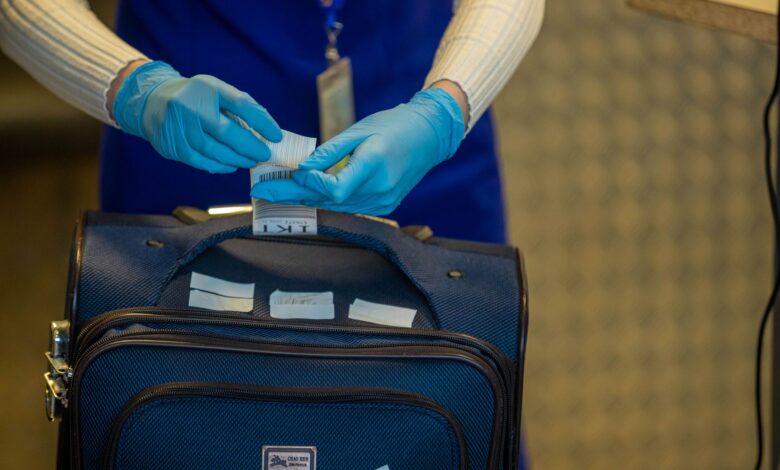
The weight of your ticket should be read as a maximum weight for your checked luggage, as opposed to being an allowance for packing (i.e., the size of the bag). This means, for example, that if you have a 23 kg maximum weight for this particular bag, it has already used up a certain amount for the suitcase itself before you even put a shirt inside. The Air Canada baggage allowance does not specify the weight of your actual packed item, but rather indicates a maximum weight per bag based on its overall weight (including handle and wheel weight). So, if you purchase a large hard-sided case, you will find that it weighs approximately 5 kg empty, and therefore a bag that feels full will still be overweight at the counter.
The weight limits for checked baggage can change over time. Your weight limit for your checked bag is based on both your fare and your trip, and is not limited to just one worldwide standard: for instance, the Emirates Airlines conditions state that some Economy class fares (that were published in September 2026) allow for 20 kg for all bags combined; and the case for a ticket booked for travel to the Americas allows for two bags, each with a weight limit of 23 kg. So, if you choose a bag that has the wrong dimensions, that bag can be the reason why you are on your knees in an airport terminal moving shoes from one bag to another. Therefore, the question you should ask is not how much you can pack, it is “What is the scale actually weighing?”.
What the 23 kg Checked Bag Limit Actually Counts
When making inquiries at the check-in desk, travellers often receive one amount of confusion in response: “but the suitcase was empty.” That being said, the scale is not concerned whether or not the suitcase contained any clothing, shoes, souvenirs, or other items, nor what items were placed within the suitcase. What the airline measures is the total weight of whatever object they placed on the scale — the suitcase, the packing cubes, and the shoes — and compares that weight with the amount permitted on their ticket.
All of these numbers are specific to the airline or governing authority that issued them at the time, and they are constantly changing. For instance, the numbers provided in this guide have been confirmed as accurate as of 20 September 2026, based on confirmation from the airline or authority responsible for each number. In addition to the changes in allowance amounts, the number used for your trip will be whatever number is shown in your reservation or baggage page from the airline.
The 23 kg allowance comes from the people who work in the baggage handling industry — IATA, the International Air Transport Association, has provided guidance for passenger baggage rules stating all of the allowances for passenger checked baggage, and further clarifying from a health and safety standpoint, that checked bags should not exceed 23 kg (50 lb). IATA also states the maximum permitted weight for any one checked bag can be as high as 32 kg (70 lb) in some parts of the world, including the United States and the European Union, while baggage allowances and conditions will vary by airline.
The shape of the number is explained by its origin. The Health and Safety Executive, the regulatory body for workplace safety in Great Britain, lists the handling of weight as one of the principal dangers associated with the handling of baggage, as do the principal risk factors associated with baggage handling (i.e., the stacking of baggage within the hold and the lifting of baggage below knee-height). The HSE’s Director of Transport has been forthright in noting that there is no safe weight for the repeated handling of baggage under turnaround pressure (even at 23 kg or less). The figure of 23 kg is a compromise between what is safe for the handler and what the airlines are willing to give away.
For that reason, the limit applies to the entire bag. For an itinerary specifying an allowance per piece, the scale measures each piece individually; for an itinerary specifying a total weight, each bag is measured individually and the totals are combined. To illustrate the differences between the two concepts, Emirates has provided these two statements on their checked baggage web page: “The free baggage allowance either depends on the total weight of all your bags or on how many individual pieces you are allowed. This is called the Weight Concept or the Piece Concept.” So within the Weight Concept, you can check as many bags as you want within the allowance (based on your class of travel), but basically every individual bag must weigh a maximum of 32 kg.
This is why stating “my bag looks full, not heavy” is misleading. It is the density, not the volume, that determines the weight of a bag. A suitcase full of knitwear and towels can weigh 23 kg before it visually appears full; conversely, a suitcase containing only winter coats may appear overstuffed at a total of just 14 kg due to the difference in density between the items in each case. Only the scale determines how much the suitcase weighs.
If this weight is the maximum weight that your suitcase can be for the purpose of checking in, the next question to ask is: what is the maximum weight that applies to your specific ticket? The 23 kg limit is not applicable across the board. It is determined by the airline you are flying with, the fare class that you booked, and the route you are flying.
Checked Bag Weight Limits by Airline, Fare, and Route
At present, there is no uniform global limitation placed on the amount of checked luggage a ticket allows for, however, all airlines maintain one common set of limits called the standard when producing tickets. The limits set forth in each airline’s ticket agreement must be upheld and cannot exceed the limits set forth in that airlines’ standard contract.
Brazil’s civil aviation regulator frames this for departures from the country. On its passenger baggage page, updated in April 2026 and read on 20 September 2026, the Agência Nacional de Aviação Civil explains that since Resolution No. 400 of 13 December 2016, airlines may sell tickets with different checked baggage allowances, or with none at all, for passengers who choose not to use the service. The same page adds that the rules of the contract apply to every ticket, whatever the flight date — so what you compare when shopping is what you get. For domestic Brazilian flights there is no single statutory figure for the checked piece; the allowance is whatever the fare states. What is fixed is the cabin, where the page sets a floor of 10 kg of carry-on at no extra cost, and notes that oversized or overweight cabin baggage may be charged as excess.
This following table displays the weights allowed for checked bags published by five airlines regularly operating long-distance routes between Brazil and Europe, where each airline’s published conditions can be verified as of 20 September 2026, directly on that airline’s web site.
| Airline and route context | Standard per-bag weight | Upper weight band | Fee reference point |
|---|---|---|---|
| Delta Air Lines, US domestic | 50 lb (23 kg) | 51–70 lb: US$100; 71–<100 lb: US$200; 100 lb or more not accepted | Third bag US$200, charged each way |
| Delta, Americas to Europe | 50 lb (23 kg) | 51–70 lb: US$100 (€85 when exiting Europe); over 70 lb not permitted | Separate fee for each limitation exceeded |
| American Airlines, most regions | 50 lb / 23 kg (62 in / 158 cm) | 50–53 lb: US$30; 53–70 lb: US$100; over 70 lb not accepted to Europe, Israel or Qatar | Business and First free bags up to 70 lb / 32 kg |
| American Airlines, to or from Australia or New Zealand | 70 lb / 32 kg for free bags | The 50–70 lb band applies to excess charged bags | Oversize US$30–US$200 by region |
| Air France, intercontinental economy | 23 kg per piece | Overweight band 23–32 kg: US$55–US$100 by route | Online pre-purchase earns a 20% reduction |
| LATAM, published cabin rules | 23 kg (51 lb) per checked piece | 158 cm linear maximum per piece | Fare decides how many pieces are included |
| Emirates, weight concept routes | Total for all bags, from 20 kg in Economy Special | Each individual bag capped at 32 kg | Cabin allowance varies by fare |
Each of the columns within this table should be carefully reviewed, because it is important to understand that an airline may set different limits depending on the location of the traveller.
Delta imposes fees based on weight, with an additional fee if the bag is overweight or oversized; all three categories are subject to the same compounding fee structure for excess baggage. For those traveling between the USA/Canada and South America, each bag numbered 3 through 10 incurs a US $200 charge for each leg. Delta also prohibits the carriage of cartons between the USA/Canada and Brazil, Mexico or Chile, at any time of the year as a rule of their baggage conditions, and has an additional US $100 fee for oversized articles shipped from Brazil.
American Airlines provides an excellent example of how the upper end (50 lb) limit is not the end of the line, as it has established general baggage allowances of 50 lb and/or 70 lb first/business class free allowances for most locations except for Australia and New Zealand. Their published weight and size limits are applicable to all locations other than Australia and New Zealand for free first/business class bags, with higher limits for free first/business bags. American provides its own overweight schedule as follows: a narrow band between 50 lb and 53 lb charged US $30; a wide band between 53 lb and 70 lb charged US $100; and a maximum band (70 lb+) charged US $200 and refused entirely for Europe, Israel and Qatar routes. Lastly, in their baggage policy for the airline, when an item exceeds both the weight and the size standard, the larger charge applies, in addition to the checked bag charge.
The structure of baggage allowances and fees from Air France is clearly stated. Each piece of checked luggage can weigh no more than the total limits applied to the class of travel (23 kg for economy class and 32 kg for premium economy, business and first). If the weight exceeds these limits but is less than 32 kg for a heavy bag, Air France charges an excess weight fee based on the route traveled. The following details regarding baggage allowances and how Air France allows for families or groups travelling together at the same time also should be taken into consideration when planning a trip with Air France. Families or groups travelling together can “pool” their checked baggage allowance, but cannot “pool” their excess weights. Additionally, for those travelling from Brazil to anywhere in the world using an Air France economy class ticket purchased in Brazil, the passenger will be allowed to check-in up to two (2) pieces that are no greater than 23 kg per bag. The published baggage fees state that each piece of checked baggage must not exceed 23 kg or 32 kg according to the class of travel.
On the other hand, Emirates makes the sharpest distinction between the concept of a piece’s versus weight, giving a unique example of this with their piece-concept and weight-concept routes. On flight routes to and from the Americas, and on Emirates routes to and from Africa, a fixed number of bags will be provided with a maximum weight allowed per bag; the usize of the weight cap is limited to the number of bags checked in for travel. On Emirates’ weight-concept routes, total weight for all of the bags checked is the maximum weight limit, however the number of bags is at the traveller’s discretion. Those travellers reading “23 kg” and using that as the limit per bag for weight-concept
Emirates export their fares as much further than Air France. An economy “light-type” or basic economic ticket may have no checked luggage whatsoever permitted. An economy “light-type” or basic fare has a zero checked baggage allowance until an allowance is purchased by an individual at the time of payment for the fare. Thus it is usually less expensive to purchase an allowance for checked bags prior to departing for the airport rather than attempting to do so at the airport; therefore, when planning a trip via an economy ticket using Emirates fare, the traveller should look up the weight limit.
This lookup takes approximately 1 minute but will resolve most of the issues addressed in the article above. To verify the contents of your booking or an airline’s baggage page, you need to verify that you have 3 separate items: (1) the number of checked bags allowed per itinerary, (2) how much weight each checked bag is allowed to weigh, and (3) the maximum allowable weight for any checked bag(s). For example, Air Canada will only allow checked bags weighing over 32kg (70lbs) to be checked as cargo, and Delta will not accept checked bags weighing 100 lbs (45kg) or more on any domestic flights within the United States. Additionally, Delta does not accept checked bags weighing more than 70 lbs (32kg) to or from Europe. The number on your ticket defines your checked baggage allowance; the number in the hard cap defines the maximum weight for any single checked bag. It is important to note these two numbers are different.
How Much of Your 23 kg Allowance the Empty Case Already Uses
If you weigh a hard-shell checked bag before packing, you can typically expect to find that it weighs between 4 and 6kg. This isn’t considered a defect. This is the trade off for the wheels, telescoping handle, polycarb shell and locking system on these bags, and is also what the airline will charge you for.
Consumer information quantifies the impact of hard-shell checked baggage. For example, a guide to empty luggage lists a large checked bag as weighing between 8-13 pounds (3.6-5.9kg) and a medium checked bag as weighing between 7-11 pounds (3.2-5kg). The guide also provides a simple calculation for the user. If your airline allows you to carry a maximum of 50 pounds total and the suitcase is 10 pounds when empty, you can carry about 40 pounds of clothing, shoes, toiletries and souvenirs. Therefore, treat these weight ranges as a guideline for packing; you can calculate your own weight by weighing your own luggage.
To illustrate the calculations in one area, consider a 28″ hard-shell suitcase weighing 5kg packed for a 2 week trip with 18kg of total weight capacity against the 23 kg maximum limit set by the airline. If that same suitcase weighs 7 kg when empty then you have only 16 kg of capacity left. This difference of 2 kg equals 1 pair of boots, a hair dryer or an additional outfit. If you made your purchase based solely on the specifications found on the hangtag months before your trip, then this could have easily been a mistake.
Travelers have experienced a similar effect from that direction. A travel forum post from the Rick Steves packing forum in 2023 indicated a wheeled carry-on that weighed 7.38 lb when empty and needed to be at or under 20 lb when packed; one commenter pointed out that most brands of travel bags weigh close to the 3 kg range, while another mentioned that the difference in total weight between two bags was simply “two pairs of sandals and two shirts, or one pair of leggings, one shirt and one cashmere sweater.” This is a small version of the larger discourse: two kg of baggage equals two kg of clothing you will be unable to pack and take with you.
More than a brand name, it is the combination of the shape of a case and its construction materials that influence the weight. Hard shell cases offer greater protection against damage to your possessions, but they also weigh more — and the type of handle and wheels can have a large effect as well; for example, a two-wheel case with a single T-bar handle is usually lighter than a four-wheel spinner, providing the same volume capacity. Cases that expand with zippered openings, have external pockets, built-in locks, and heavy inner linings will have additional grams of weight added to them, and those grams will translate into kilos when you factor in the opportunity cost of what you left behind while packing. While having a lighter case will not necessarily mean you will save money by purchasing that particular bag (a cheap piece of baggage that breaks while traveling abroad costs substantially more than the weight it saved), comparing the weights of various bags should be an important consideration in making your buying decision, along with the price of each bag.
Purchasing the practical bag only once rather than continually coming back is simply auditing rather than buying permanently. To determine the weight of the packet, weigh your empty bag on an accurate scale that measures in metric (kg). Write the number down on a luggage tag or tape it to your bag. This will be the only number you use to calculate how much weight your packet can hold. Each time you weigh the bag after it has been packed, that number represents how much additional weight has been added to the bag (the ‘payload’). The calculations are mathematically straightforward: the maximum possible weight (the “payload”) equals the maximum allowable weight minus the weight of the bag, minus any space reserved for margin.
How to Weigh Your Checked Bag at Home (and the Margin You Need)
There are two different ways that you can weigh your luggage without purchasing anything, but one method is more reliable than the other.
A hanging scale is a more direct approach to weigh your bag. To use this type of scale, grasp the case handle with the hook and lift it to keep it off the ground. Wait until the weight reading stabilizes before taking your final reading. Digital luggage scales sold on the market, which are small enough to pack for your journey home, fit these requirements.
| Method | What you need | How it works | Accuracy |
|---|---|---|---|
| Hanging luggage scale | A digital hook scale | Clip to the handle and lift clear of the floor | Direct reading; depends on the individual scale’s tolerance |
| Bathroom scale, subtraction | Any body-weight scale | Weigh yourself, then weigh yourself holding the bag and subtract | Workable, but the bag sits off-centre, which is not what the scale is designed for |
| Bathroom scale, bag alone | Any body-weight scale | Put the bag on the platform and balance it | Often impractical for a large case on a small platform |
Most people will try to weigh their luggage using the method of subtraction on the bathroom scale as their first choice, because it is clearly a simple process. To use a bathroom scale, step onto the scale alone and take note of your weight. Then step onto the scale again while holding the closed luggage in front of you so that its weight is distributed directly above your feet, rather than hanging to one side or another. Finally, subtract your weight (from step one) from the total (step two). While this method is effective, keep in mind that because the bathroom scale is not an accurate weight measuring device, the placement of the luggage will affect the accuracy of the reading. When the luggage is positioned further from the middle of the scale platform, the accuracy of the scale decreases.
This comparison may be more relevant to you than you may realise, as the weight given by home and airport scales do not always agree. In August 2023, a user on r/travel reported that their baggage weighed between two and three kilos heavier at the airport than at home with all three airlines. Although many of the more experienced users were suspicious of the home measurements and referenced the general methodology of using a scale in an unbalanced position, one post in the thread included some information that can be either supported or disputed: “In Gatwick, my scale was already reading 1.5kg before I put my luggage on.” The poster asked the check-in agent to deduct this from the weight of their baggage. A scale that gives a reading above zero before you place your bag on it is broken, and it is entirely reasonable to ask for it to be reset to a zero reading rather than approaching the situation in an aggressive manner.
Another commenter in the same thread described the other side of the scale experience from the counter perspective, sharing that most scales across different airports are all within about 0.5 kg of each other. He also stated that several airports provide scales for use before check-in. While the readings themselves may be inaccurate, there are official standards in place in the U.S. to determine whether or not a scale has met the necessary legal requirements for use in commercial situations. According to the National Institute of Standards and Technology, in the U.S., a scale used to calculate fees for services rendered (an example of which is the luggage scale at an airport) is classified as a legal metrology device, and therefore, prior to being approved for commercial use, scales must undergo an inspection by an approved agency of the state in which they are utilized. All scales of this type must conform to this standard, which supports the fairness of requesting that a counter scale be checked to ensure a zero reading.
You should maintain a minimum of half a kilogram as a buffer when weighing your luggage. This has two reasons behind it. Firstly, airlines listed as sources for this guide do not offer any reassurance that they will allow for any additional weight above what is quoted — Delta, American, Air France, Air Canada and Emirates all have published maximum weights with a fee structure that begins immediately after that maximum. Whether or not your bag has actually been weighed and charged above 23.2 kg will depend on the scale used when you checked in, the employee handling your check-in (if you are using a staffed counter), and if you are using a self-service machine or not; none of this is in your control.
Upon arrival at the airport, re-weigh your bag; this can be done before joining the check-in bag-drop line. At many airports, empty check-in machines have their scales switched on, and when dropping off your bag at a self-service machine, the machine will weigh your bag before allowing you to print your boarding pass. If the self-service machine shows a weight that appears to be noticeably different from your home scale, proceed directly to the check-in counter rather than reweighing at the self-service machine again.
Do not, under any circumstances, consider the limit to be a target weight with excess allowance above it. Your buffer protects you against measurement discrepancies; a buffer does not give you the right to pack up to 23.4 kg and simply assuage your fears.
What an Overweight Checked Bag Actually Costs
When the scale indicates red and displays a number, this number will be translated into a dollar amount that is based on the specifics surrounding the individual airline, route, and amount of excess baggage weight.
One example of how rapidly costs increase is Delta’s band structure that’s made public. Delta charges US$100 for bags weighing between 51 lbs and 70 lbs at departures from the USA, Canada and Puerto Rico; for bags weighed 71 lbs to less than 100 lbs, it costs US$200; and for bags weighed 100 lbs or more, Delta does not accept. To flights that depart from the Americas to Europe or North Africa, Delta has the same guideline as above with a US$100 band; bags exceeding 70 lbs are not carried by Delta. Each of these costs is indicated by Delta as “each way,” hence when you have an overweight bag on both legs of a round trip, you double your exposure.
American Airlines Also has a similar structure of bands but with one additional layer added. The amount you pay depends upon your range; from 50 lbs – 53 lbs, it costs US$30; from 53 lbs – 70 lbs, the cost is US$100; above 70 lbs, the price to most destinations is US$200 per bag, with the exception of certain international destinations; bags exceeding 70 lbs are not accepted by American Airlines to these three countries: Europe, Israel and Qatar. Additionally, American Airlines quotes that overweight bags incur a fee that combines both overweight and oversize components; therefore you will pay both the checked bag fee and the overweight charge on top of it.
Air France sets the overweight band price by route/class and includes an overweight bag in your itinerary from 23 kg – 32 kg with a schedule of approximately $55 for a heavy bag on short haul/intra Caribbean, to Approximately $100 for heavy bags on long haul. However, Air France notes that by purchasing additional allowance via the internet, you receive a 20% discount compared to purchasing a heavy bag at the airport (no discounts). This last sentence encapsulates the entire strategy: at the moment when you want to purchase what is available to you through the discounted channel, you have to do so at the airport.
Two structural factors increase your fee exposure for overweight bags beyond what you see in Air France’s headline price. One is weight-based fees are typically assessed in both directions; that is, you pay for both your outbound and return bags separately if each is overweight. The second thing to note is that Air France assesses fees for the two limitations (overweight and oversized); they will assess both if either of those limits are exceeded for your bag, and Delta charges your fee based on the weight of your bag in the same situation, while American will charge the larger of both fees on top of the original bag fee. The basic charge structure in place makes it possible that a poorly packed case on the Brazil–Europe route can give rise to up to 3 separate fees being assessed at once.
In most cases, rather than paying, there are options available to buy them. A third checked bag on Delta on many international routes will cost $200, and this fee would be the same as the overweight fee for bags of 71 – 100 lbs and double the fee for bags of 51 – 70 lbs, meaning from a cost perspective, you will often find it cheaper to pay the lighter overweight fee than to add a bag while travelling with Delta unless you already have a second bag included in your ticket, in which case, you would not incur any additional redistribution fees at all. On those operating carriers where the only excess charge is the minimal overweight charge, pre-purchasing a larger bag allowance online typically costs less than the kiosk rate when you arrive at the airport, as the discount for advance purchases typically expires by the time you arrive at the check-in counter. Therefore, as in all cases involving airline travel, the answer to your question will depend on both the airline and the fare purchased, and therefore should be viewed in terms of comparisons rather than as a rule.
| Airline and route | Overweight charge | Extra-bag alternative | Which is cheaper |
|---|---|---|---|
| Delta, US domestic | 51–70 lb: US$100 | Third bag: US$200 | Overweight charge |
| Delta, Americas to Europe | 51–70 lb: US$100 / €85 | Third bag: US$285 / €240 | Overweight charge |
| American, Europe and Qatar | 50–53 lb: US$30; 53–70 lb: US$100 | Third bag: US$200 | Overweight charge below 70 lb |
| Air France, long-haul | Over 23 to 32 kg: about US$100 | Second piece: about US$100; 20% off online | Depends on whether you buy ahead |
| Emirates, weight concept | No overweight fee within the allowance | Additional allowance purchased in advance | Buy the allowance |
The last row of the table illustrates a pattern when viewed in conjunction with the other rows. If the allowance provided is based upon overall weight instead of the number of checked pieces, it will frequently be less expensive overall to purchase an increased bag allowance prior to departure rather than to arrive with an over limit. If, on the other hand, your ticket allows you a specific number of pieces with a maximum weight allowance per piece, your less expensive option will be determined by how far beyond the limits of your ticket you have exceeded, as well as whether or not a second checked bag is included with your ticket.
An additional expense to consider is the time it takes to fix your luggage if it arrives at the check-in counter overweight. As Air France describes, a bag weighing more than 23 kg but less than 32 kg (with an additional fee) will be treated like it’s overweight and charged at the airport (like Delta and American). This means having to wait in line, pay for it, and get a receipt. Each minute spent on repacking will reduce the amount of time standing in the security line. Additionally, some airports require that bags requiring repacking also be retagged and rescreened.
Fixing an Overweight Bag Before Check-In
If your home’s weight scale indicates an “overweight,” the five levers are where you should put your efforts, as well as the 20 min time frame, to make changes prior to arriving at the counter. Making these adjustments at home vs. at an airline counter means the difference between a free and a paid fix.
The first lever is “Weight Transfer” to the cabin. For most long-haul airfares, a passenger is allowed to carry-on one item that meets a specific weight limit as well as a personal item that will fit beneath the seat, and whatever weight limit has not been met is considered additional carry-on capacity at no charge. By removing the laptop, boots, jacket and toiletries from your checked-in bag and putting them into the backpack, you could potentially drop as much as 2-3 kg without significantly changing the number of items in your backpack or suitcase. If the airline fare does not include a carry-on weight limit, the value of this transfer is lost, so be sure to check before you make changes.
The second lever is “What You Wear.” Whether you wear or pack your coat, boots or thick-knit sweaters, their weight is the weight of the item; accordingly, if you wear them during check-in and security, it is a common practice, and it is not a “trick.” In the r/onebag weight limit topic, one traveller reports weighing her clothing in front of the station agent, who waved her through, and a few recommended wearing jackets with large pockets for heavy items; additionally, one traveller posted a picture of a travel neck pillow with a zipper to hold clothing instead of foam in the same topic.
The third option for re-allocating weight for your bags is known as “Redistribution Across Bags”. To determine if your ticket uses the “weight” or “piece” concept, look at how many kilos you are allowed to take as one total weight versus how many individual pieces of luggage you can check on the same ticket. If you have a ticket that uses the “weight” concept, moving kilograms from a heavy bag to a second bag will not affect your total allowed weight; the only questions are whether a second piece is allowed, and whether there are any per-piece limits that apply. For example, Emirates has an excellent policy for this: if you have the “weight” concept, you can check as many bags as you want, as long as the combined weight is within your total, but there is a 32 kg weight limit for each bag. Therefore, if you find yourself with a 26 kg piece of luggage, you can split that piece of luggage into two bags that weigh 13 kgs each, thereby removing the overweight issue for the “weight” concept, but not for the “piece” concept.
The fourth option for redistributing weight is the “Nest” and is the quickest way to reallocate weight among the five methods. A soft duffle bag or tote can be placed inside your main suitcase and takes up virtually no space or weight when it is empty. Then, if the bags read over, you can simply open the suitcase, take out the densest items – like shoes, chargers, books, cosmetics, etc. – and place them in the duffle. You then carry that duffle as a personal item. People travelling through /r/Flights have described this method in detail: they stuffed a roll-up duffle inside one of their checked bags, and they kept adding soft items to the duffle until all of their other bags were within their total allowed weight limit. This transforms what could be a counter-productive moment into a two-minute task and takes advantage of the fact that a personal item allowance is separate from the checked baggage allowance.
Making a decision on whether to buy a bag based solely on the arithmetic and not as a function of packing is an example of the fifth lever: that is to say, the Air France published schedule, which contains a ‘one-line’ comparison of extra baggage allowances purchased in advance through the airline’s website, provides an example of the asymmetry or contradiction that is often found between the extra baggage allowance purchased in advance through the website (20% discount) and extra baggage purchased at the airport for takeoff (no discount). This example is a rule or general principle, where, when you have advance notice to purchase extra baggage, it is generally more cost-effective to do so via the airline’s website rather than paying for an over-weight fee at the ticket counter; however, if you do not have advance notice, then the cost to you will be the same whether you purchase the extra baggage via the airline’s website or by paying an over-weight fee.
Therefore, before you make a purchase, you should check with your specific airline to find out what fees apply to your bag, because there may be differences between the airlines that could affect your decision. For example, on Delta, for many international flights, the third-bag fee of $200 and the heavier overweight fee of $200 are both the same. Therefore, for a traveller who is selecting a bag weighing 72 lb, he/she is faced with two identical fees for the third bag, so it would be reasonable to select the simplest option. American Airlines charges only $30 for a bag weighing 52 lb, and therefore for a traveller weighing in at 52 lb, it is logical to pay $30 for the overweight fee rather than fail to meet the maximum carry-on weight limit — in this case, the airline specifically indicates that the fee which applies to the heavier bag is either the overweight fee or the oversize fee, not both.
At the Counter: What to Do When the Scale Reads Over
When you put your bag on a scale and receive a weight from the scale reading, you can trust that your bag is being weighed properly because there is an expected sequence of events when getting your bag on the scale and getting your bag weighed. Following this sequence is important for the protection of your investment and for ensuring that you leave at your planned departure time.
When approaching the scale, your first step is to check the scale and ensure that it is reading zero before placing your bag on it. Keep in mind that all scales can “drift” between inspections, therefore, if you see a significantly higher reading on the scale than you measured your bag’s weight with during your morning check-in, it is reasonable to request a re-weigh on another scale. One commenter on r/airport provided the same advice in a straightforward manner, “airport scales are not always calibrated correctly, so if your bag weighs significantly more than expected, be sure to ask for a re-weigh on another scale.”
The standard behind the request for a re-weigh or a secondary weight is what makes the request reasonable. Counter scales compute the amount you owe for your checked bag, which fall under the commercial category created by the National Institute of Standards and Technology. This means that all devices classified under that category must be properly calibrated, inspected and approved before they can be used to charge you for a checked bag. A second scale does not guarantee you have a right or an entitlement to that weight of your bag. Enforcement is not consistent and the final resting place of your luggage depends on the scale, agent and the process, therefore treat the use of the second scale as a specific remedy to a specific erroneous weight, not as a blanket escape route.
Reading the display unit should be more about literacy than about tactics. A US-carrier display unit often shows weight in pounds. A passenger who used a kg weight for his luggage could mistakenly interpret luggage that is 0.2 kg over as only slightly below. The reason is because 23 kg converts to 50.7 lb, and when displayed in pounds, it may read 50 lb. If a counter displays a choice of units, the kg reading is the correct representation of the figure on your ticket. This requires approximately 30 seconds of contemplation and is not a loophole. The actual allowance remains unchanged based on which unit you use to display it. The difference in units is a real safeguard.
If a bag is truly over the correct weight limit and the decision is made to make corrections instead of paying for excess, the time allowed for a decision will determine the method used to rectify the problem. There are two ways to quickly fix the nested bag trick at the airport counter: the nested bag method or the wear-on-the-plane method. Both of these methods happen in a public area while standing in line with your items lying on the ground. Multiple travellers on r/onebag have also described re-packing their bags in front of airline employees; one held a book in his hands so that he could re-pack. Re-packing in this manner is permitted and used by many, but it is usually a slower method than doing it in the comfort of one’s own home, and you do not always have access to this option. The check-in counter can sometimes tag a bag and print a receipt before you arrive; if that happens again, you may have to start over again to fix your problem.
In situations where repacking a traveler’s bag is not a viable option, there is a good chance the traveler will have to pay a fee to the airline, and the airline will process the payment at the ticket counter or at some other designated point. The cutoff date for checking in and dropping off luggage is a crucial part of that process. Each airline and airport establishes its own cutoff dates and times that are non-negotiable; if a traveler tries to repackage their bag after the cutoff date, it does not create a fee problem, but it creates a rebooking problem. Travelers should make sure to know exactly what time the deadline is on their ticket before they bring their bags to the counter.
Next, there are two types of travellers who should not be involved in this sequence. The first type of traveller treats the ticket counter as a place to negotiate for the baggage allowance: the baggage allowance was established by the fare rules when the customer purchased their fare, and it is up to the agent to enforce those rules. The second type of traveller is the one who waits until after the trip, does not tell anyone about being overweight, and then discovers that they were overweight at the next airport. If the bag is so heavy that a machine will be unable to accept it, then the way to resolve the situation is to deal with it while a representative is standing at the ticket counter with the traveller.
Your Tare-to-Payload Weight Budget for the Whole Trip
From everything listed above, a single number is produced and this is not the weight limit of your luggage (it is simply the payload).
Payload ceiling = your per-bag limit − the case's empty weight − your margin
Take an example: a 28′ hardside case weighs five kilograms when empty, the per-bag limit for your ticket format is 23 kilograms. Therefore you have a margin of 0.50 kilograms; your payload ceiling is 17.5 kilograms (the number of things you can put into your bag). In this same example, changing the case to a seven-kilogram case changes the ceiling to 15.5 kilograms (two kilograms of items eliminated by that decision made at a store).
The formula is only as precise as your three measurements taken in proper order. First weigh your bag empty, record that weight as fixed and from there read the per-bag limit from your specific booking (not from an article on a general subject). Every airline has its own fare conditions with respect to checked baggage weight; if the airline uses the concept of piece limits then the per-bag limit is not an absolute limit (i.e. 32 kilograms). Second, choose your margin (the minimum should be 0.50 kilograms).
Armed with the ceiling number you now have a reference for packing budget without having to pick an arbitrary number of pieces of baggage. Packing by weight is not a straightforward process as weight is not evenly distributed among pieces of luggage, therefore a few small heavy items may be sufficient to consume the majority of available weight limits.
| Category | Rough planning weight | Note |
|---|---|---|
| Filled 100 ml toiletry set, full sizes | 1.5–2.5 kg | Liquids are the densest thing most people carry |
| Pair of shoes | 0.7–1.2 kg | Boots sit at the top of the range |
| Outfit (top, bottom, underlayer) | About 0.7 kg | Planning estimate; varies widely by fabric |
| Laptop and charger | 1.5–2.5 kg | Often the single heaviest non-clothing item |
| Hairdryer or styling tool | 0.5–0.9 kg | Usually replaceable at the destination |
| Paperbacks | 0.2–0.4 kg each | Three books is a kilo |
| Gifts and purchases | Varies | The main cause of an overweight return leg |
The figures given represent estimates for the weight of each item, and as such are not actual weights. The figures are intended to provide guidance as to where weight is concentrated rather than to allow you to guess how much your bag will weigh. The most useful aspect of this figure is the pattern. For instance, on the majority of occasions, the heaviest items will be liquids, electronics, and paper, not clothing. In addition, if you have a one-week trip planned where the only garments you will carry are knit and linen materials, and you have no other bulky items, your garment bag will weigh much lighter than a weekend bag that contains a laptop, a hairdryer, a toiletry case with all of your toiletries, and two hardback books (which has the weight to trigger a charge).
Next, think about the Return Journey when planning your Budget as most Budget Failures occur on the Return Journey. Typically, overweight charges are assessed in both directions, so whatever weight you carry when you fly out will need to be carried back with anything you purchase while you are away. You can take one of two approaches to avoid being stuck with additional overweight charges on the return journey, and both are legitimate. First, you can purposely pack your luggage out to the limit (whatever that limit is based on airline rules) and only take full-size items in your bag with the knowledge that these will not be coming back with you, thereby allowing for more room in the bag for any purchases made during your trip. Or, you can book your luggage allowance on the return flight when you book the outbound flight because typically, buying your luggage at the airport will be at the highest price you can pay. We sell travel packages so we disclose herein that the primary benefit of purchasing luggage through an agency is the convenience of having your luggage booked at the same time as your flight. It will not be cheaper than purchasing the same exact fare allowance directly from the airline’s website, which is where the discount for pre-purchase actually occurs. If you booked a flight without the help of an agency, you should also book the luggage allowance directly from the airline.
For travellers who include domestic flights within Brazil, there is one additional edge case that needs to be taken into account. Theoretically, when you have an allowance of total weight, as opposed to the per-piece, in those cases you would typically be allowed to split your total belongings between more than one volume, since the maximum you could carry is the total weight each piece could weigh, therefore, it is the total weight that restricts your ability to take additional items with you, not the number of items or the count thereof. However, because airlines create contractual rules on their travelling procedure that govern how items are prioritised for each particular leg of a flight, you will only follow the rules stated in your contract, which means that while you may have contracted with the same airline for your entire journey with all of your segments in one place, you may be subject to differing airline regulations on various segments of your journey. The aviation agency’s regulatory framework in Brazil must be adhered to in all domestic flights from Brazil, so for every date of travel, your itinerary must reflect those conditions and, therefore, it is the same weight restriction and volume limitation.
The following outline provides an example of how you could use this method as you prepare to pack your items for travel.
- Write the airline and the exact fare name off your booking.
- Write the per-bag limit stated for that fare, in kilograms.
- Write the airline’s hard cap per piece — the figure above which the bag goes to cargo.
- Weigh your empty case and write that figure down; leave it on the bag as a label.
- Subtract the case and 0.5 kg of margin from the per-bag limit. That is your payload ceiling.
- List the dense items first — liquids, shoes, electronics, books — and give them weights before you list clothing.
- Check the carry-on and personal-item allowances on the same fare; anything they can absorb is weight the checked bag no longer has to carry.
- Repeat the ceiling calculation for the return leg, adding an estimate for what you expect to buy.
O Detalhe Que Decide a Viagem
There’s a big catch to the limit because the limit you’ve got is based off of the closed bag, and the bag you purchased in a store months ago is a part of that limit. So weigh your empty bag and write the number down you get when you do so. Then subtract the weight of the empty bag from your allowable limit for per-bag weight and subtract half a kilogram from that amount. What you are left with is your actual carry-on limit, rather than leaving it up to luck. If you weigh your empty bag before you leave home, then you don’t have to worry about the weight of the bag on the airport scale; if you don’t weigh your bag before you leave home, then you have to make a choice between paying a fee at the check-in desk for excess weight, repacking your bag on the terminal floor, or having to obtain a new tag by the deadline at check-in time, which is firm.
Frequently asked questions
If my trip has a connection on one ticket, do overweight fees apply again on the second flight?
The airline that operates the first segment will often determine the baggage policies for the rest of the journey, which is how Air Canada has stated it on their website. For most itineraries, if you have purchased just one ticket, you will pay for each direction once; however, if you have purchased two tickets separately, you will check your baggage in two places and will incur two separate fees.
Can I ship my suitcase ahead instead of checking it?
Some airlines list a shipping partner for luggage, such as the shipping option available through Air Canada on the Checked Baggage page, and this option avoids the issue of excess bag weight altogether. Make sure you compare the prices of shipping luggage door-to-door against the overweight baggage fees you would incur in both directions before purchasing your ticket, as door-to-door shipping is generally the higher cost option if you have only one item to ship.