
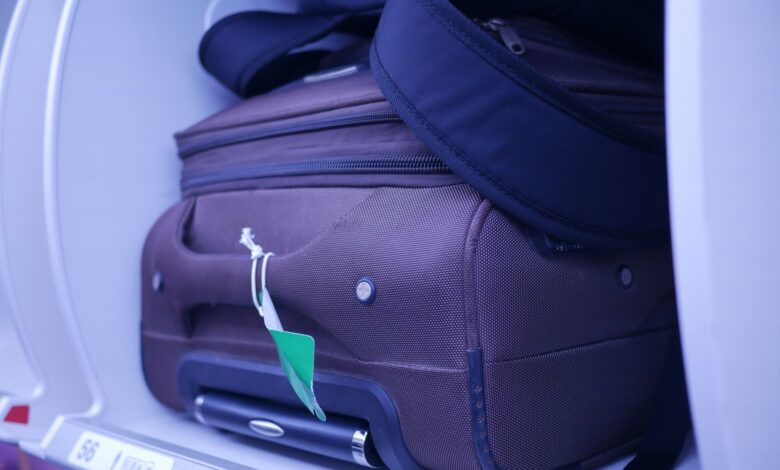
The number printed on your suitcase and the number published by your airline are usually measuring two different objects. One describes the packing body; the other describes the whole bag as it reaches the gate, wheels, handle housing and outside pockets included. Air France says so in writing: its cabin limit of 55 x 35 x 25 cm counts pockets, wheels and handles, and that was still the published figure on 20 September 2026.
That gap is only half of it. Every airline sets its own three-sided box, and the boxes do not agree, so a bag that slides through one carrier’s frame can be turned back at the next gate on the same ticket. So the only carry-on luggage size that matters is the one published by the airline operating the flight you are actually on. And the frame at the gate is not measuring quite what most people assume.
What the Airport Sizer Actually Tests
A sizer is not a ruler. It is a fixed frame at the check-in desk or the gate, and the only question it answers is whether your bag passes through in the state you are carrying it. United points travelers at exactly that: its carry-on maximum is 22 x 14 x 9 in (56 x 35 x 23 cm), and if you are unsure, the airline tells you to put the bag in one of its sizers.
Every figure below was checked against the airlines’ own pages on 20 September 2026, and because each carrier sets and changes its own limits, the page belonging to the airline operating your flight is the one that settles your case.
The same United page adds four words that do most of the damage. When you measure your bag, it says, “be sure to include the handle and wheels.” What is being assessed is the outer envelope of the object you hand over, so the retractable handle housing, the spinner wheels, the zip pulls and the stuffed front pocket are all part of it.
Then there is the arithmetic trap, which catches more people than the hardware does. A traveler on Reddit described being stuck on it. Their airline published both a 45-linear-inch ceiling and a 22 x 14 x 9 in maximum, and they could not tell whether a 21 x 14 x 10 in bag was allowed, since those numbers also add up to 45.
They are not interchangeable, and the reason is physical rather than bureaucratic. A frame has three fixed sides, so the bag has to clear all three at once. An extra inch of depth cannot be paid for with an inch saved on height, because the depth side of the aperture does not know what the other two are doing.
Is the sizer bigger than the published limit?
On the Tripadvisor air travel forum, a poster who took a tape measure to a United sizer in Portland reported the inside of the frame at 23 x 15 x 10 in against the airline’s 22 x 14 x 9 in limit, and read it as “a little leeway.”
That report is over a decade old, it covers one frame at one airport, and United’s own page publishes no clearance figure of any kind. The published maximum is the rule. The frame is only the instrument the airline happens to be holding, which leaves the question that catches most people: how does a suitcase sold as a carry-on end up failing a frame built for carry-ons?
Why a “Carry-On” Label Can Still Fail the Sizer
Because “carry-on” is a product category, not a measurement. The clearest way to see it is on a listing that publishes both numbers. Travelpro does this on its Platinum Elite carry-on spinner: the case dimensions, meaning the packing body only, are 21 x 14 x 9 in, while the overall dimensions including wheels and carry handles are 23.5 x 14.5 x 9 in.
Same suitcase. Two and a half inches of difference in height, and only one of those numbers is the one an airline is asking about.
To its credit, the brand says which is which. Its own page tells buyers that when airlines publish carry-on size limits they mean the overall size, and that this model’s 23.5 in height sits “slightly above the commonly published 22 x 14 x 9 in. standard.” That is the manufacturer describing its own product, and it is worth reading next to the number the carrier publishes rather than instead of it. Travelpro says the bag is sizer-bin tested and fits where it matters; United publishes 22 in. Both statements can be accurate at once, for the reason the frame already gave you.
Travelers hit this from the other direction and find it baffling. On the Rick Steves travel forum in February 2022, a poster shopping for replacement luggage wrote that the “21 inch expandable spinner is actually 23×14.5×9” and asked why a major manufacturer would “create carry on bags that exceed the carry on limits set by airlines.”
The answer is dull but useful: the model name refers to the case, the airline measures the object, and nobody is obliged to make those agree. So when you read a listing, find the word overall or external. If a page gives you only one set of numbers and does not say which kind they are, treat that as the number you still have to check yourself.
What changes the number after you buy it
Two things, and neither shows up on the label.
The first is how you pack. Travelpro’s own page puts the expansion at about 2 inches of extra packing depth and warns that a “Fully expanded carry-on may not meet airline restrictions,” which is the manufacturer telling you its own bag has two different depths depending on a zip you may not think about.
The second is quieter, and it caught a traveler at a Madrid check-in desk in February 2024. In another thread there, she described carry-on bags being weighed and “placed into the metal sizer box” at a counter marked for KLM and Air France, and her husband’s bag being rejected and checked through to Seattle.
It was not overpacked and the expansion zip was not open. As she put it afterwards, “It was the length that didn’t fit in their sizer.” The bag measured 22 in; the thread eventually reached the seller, whose staff member confirmed that the 22-inch version had been discontinued around a decade earlier because “it no longer fit the carry-on standard for most airlines.”
So the same product name, from the same brand, had been two different sizes over time, and the one in his hallway was the old one. Which is the practical reason a listing can only ever be a starting point: the number that decides anything is the one you take off the bag you are actually holding, packed the way you are actually going to pack it.
How to Measure Your Carry-On Suitcase After You Pack
Start with the state of the bag, not the tape. Almost every guide to carry-on suitcase dimensions tells you to find the widest point and include the wheels, which is correct and incomplete, because it describes an empty suitcase standing in a hallway. The one at the airport will be full, and a full bag is a different shape.
Back on that Tripadvisor thread, the same poster noticed it himself. His roller was “exactly 22″ x 14″ x 9″” and slid into the frame easily when it was empty, but as he put it, “overpack it so it bulges and it won’t fit.” Nothing about the suitcase had changed. The soft sides had simply stopped being flat.
So pack first, then measure. Zip the expansion closed if you are going to travel with it closed, load the outside pockets the way you actually load them, and clip on whatever normally hangs off the handle.
Taking the three numbers
A tape held against a curved shell reads short, so work against something flat instead.
- Stand the bag upright on a hard floor with one flat side against a wall or a closed door.
- Lay a rigid flat object across the top, a chopping board or a hardback book, pushed down only as far as it sits without force.
- Measure from the floor to the underside of that flat object. That is your height, wheels included.
- Turn the bag and repeat for width and depth, each time reading to the outermost thing on that face, including a bulging front pocket or a protruding lock.
- Write all three down. Not the total.
The total is the trap, for the reason the frame already gave you: three fixed sides, all of which have to clear at once.
Two small habits make the result worth having. Measure on the day you finish packing rather than a week earlier, because what goes in on the last evening is usually what pushes the depth out. And round up rather than down, since nobody at a check-in desk is going to argue you back half a centimetre.
What you have now is a real set of numbers for a real bag. What you do not have yet is the number to compare them against, and on an itinerary with more than one airline on it, that turns out to be a harder question than it sounds.
Compare Carry-On Limits on Every Flight in Your Itinerary
Your ceiling is not your airline’s number. It is the smallest number on any axis across every carrier that operates a segment of your ticket, and on a one-stop international trip that is rarely the airline whose name is on the booking.
The carriers say this themselves. Air France tells passengers that where the allowance changes between segments of one booking, it recommends following the strictest guidelines, and that its own figures apply only to flights it operates. LATAM puts it more bluntly: if your flight is operated by another airline, check that airline’s limits on its own website.
What the four carriers actually publish
Sizes below are normalised to height x width x depth in centimetres so the axes line up, and every figure comes from the carrier’s own baggage page rather than a third-party chart.
| Airline (own published terms) | Maximum carry-on size | Cabin weight limit | Page says wheels and handles count? |
|---|---|---|---|
| United Airlines | 56 x 35 x 23 cm (22 x 14 x 9 in) | None stated on the page | Yes, explicitly |
| Air France | 55 x 35 x 25 cm (21.7 x 13.8 x 9.9 in) | 12 kg, with the small bag, Economy | Yes, and pockets too |
| LATAM | 55 x 35 x 25 cm | 12 kg Economy, 16 kg Premium | Not stated for the carry-on |
| TAP Air Portugal | 55 x 40 x 25 cm (22 x 16 x 10 in) | 10 kg | Not stated |
All four pages were checked on 20 September 2026, and each carrier can change its own terms without notice. Read the table as research into published conditions rather than as a test of the bags themselves, because nothing here was measured at an airport.
What it shows is that no single carrier is simply the strictest. United gives you the most height and the least depth. TAP gives you five extra centimetres of width, more than anyone else, and pairs it with the lowest weight ceiling on the table, which makes a bag bought around TAP’s width the easiest way to arrive over on the scale instead. Air France and LATAM agree on the box and disagree on almost nothing until you reach the weight column.
Take the tightest figure from each axis and you get the bag that clears all four: 55 x 35 x 23 cm. That is not a rule anyone publishes. It is just the overlap, and it is 2 cm shallower than three of the four carriers would accept on their own.
Where the table is easy to misread
Two traps sit inside it. The first is units. TAP renders its 55 cm height as 22 in; United’s 22 in is 56 cm. Shopping in inches across carriers quietly loses you a centimetre exactly where you can least afford one.
The second is the last column. United and Air France both say in writing that the hardware counts. TAP and LATAM, on the pages above, do not say either way for the carry-on, and an absence of wording is not permission. Treat the outer measurement as the one being tested everywhere, and you will never be wrong in the direction that costs money.
Weight is a separate test, and it fails separately
Three of the four carriers cap cabin weight, and a bag can pass the frame and still be refused at the scale. Air France counts the hand baggage and the small bag together against 12 kg in Economy; TAP allows 10 kg; LATAM allows 12 kg in Economy and 16 kg in its Premium cabins. United’s carry-on page publishes no weight limit at all, which is a difference in kind, not degree.
For a trip starting in Brazil, the national position is the same one the carriers take. Brazil’s civil aviation authority, ANAC, states that carry-on limits vary among airlines and aircraft types, gives only a general range that includes wheels and handles, and tells travelers to check the airline’s own site or their travel confirmation. There is no Brazilian number that overrides a carrier’s.
So before you commit to a bag, open your booking and read the small print under each flight number, where the operating carrier is named. On a codeshare the marketing airline on your ticket and the airline flying the aircraft are often not the same company, and it is the operator’s limit that gets applied at that airport.
Worth saying plainly: Happy Day Turismo is a travel agency and books flights on these carriers, so treat this comparison as what it is, a reading of four public pages. Every carrier link here goes to the airline’s own page, and checking them yourself costs nothing and beats trusting any chart, including this one, on the week you actually fly.
What to Do If Your Bag Does Not Fit at Home
Finding out in your hallway is the cheap version of this problem. Every option below is still open to you there, and by the time you are at a counter most of them have closed.
Start by understanding that there are two separate ways a cabin bag ends up in the hold, and only one of them costs you anything.
The first is capacity. TAP Air Portugal states that on flights with a high number of passengers it may need to move some hand baggage to the hold free of charge “even if the defined limits are met,” and Air France describes the same thing on a full flight. Nothing has gone wrong and nobody is charged. Your bag was simply surplus to the bin space that day.
The second is size, and that one has a price. United says a carry-on over the limit has to be checked and a fee may apply; LATAM says cabin baggage exceeding its allowance goes to the hold and you pay the additional cost; TAP applies published excess fees at the boarding gate. So the goal is not to avoid the hold. It is to avoid being in the second group.
Fixing it before you leave, cheapest first
Zip the expansion shut and leave it shut. Travelpro gives this exact instruction for its own expandable carry-on: if your airline enforces its sizer, board unexpanded and save the extra capacity for the trip home. On most expandable bags that recovers the entire depth problem on its own.
If it is still over, take the depth back out of the outside. Front pockets are where a compliant bag quietly becomes a non-compliant one, and a laptop, a folded coat or a water bottle moved into your personal item changes the measured face without changing what you are carrying.
Next option, and it is a better one than people expect: use a different bag. A traveler on r/TravelHacks described buying a carry-on an inch larger than the airline’s published size and then simply leaving it at home, writing that they didn’t want to gamble so they took their old one. An older, slightly smaller suitcase you already own beats a newer one you have to argue about.
And if none of that works, pay early rather than late. United’s Basic Economy page, checked on 20 September 2026, puts bag fees for tickets bought on or after 3 April 2026 at 45 US dollars prepaid, 50 at the lobby counter and 75 at the gate. The bag is the same bag in all three cases. Only the moment you admit it changes.
Happy Day Turismo is a travel agency and can add that checked bag to a booking for you, which is worth saying out loud rather than burying. It is also worth saying that you can add it yourself on the airline’s own site in about two minutes, and on a simple one-airline booking that is usually the faster route, so use the agency for the itineraries where several carriers and fare rules are interacting and it actually saves you something.
What if it gets taken at the gate anyway?
Pack the small bag as though the big one is going below. United tells travelers to keep medication, keys and other essentials in the personal item in case of a gate check; TAP says to remove valuables, electronics and essential medication before hand baggage is transferred; Air France says to keep documents, medical paperwork and devices with you. The traveler whose bag was turned back at that Madrid desk had left the car keys inside it, and only got them back because the bag reappeared at the right airport.
That is the whole decision, and it is a small one if you make it at home.
O Erro Que Mais Custa Caro
The expensive mistake is trusting a number you did not take yourself, off a bag packed the way you are actually going to pack it. Measure the travel-ready bag at its outermost points, then check those three figures against the published page of every airline operating a segment of your ticket, and plan to the tightest of them. At home the fix is free: a zip left closed, a coat moved into the personal item, an older suitcase taken instead. At the counter the same bag costs the gate rate, and sometimes whatever you needed out of it before it went below.
Frequently asked questions
Does my personal item get measured too?
Yes, and the limits are tighter than most people expect. United publishes 22 x 25 x 43 cm for the item under the seat, Air France and TAP both allow 40 x 30 x 15 cm, and TAP caps it at 2 kg.
Does the suitcase’s own weight count against the cabin limit?
It does, because carriers weigh the bag as presented. Travelpro lists its Platinum Elite carry-on at 7.8 lb, roughly 3.5 kg, which is a third of TAP’s 10 kg allowance gone before you pack anything. On weight-capped airlines a lighter shell beats extra litres.
Is an “international” carry-on automatically the safer buy?
Not automatically, because those models trade height for width. Travelpro’s international version measures 21.75 x 15.75 x 7.75 in, which is shorter than its domestic sibling but about 40 cm wide, over the 35 cm width that United, Air France and LATAM each publish. Check the axis that is actually tight for your carriers.
