
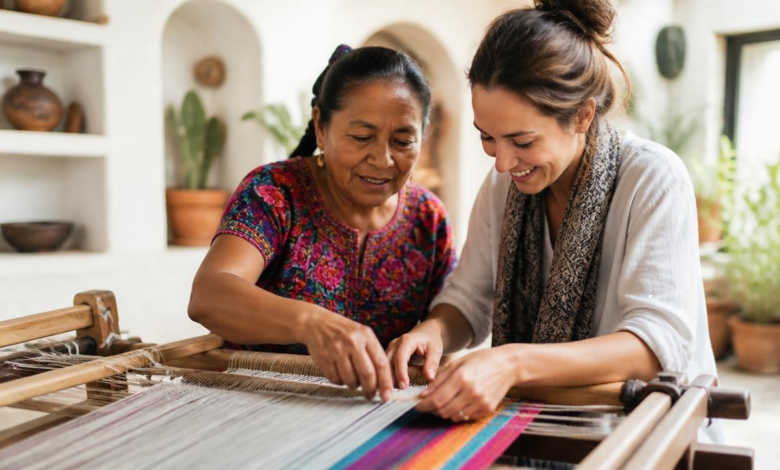
Some trips are remembered for landmarks, while others stay with you because of a conversation, a shared skill, or the quiet rhythm of hands at work. This is where traditional crafts cultural immersion becomes powerful. Sitting beside an artisan, watching raw materials transform, and understanding a pattern’s meaning makes culture feel personal, not distant.
Traditional crafts offer more than just beautiful souvenirs. They carry memory, identity, and techniques passed down through generations. A woven textile, a carved mask, or a dyed fabric can reveal how a community connects with its land, family, rituals, and trade. For travelers seeking truly authentic cultural experiences, crafts open a door that museums and typical sightseeing often cannot.
This approach to travel is also more unhurried and human-focused. Instead of rushing, you pause to notice details: the scent of wood, the patience in hand-knotting, the symbolism of colors, and the pride in explaining a family method.
The Essence of Traditional Crafts in Cultural Immersion
At its core, cultural immersion is not about collecting exotic moments. It is about understanding how people live, create, and transmit knowledge. Engaging with traditional crafts helps you achieve this, as the craft itself serves as a unique language. Materials, motifs, and methods collectively communicate something profound about a place and belonging.
UNESCO recognizes traditional craftsmanship as an integral part of intangible cultural heritage. This perspective highlights not just the finished object, but also the gestures, stories, and training behind it. It encourages travelers to appreciate the process as much as the product, fostering a deeper understanding.
This engagement also transforms your journey through a destination. Instead of simply asking, “What should I buy here?” you begin to inquire, “Who made this, how was it learned, and what does it represent?” Such questions lead to richer exchanges with makers and more respectful choices in markets and studios.
Beyond personal insight, there is a significant social dimension. In many regions, cultural heritage crafts sustain households, boost community pride, and connect younger generations to local identity. By choosing genuine artisan-led experiences, travelers help ensure these traditions remain vibrant, rather than succumbing to mass production.
Defining Authentic Immersion
Authentic immersion does not demand perfect fluency or expert craft knowledge. It calls for curiosity, humility, and dedicated time. You do not need to master a loom or perfectly shape pottery. You simply need to arrive ready to listen, learn, and respectfully enter someone else’s cultural framework.
Often, this means observing before participating. In many workshops, the initial lesson is not technical, but relational: how to greet people, when to ask questions, and which parts of the process might be private. For guidance on navigating these moments respectfully, consider learning about essential non-verbal cues for global travelers.
Authenticity is also context-dependent. A demonstration primarily for tourist photos, while enjoyable, differs from time spent in a working studio or family courtyard. Here, craft is integrated into daily life. The closer you are to the genuine environment of creation, the more profound the cultural exchange tends to feel.
Engaging with Crafts for a Richer Journey
The most straightforward way to begin is through local artisan workshops. These experiences provide direct access to makers, tools, and their stories. A well-designed workshop introduces techniques, explains cultural meanings, and encourages conversation. Even a brief session can profoundly change how you perceive a region and its crafts.
Seek out classes led by actual artisans, cooperatives, museums with community ties, or heritage centers. Prioritize experiences that clearly explain how finances benefit the local community and how the activity connects to established traditions. If a description focuses solely on photo opportunities, it may be more entertainment than immersion.
Studio visits offer equal value. Observing a master weaver, a potter at their wheel, or a woodcarver refining details reveals the dedication behind craft. It teaches patience and helps you appreciate why handmade work costs more than factory-produced alternatives, emphasizing the importance of fair compensation.
Markets can also deepen your experience, especially when artisans sell their own creations. Ask open-ended questions: What materials are local? How long does a piece take? Is the design linked to a specific region or family? These conversations often become the highlight of indigenous crafts travel, particularly when approached respectfully, without aggressive bargaining.
Supporting Artisans and Fair Trade
Thoughtful purchasing is an essential aspect of responsible travel. To ensure your purchase supports preserving cultural heritage through crafts, aim to buy directly from makers or from certified cooperatives. Organizations like the Fair Trade Federation provide valuable principles for transparency, fair wages, and long-term community benefits.
Exercise caution with mass-produced “traditional” items. Repetitive patterns, synthetic materials, and unusually low prices can indicate a product made far from the community it claims to represent. Ethical buying is not about suspicion, but about taking a moment to inquire about an item’s origin and creator.
Pairing shopping with learning is often beneficial. Witnessing how dyes are prepared, fibers spun, or carving tools handled gives you a practical sense of the labor and skill involved. This makes it easier to recognize authenticity and to make purchases with greater confidence and less guesswork.
For broader insights into responsible travel, explore ethical tourism and supporting local communities and indigenous arts. These themes naturally complement craft-focused journeys, enhancing your positive impact.
Transformative Benefits of Craft Immersion
One of the clearest benefits of engaging with traditional crafts is their ability to spark genuine conversation. When language barriers exist, the act of making becomes shared ground. Demonstrations, repetition, gestures, and touch facilitate communication beyond words, often leading to warmer and more memorable exchanges than standard tourism transactions.
Another significant advantage is the shift in perspective. Handmade traditions remind us that efficiency is not the sole value worthy of respect. In a world driven by speed, craft encourages appreciation for slowness, precision, repair, and continuity. You begin to view skill not as a mere performance, but as a deep relationship between maker, material, and time.
Craft immersion can also transform the souvenirs you choose to bring home. Instead of buying a generic item, you return with an object connected to a face, a place, and a lesson. This item carries a story you can genuinely tell, making it far more meaningful and likely to be cherished.
Furthermore, there is a tangible community impact. Ethical craft tourism can empower women-led enterprises, support small family businesses, and boost rural economies. It encourages younger generations to continue learning traditions, showing them that such work holds value, dignity, and an audience beyond their immediate surroundings.
Building Community Connections
Many travelers express a desire “to live like a local,” yet this phrase can become superficial if it ignores cultural boundaries. Craft-based immersion offers a more meaningful path. You are not pretending to belong; instead, you are invited to respectfully witness and participate in a skill significant to the community.
This invitation often leads to broader understanding. A weaving lesson might evolve into discussions about agriculture, migration, marriage customs, or seasonal rhythms. A pottery session could reveal how local clay influenced cooking traditions. When craft is treated as cultural knowledge, every lesson extends beyond the object itself.
Global Craft Traditions: Examples and Insights
Textiles offer one of the most accessible avenues for traditional crafts cultural immersion. In the Andes, weaving traditions frequently link color and pattern to local geography, family identity, and ritual memory. In Japan, resist-dye methods like shibori emphasize precision, restraint, and the beauty of controlled variations. In both cases, cloth serves as both utility and narrative.
Pottery provides another rich path. In regions renowned for ceramics, the local earth itself becomes central to the narrative. The specific clay body, glazing techniques, firing styles, and vessel shapes can reveal long-standing relationships between the environment, food culture, and daily routines. Even a short pottery class typically instills a deeper respect for what might initially seem simple.
Woodcarving and sculpture often hold strong spiritual or ceremonial significance. Masks, furniture, tools, and figurative carvings may possess meanings not immediately apparent to outsiders. Here, respectful questioning is paramount. Not every symbol should be copied, worn casually, or treated as mere decoration detached from its original purpose.
Basketry, metalwork, embroidery, and natural dyeing also deserve considerable attention. While they might not always command the spotlight, these crafts often demonstrate the most intimate connection between people and their landscape. The fibers, reeds, bark, pigments, and metals reveal what a region gathers, grows, trades, and protects.
The Art of Weaving: Story and Technique
Among all crafts, weaving perhaps best illustrates how technique and identity are intertwined. Understanding warp, weft, tension, and pattern repetition provides a technical foundation. Learning why certain motifs recur, who traditionally creates them, and when they are worn imparts cultural meaning. Together, these layers transform simple observation into genuine appreciation.
If you are particularly drawn to fibers and handmade traditions, consider combining craft stops with slower, regional travel rather than rapidly moving between crowded cities. This approach allows more time for village markets, heritage centers, and repeat visits to workshops. The outcome is typically more rewarding than trying to fit a meaningful class into an overpacked itinerary.
Planning Your Authentic Craft Journey
Start with thorough research, but allow room for serendipitous discovery. Read about regional crafts before your arrival, then ask locals which workshops are highly respected within their community. Tourism offices, museum staff, ethical tour operators, and accommodation hosts can all offer valuable guidance. Always verify if your chosen activity is artisan-led and if participants receive fair compensation.
Consider the local context when dressing and behaving. Some workshops are situated within homes, cooperatives, or sacred spaces. Punctuality, asking permission before taking photographs, and patiently following demonstrations are all crucial. Small acts of attentiveness often significantly influence the warmth of the welcome you receive.
Maintain realistic expectations for your involvement. It is unlikely you will produce museum-quality work in a single afternoon, and that is not the primary objective. The goal is to comprehend the process, appreciate the labor, and forge a respectful connection. Embrace the role of a beginner; mistakes frequently lead to the most memorable conversations.
Pack thoughtfully if your trip primarily revolves around workshops. You might want clothing that can get dusty or stained, a notebook for recording techniques and names, and secure space in your luggage for any fragile handmade items you acquire.
Honoring Local Customs and Makers
Respect forms the core of all meaningful authentic cultural experiences. This includes accurately crediting traditions, avoiding imitation without true understanding, and acknowledging that some knowledge may only be shared partially. If an artisan indicates that a symbol, method, or story is not for reproduction, accept their boundary without pressure.
Online conduct is also vital. While posting workshop images is generally acceptable, always ask permission first, especially if children, private homes, or culturally sensitive processes are involved. Tagging the artisan or cooperative, when they welcome it, can be a more supportive gesture than merely reducing the experience to aesthetic content.
Whenever possible, prioritize community-rooted experiences over anonymous intermediaries. The most impactful examples of cultural immersion through artisan workshops are typically shaped by local voices, rather than solely packaged for external consumption. This ensures that travel remains mutually beneficial, rather than extractive.
Conclusion: Crafting Your Own Cultural Narrative
Traditional crafts invite you to travel in a distinct way. They encourage you to slow your pace, sharpen your attention, and engage with culture through touch, repetition, and conversation. Whether you are learning basic traditional weaving techniques, visiting a potter’s studio, or conversing with artisans in a bustling market, you encounter a living form of heritage, not a static display.
The beauty of this approach lies in its balance of intimacy and responsibility. You gain cherished memories, new skills, and profound insights, while your choices simultaneously support livelihoods and help keep invaluable traditions alive. This is precisely what makes engaging with traditional crafts one of the most rewarding forms of cultural travel.
If your next journey aims for deeper connection, allow craft to be part of your guide. Follow the stories embedded in the materials, ask thoughtful questions, and choose experiences that honor the people behind the work. In doing so, you may discover that the most enduring souvenir is not an object you bring home, but the fresh perspective you gained for seeing a place.