
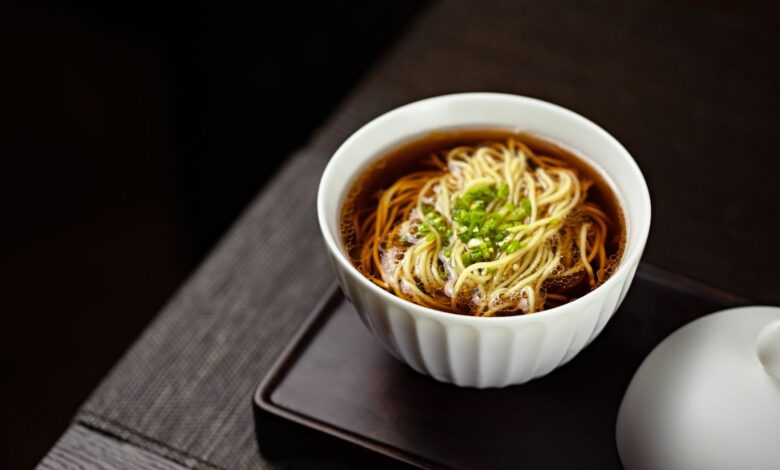
Yes, you can eat vegetarian in Japan. What catches most first-time visitors is invisible: the clear, savory stock used to season soups, sauces and simmered vegetables is normally made with fish. That stock is called dashi, and the Umami Information Center describes the standard version as kelp briefly simmered with dried bonito flakes, which come from a sea fish. A bowl holding nothing but vegetables can still be built on it.
Saying “I don’t eat meat” rarely closes the gap, because in a working kitchen that usually means no beef, pork or chicken. Fish stock sits outside that category, which is how vegetarian food in Japan ends up failing quietly instead of obviously. Seeing it coming is a skill with three parts: which dishes carry it, which words on a label give it away, and what to say so the kitchen hears the right thing. Start with why a plate of vegetables ever needed fish in the first place.
Why Vegetable-Labeled Dishes in Japan Still Contain Fish
Vegetable-labeled dishes in Japan still contain fish because the savory base underneath them usually does. Japanese cooking builds its depth from a light stock rather than from fat or long-simmered bones, and the standard version of that stock is made with dried fish. Nothing on the finished plate gives it away. The liquid is clear, the vegetables absorb it, and the menu almost never mentions it.
That stock is dashi. Its classic form pairs kombu, or dried kelp, with katsuobushi, the bonito that is dried, fermented and then shaved into paper-thin flakes. The pairing is not decorative. Kombu carries glutamate and bonito carries inosinate, and the Umami Information Center records that putting the two together makes the stock taste roughly eight times as savory as the amount of umami substance in it would suggest. Fish is in the pot because it multiplies flavor, not because anyone forgot you were coming.
Everything below was checked against its source in September 2026, and labeling rules, voluntary vegan marks and restaurant recipes can all change without notice, so the kitchen in front of you and the label in your hand are the final word on what you are about to eat.
Plant-only dashi is real. Kombu alone makes a clean, fully plant-based stock, and dried shiitake makes another. Both are standard equipment in vegan and temple kitchens. Outside those kitchens they are the exception, and a byFood guide for travelers puts it plainly: kombu-only versions exist, but they are rare. That gap between possible and likely is the whole problem in one sentence.
The second half of the problem is not culinary at all. In a working Japanese kitchen, “meat” tends to mean beef, pork and chicken. Fish sits in its own category, and fish stock sits somewhere behind that again, closer to salt or soy sauce than to an ingredient anyone would think to declare. The share of people who need that distinction drawn is still small: Zenbird reported Vegewel’s January 2023 survey of 2,418 adults, in which 5.9% described themselves as vegetarian or vegan and 19.9% as flexitarian, cutting animal products at least one day a week. A cook who has never had to separate stock from seasoning has no reason to hear your question as a question about stock.
So how did temple kitchens manage without it?
They built the fish-free version on purpose, and a very long time ago. Writing in Kikkoman’s Food Forum, the Soto Zen priest and shojin specialist Shoshi Takanashi traces the plant-based temple cuisine shojin ryori partly to a decree issued by Emperor Tenmu in 675 banning the consumption of meat, a ban he notes held, at least in name, for about 1,200 years.
Temple kitchens spent those centuries working out how to pull depth from kelp, dried mushrooms, beans and vegetable trimmings instead of fish, which is why avoiding fish stock in Japan is not a modern favor anyone is improvising for you. It is an old craft that lives in some kitchens and not in others, and most of the work is telling which kitchen you are standing in.
That is also why “is this vegetarian?” is the wrong question to carry into a restaurant. “What is the liquid made of?” gets a straight answer, and the number of places that liquid hides is smaller than it feels.
Where Fish Stock Hides: A Dish-by-Dish Risk Map for Travelers
Risk in a Japanese meal is not spread evenly across the plate. It pools in the wet parts. Grilled vegetables, rice, pickles, tofu and fruit are usually fine on their own; what carries the fish is the broth they sit in, the sauce they are dipped in, the liquid they were simmered in, and the flakes scattered over the top at the last second.
This matters because a menu describes solids. It tells you there are noodles and mushrooms and greens in the bowl, and says nothing about the two litres of stock they are swimming in. One traveler posting in 2024 to a r/JapanTravelTips thread on eating vegetarian in Japan described ordering a sauteed vegetable dish that arrived with large pieces of pork in it, none of which the menu had mentioned. That is one diner in one restaurant, not a pattern, and it is worth exactly one thing: it shows that the menu text and the pan are two different documents.
| Dish or component | What is usually in it | How often |
|---|---|---|
| Miso soup | Fish dashi | Almost always |
| Udon, soba and ramen broth | Fish dashi, or pork or chicken stock | Almost always |
| Cold soba dipping sauce (tsuyu) | Fish dashi | Almost always |
| Tempura dipping sauce (tentsuyu) | Fish dashi; batter may contain egg | Almost always |
| Clear soup in a set meal | Fish dashi | Almost always |
| Simmered vegetables (nimono), blanched greens (ohitashi) | Fish dashi, often bonito on top | Usually |
| Japanese curry roux | Animal fats, dairy, meat extracts | Usually |
| Salads and dressings | Bonito flakes, fish-based dressing | Sometimes |
| Inari-zushi and vegetable sushi | Dashi in the seasoned rice or pouches | Sometimes |
Read down that middle column and one distinction does most of the work: fish can be dissolved in a dish or sprinkled on it, and those are different problems. Bonito flakes on top of blanched greens can be left off if you ask before the plate is made, and you can see them if it arrives anyway. Dashi cooked into a broth cannot be removed, cannot be seen and cannot be tasted around. When a kitchen tells you a dish can be made without fish, the useful follow-up is whether they mean the topping or the stock.
The most reliable fix for the dipping-sauce rows is also the least obvious: skip the sauce. A Japan Travel guide suggests asking for salt instead of the tempura dipping sauce and asking whether a soy- or kombu-based alternative exists for cold soba, which turns a near-certain problem into a straightforward request. Cold soba with salt and wasabi is a normal thing to order, not a compromise.
Packaged food repeats the trap in written form. “Vegetable” is a flavor description in Japan, not a dietary claim, and a retort curry sold as Bon Curry Gran Vegetable carries chicken extract, pork fat and butter in its ingredient list, as documented by the reference site Is It Vegan? Japan. The same page notes something worth carrying into a supermarket: the pork fat appears in the ingredient list but not in the allergy box on the back. Which raises the obvious next question — if the allergy box is not going to tell you, what will?
How to Read Menus and Konbini Labels for Hidden Dashi
The allergy box on a Japanese package will not tell you whether there is fish stock inside. It exists for a different purpose, it covers a named list of allergens, and fish stock is not on that list.
Here is the current position. Japan’s Food Labeling Act requires a defined set of allergens, the “specified raw materials,” to be declared on packaged food, and the list changes. Osaka Prefecture’s food-labeling notice, updated on 15 April 2026, records that a Cabinet Office Ordinance revision took effect on 1 April 2026 adding cashew nuts, bringing the mandatory items to nine: shrimp, cashew nuts, crab, walnut, wheat, buckwheat, egg, milk and peanuts.
A second tier of around twenty items is recommended rather than required, and in the peer-reviewed review of the system by Akiyama and Adachi that second tier includes salmon, mackerel, squid, chicken and pork. Bonito, the fish in most dashi, is on neither list. Checked 20 September 2026.
All of that is a rule about packages. A bowl handed to you across a counter has no ingredient panel at all, and the Tokyo Metropolitan Government’s guidance for eating and drinking establishments is written as something restaurants are being asked to do rather than something they must: give customers an up-to-date, accurate description of the ingredients when asked, and, in the Bureau of Public Health’s own words, answer “I don’t know” and refer the question upward when the information may not be accurate. Take that at face value when you hear it. A server saying they are not sure is the system working correctly, and it is far more useful than a confident guess.
So the reading you need is not the allergy box. It is the ingredient list, and it comes down to recognizing about nine strings of characters.
| What you see | What it is | What it means |
|---|---|---|
| 出汁 / だし | dashi, stock | Fish unless kombu or shiitake is named |
| 鰹節 | katsuobushi, dried bonito | Fish |
| 魚 | sakana, fish | Fish |
| 魚醤 | gyosho, fish sauce | Fish |
| ちくわ | chikuwa, fish cake | Fish |
| 豚骨 / 鶏ガラ | tonkotsu / torigara | Pork or chicken stock |
| 卵 | tamago, egg | Egg |
| 乳製品 / バター | dairy, butter | Milk |
| ゼラチン / はちみつ | gelatin, honey | Animal-derived |
Those nine cover most of what goes wrong, but the one that slips past careful readers is not in the table. It is the word “extract.” The Kyoto chef behind Kyoto Green Cuisine, who has cooked in Japan for over thirty years, singles out anything written as “○○ extract” as the thing to watch, because katsuo extract, seafood extract, chicken extract and pork extract are exactly how animal flavor enters soups, granulated dashi and noodle sauces without any recognizable fish or meat word appearing on the pack.
The marks that are actually worth looking for
Japan has had a government standard for this since September 2022. Two Japanese Agricultural Standards were established that month, and the English translations published by FAMIC on 26 September 2023 cover processed foods suitable for vegetarians or vegans (JAS 0025) and the management of restaurants serving them (JAS 0026). Separately, the NPO VegeProject Japan runs the mark you are most likely to actually see: as of September 2026 it reports more than 1,800 certified products and menu items across over 300 companies, with the vegan mark meaning no animal-derived ingredients at all, including honey, and the vegetarian mark meaning no meat or seafood.
One warning about a word that looks like a mark and is not. Several travel guides recommend hunting for “plant-based,” written in katakana as puranto-beesu, as the most reliable modern menu signal. The certifying body disagrees with that advice, and it is worth knowing why: VegeProject states that plant-based has a less clearly defined meaning in Japan than vegan or vegetarian, and that a product may be called plant-based when only its main ingredients are plant-derived.
A certification mark has been reviewed by someone. A descriptive phrase has not. Where both appear, the mark is the stronger signal.
Before you buy anything packaged, there is one check worth building into the trip: photograph the ingredient panel on the back, not the front of the pack, and run it through your phone’s camera translation. The Kyoto chef recommends exactly this for labels that are hard to read. What you are looking for is any of the nine strings above, plus the word extract. If the translation comes back garbled, which happens often with small print on curved packaging, treat that as a no rather than a maybe.
What to Say in Japanese When “No Meat” Doesn’t Work
“I don’t eat meat” is a true sentence that solves roughly a third of the problem, and the reason is grammatical rather than cultural. In Japanese, niku (肉) is a category that holds beef, pork and chicken. Fish is sakana (魚) and sits outside it. Stock made from fish sits outside that again, filed with salt and soy sauce as seasoning. Voyapon’s guide to the problem puts the consequence bluntly: say niku wa dame desu and a chef may still serve you fish dashi, or small pieces of seafood, without either of you noticing the misunderstanding.
The official position is no softer. In its own vegetarian and vegan guide, the Japan National Tourism Organization notes that “vegetarian” arrived as an imported word, is often understood in a broader sense than you mean it, and that simply requesting vegetarian meals may not be sufficient. When the national tourism body tells you the word will not carry the request, believe it.
The fix is to stop naming your diet and start naming the ingredient. byFood suggests the construction “X ga taberaremasen,” meaning “I can’t eat X,” precisely because ビーガン and ベジタリアン often draw a blank while a named ingredient does not. Swap the ingredient and the same sentence works everywhere.
There is also a good reason to make a statement rather than ask a question. Makiko Itoh, the Japanese food writer behind Just Hungry, explains the logic in her notes on dining cards: dashi at restaurants is normally made with some kind of dried fish, so a kitchen that happens to use vegetable-only stock is the unusual one, and that kitchen can simply tell you so once you have said you cannot have dashi. Asking “is there fish in this?” invites a yes or no about what is visible. Saying “I can’t have dashi” puts the stockpot itself on the table.
These are the lines that do the work. Each is reproduced as published by the guides credited below, rather than translated here.
| What you want to say | Japanese | Romaji |
|---|---|---|
| I can’t eat meat or fish | 私は肉と魚が食べられません | Watashi wa niku to sakana ga taberaremasen |
| Please don’t use dashi | だしを使わないでください | Dashi o tsukawanaide kudasai |
| Fish stock is also not okay | だしもダメです | Dashi mo dame desu |
| Without bonito flakes | 鰹節なしで | Katsuobushi nashi de |
| No meat, fish, egg or milk | 肉・魚・卵・牛乳なしで | Niku, sakana, tamago, gyunyu nashi de |
| Could you make it without the meat? | お肉なしで作って頂けませんか | Oniku nashi de tsukutte itadakemasen ka |
Those lines come from the vegetarian guides published by byFood, Japan Travel and Best Tokyo; the direct question about stock, sakana no dashi wa haitte imasu ka, comes from Voyapon. Read down the middle column and the pattern is easy to miss: nashi de, meaning “without,” turns any of them into a request rather than an interrogation, which is the version a busy kitchen can act on.
Say them if you can. Show them if you can’t. A written line cannot be mispronounced, and it can be passed from the server to the cook without anything being lost in the retelling. Itoh publishes free print-and-cut cards for exactly this, including separate vegetarian and vegan versions, and her own caveat is the honest frame for all of it: the cards do not transfer responsibility to whoever is serving you, they just help that person help you.
Which is the real limit of everything above. Words work on what a kitchen is willing and able to change. They do nothing about a kitchen that has one pot of stock and builds every dish on it.
What to Order for a Guaranteed Vegetarian Meal: Shojin Ryori and Vegan Ramen
There is a difference between a kitchen that will accommodate you and a kitchen where fish was never in the building. Everything so far has been about the first kind. The second kind comes in three tiers: temple cuisine, fully vegan restaurants, and a single certified dish sitting on an otherwise omnivorous menu.
Temple cuisine is the oldest and the most reliable, because the absence is the point rather than a substitution. Shigetsu, the shojin ryori restaurant run directly by Tenryu-ji in the Arashiyama district of Kyoto, states on the temple’s own site that it uses no animal-derived ingredients at all, building its courses from vegetables, mountain greens, wild herbs and seaweed.
The practical catch is the booking. As listed on 20 September 2026, the three courses run ¥3,800, ¥6,500 and ¥9,000, plus ¥500 for garden admission; the ¥3,800 course needs to be reserved two days ahead, and the two larger ones need three days and a minimum of two people. It serves lunch only, from 11:00 to 14:00, and closes on Thursdays. None of that is a reason to skip it. It is a reason not to arrive hungry at 18:00 on a Thursday expecting it to solve your evening.
Vegan restaurants are the second tier, and this is where vegan ramen in Tokyo has quietly become a normal thing to eat rather than a novelty. T’s Restaurant in Jiyugaoka publishes an entirely plant-based menu built on soy meat and soy-milk-based sauces, with ramen and gyoza among the dishes, and the company’s site describes its T’s Tantan branches inside Tokyo stations.
Worth reading is the owner Masako Shimokawa’s own explanation of why the restaurant exists: even healthy authentic Japanese food, she writes, contains bonito, which leaves vegan visitors choosing carefully. That is an operator describing her own market, not an independent finding, but it is the same mechanism, stated from inside a Japanese kitchen. The limitation here is geographic rather than culinary. The full restaurant is one address in one neighbourhood, so it is a destination, not a safety net.
The third tier is the cheapest and the most widely available, and it carries the subtlest trap. CoCo Ichibanya, the curry chain, lists a CoCoICHI vegetarian curry at ¥683 including tax as of 20 September 2026, described on its own English menu as a curry using only plant-based ingredients. On the same page, under a different heading, sits “vegetable curry” at ¥918 including tax.
Those are two different products. The vegetable one is a topping choice on the standard sauce; the vegetarian one is a different sauce. Order by the wrong word and you get the wrong dish, which is the “vegetable means flavor, not diet” problem again, now priced in yen. The chain’s own note is worth reading too: some stores do not offer the vegetarian curry, so it is not a plan you can rely on in an unfamiliar town without checking first.
One caution about certification marks in restaurants, because it is easy to over-read them. VegeProject Japan makes its restaurant and accommodation certification available to venues offering at least one main menu item that meets vegan standards. A mark at the door is therefore real evidence about a dish, and not a statement about the kitchen. The question to ask inside a certified restaurant is still which item the mark belongs to.
What none of these three tiers gives you is a meal at 21:30 in a town where the nearest certified anything is two hours away by train.
How to Eat Vegetarian from Convenience Stores Outside the Big Cities
Outside the big cities, the convenience store is the plan, and it works better than its reputation suggests. What it does not do is work by browsing. The English on the front of a package is marketing; the information is on the back, and the fastest route through it is knowing which small number of items are reliable by default.
Rice balls are the backbone. A Voyapon guide to 7-Eleven onigiri published on 27 July 2026 picks out four that are dependable: umeboshi, the salty pickled plum, whose acidity carries the flavor so it rarely needs dashi; simmered kombu; shio-musubi, a plain salted rice ball with no filling and no seaweed, which the guide calls the absolute fallback; and sekihan, sticky rice cooked with adzuki beans. The same guide flags the trap inside that list, and it is a good one to know: kombu is a vegetable, but some manufacturers simmer the kelp in a blend of kombu dashi and katsuobushi dashi, so the most plausible-looking savory option on the shelf is the one that most needs its label read.
The other konbini trap is that word again. Writing from Tokyo in June 2026, the blogger behind The Tokyo Chapter describes buying a convenience-store salad labeled as tofu and vegetable and finding shredded chicken at the bottom, and a bakery item sold as seasonal vegetable bread with a piece of sausage sitting on top. She also notes that FamilyMart’s blue-and-green range, which reads as a plant-based line, is not strictly vegan and carries a Japanese note about possibly containing animal products.
Those are one person’s purchases rather than a survey of the chains, and that is exactly how to use them: as a reason to turn the packet over, not as a verdict on any brand.
Where a plant-based line genuinely exists, it is usually worth finding. Natural Lawson stocks soy-based alternatives and plant milks, and Japan Travel’s guide points to the words 植物性, meaning plant-based, and ビーガン, vegan, as the things to look for on supermarket packaging, alongside tofu, natto, ready-to-eat rice packs and instant miso soup with a fish-free stock. Between those and the four rice balls, a genuinely good meal is available in a store the size of a living room: a couple of onigiri, edamame, a tofu pack, cut fruit, and a bottle of tea.
That combination is also the cheapest way to eat in Japan, which is its own subject; this site covers what a day’s food actually costs at a convenience store in a separate guide, and the label-reading above is what makes that budget usable if you don’t eat fish.
One habit makes all of this faster. Buy the same two or three items on the first day in a new town, keep the packaging until you have checked it, and you build a short personal list of products you have already verified rather than re-reading every label every evening. On a two-week trip that is the difference between the konbini being a chore and it being the easiest meal of the day.
Where Most Travellers Get Caught Out
Where most travellers get caught out is not a visible piece of fish. It is the clear liquid under the vegetables, and the assumption that “no meat” already covered it. Name the ingredient instead of the diet — ask whether there is dashi in the dish, before you order, not after the bowl arrives. Get that one question into the conversation and Japan becomes one of the easier countries in which to eat well without meat; leave it out and you find out afterwards, which is the only version of this that cannot be fixed.
Frequently asked questions
Is sushi safe to order as a vegetarian?
Several staples are plant-based by default: kappa maki, kanpyo maki, takuan maki and inarizushi. Gurunavi flags two to check first — tamagoyaki nigiri, where dashi is often added to the omelette, and simmered toppings cooked in stock that may be fish-based.
Can I book a place to stay in Japan where every meal is vegetarian?
Temple lodgings, called shukubo, serve shojin ryori at dinner and breakfast, and JNTO’s temple stay guide notes the room rate normally includes both meals. Confirm the payment method when you book, because some temples accept only cash.
