
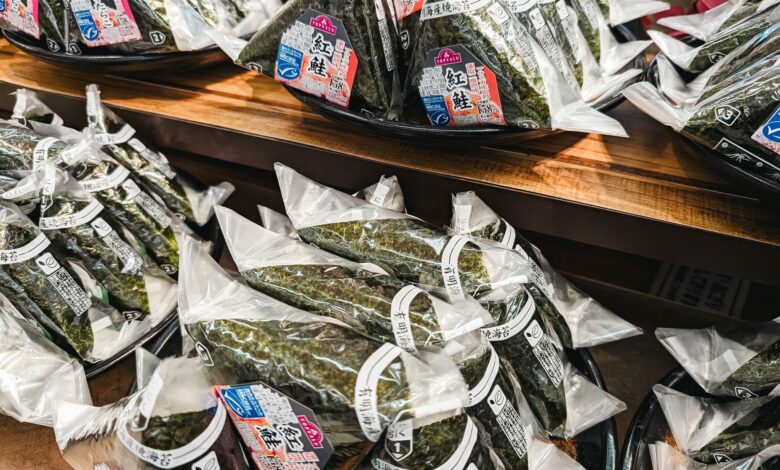
¥1,000 a day at a Japanese convenience store covers three real meals and very little else. It is a working floor rather than a comfortable budget, and a handful of choices at the shelf are what push you over it or keep you under. For scale, japan-guide puts the daily food floor for the most budget-conscious visitor at roughly ¥2,000 across every cheap option in Japan, restaurants included.
Japanese convenience store food has not held still on price either. In 2025 alone, one of 7-Eleven’s seaweed-wrapped rice balls went from ¥128 to ¥165, the Mainichi reported, after two increases the paper tied to soaring rice prices and poor seaweed yields. So a daily figure copied from a trip report two years old is already describing a different shop. Whether that number holds depends first on something simpler: whether this food counts as a meal at all.
What ¥1,000 a day actually buys at a Japanese convenience store
¥1,000 is not a Japanese price point. No chain prices anything at it, no authority publishes it as a daily food allowance, and it usually arrives in a traveller’s plan from somebody else’s trip report. Every figure and rule below was checked on 20 September 2026; Japan’s consumption-tax rules are set by the National Tax Agency and konbini prices by the chains themselves, and both can change, so check the shelf label and the agency’s own page before you commit to a number for your own trip.
Whether that number works comes down to the shelf, not the wallet. Rice-based konbini food runs on a clock measured in hours rather than days. FamilyMart’s onigiri and bento sat on a 19-hour consume-by window until the company developed a rice-cooking method that stops the grain going hard, Nikkei reported in September 2025, and the company’s own announcement puts the gain at two hours across roughly 70 rice lines — omusubi, bento, sushi — with chilled rice products and three southern prefectures left out.
Then the store shortens it again at its own end. 7-Eleven Japan tells customers that onigiri, bento, sandwiches, sweets and bread come off sale two hours before the consume-by time printed on the pack. The last salmon rice ball of the evening is not an old one. It is one that still had two hours of official life left when it stopped being sellable.
A window that short cannot be served by a weekly delivery, which is why rice lines have been trucked in around three times a day. FamilyMart has begun cutting that to twice — Ishikawa, Toyama and Fukui from mid-September 2025, then about 1,300 stores across Tohoku and Niigata from 9 June 2026 — and the reason it can is the extra two hours in the window, not a decision to let food sit longer.
That is why a konbini day is calculable at all. You are buying from a shelf that empties and refills on a same-day cycle, at printed prices, at whatever hour you are actually hungry. What ¥1,000 buys against that shelf is three modest meals with nothing spare. Which three depends entirely on what you reach for, so the item prices come next.
What each item costs: the building blocks of a day’s meals
You cannot add up a day from a list of things you might like, and a list is what most konbini guides leave you with. What a budget needs is a price layer.
Here is one, taken from a chain’s own national list rather than from another article. Every figure is the tax-included price FamilyMart published on its national rice-ball page as checked on 20 September 2026.
| Item family | What you actually get | Price, tax included |
|---|---|---|
| Plain salt rice ball | Rice and salt, no filling | ¥149 |
| Standard hand-wrapped rice ball | Tuna mayonnaise, pickled plum, kelp | ¥198 |
| Premium hand-wrapped rice ball | Salmon, spicy cod roe | ¥235 |
| Large rice ball | Roughly double the standard size | ¥298 |
| Two-rice-ball pack | Salmon and tuna mayonnaise together | ¥388 |
| Rice balls with side dishes | The closest thing to a tray meal | ¥598 |
The useful thing there is not any single number. It is the spread. The cheapest thing on the rice shelf and the most substantial thing on the rice shelf differ by a factor of four, which means your daily total is driven more by habit than by Japan being expensive. Two people both buying “a rice ball” can be ¥150 apart before either of them has had a drink.
Three cautions travel with those figures. FamilyMart’s own page states that prices vary by region and that not every store carries every line, so treat these as bands rather than a menu. They are one chain’s list on one day, and the price reporting above shows how fast that moves. And they cover rice only — hot food, sandwiches, drinks and anything from the heated case sit outside this table.
If you think in another currency, convert once and keep the date attached. At the Federal Reserve’s published rate of 153.71 yen to the US dollar on 11 September 2026, ¥1,000 was about US$6.50 and ¥198 was about US$1.30. That estimate stops being true within weeks, which is exactly why the yen figures are the ones worth memorising.
Fitting breakfast, lunch and dinner inside ¥1,000
Now the arithmetic, using only the published prices above so that you can rebuild it with your own choices.
The ¥1,000 day
| Meal | Build | Cost |
|---|---|---|
| Breakfast | Plain salt rice ball | ¥149 |
| Lunch | Large rice ball | ¥298 |
| Dinner | Two-rice-ball pack | ¥388 |
| Drink | One bottled drink | about ¥150 |
| Total | about ¥985 |
That is what ¥1,000 honestly buys: four rice balls and one drink. It clears the line, and it is a day of rice with nothing hot, nothing green and no second drink. The drink line is an allowance rather than a published figure, because drink pricing was not part of the list checked here.
Push it only slightly and the number breaks. Move breakfast up to a standard filled rice ball and lunch up to the rice-balls-with-sides set, and you are at ¥149 plus ¥598 plus ¥388, which is ¥1,135 before you have drunk anything.
The comfortable day
| Meal | Build | Cost |
|---|---|---|
| Breakfast | Standard filled rice ball | ¥198 |
| Lunch | Rice balls with side dishes | ¥598 |
| Dinner | Large rice ball plus a standard one | ¥496 |
| Drinks | Two | about ¥300 |
| Total | about ¥1,590 |
The gap between those two days is roughly ¥600, and what it buys is one properly composed meal and a second drink. That is the decision this puts in front of you: ¥1,000 is not a comfortable Japanese food budget, it is a tight one that works, and somewhere around ¥1,500 is where a konbini day stops feeling like rationing.
Your own three-meal worksheet
Fill this in before you fly, using the price table above for anything on the rice shelf and your own guess for drinks and hot food. Three columns, one line each, and a total you can argue with.
| Slot | What you would actually buy | Price from the table | Your figure |
|---|---|---|---|
| Breakfast | |||
| Mid-morning drink | not in the table | ||
| Lunch | |||
| Something hot | not in the table | ||
| Dinner | |||
| Evening drink | not in the table | ||
| Daily total | |||
| × nights in Japan |
Two rules make it work. Write down what you would genuinely eat rather than the cheapest thing available, because a budget you resent is a budget you abandon on day three. And leave the “not in the table” rows blank until you have seen a real shelf, then fill them in on your first morning and re-total — that single correction is worth more than any figure in this article.
Both worked totals above are estimates built for this guide from three variables: one chain’s published national tax-included prices on 20 September 2026, the number of rice-shelf items per meal, and a rough drink allowance. They are not an official standard, not an industry benchmark and not a measured survey of what travellers spend.
One thing can change every line in every table here, and almost nobody mentions it.
The shelf price already includes tax — and eating in-store changes what you pay
The price on the shelf is the price you pay. Japanese food retail quotes tax-included figures, which is why FamilyMart’s rice-ball page prints both ¥184 and ¥198 for the same item, and why the number in the table above is the larger one. No mental arithmetic at the till.
Underneath that sits a two-rate system. Japan’s National Tax Agency records a standard consumption tax rate of 10% and a reduced rate of 8%, both in force since 1 October 2019, with the reduced rate covering food and drink but expressly excluding alcohol and eating out. So the beer next to your bento is taxed differently from the bento, in the same basket, at the same till.
Here is the part worth knowing before you travel, because it is one of the few prices in Japan you personally control. Question 52 of the agency’s individual-cases Q&A, revised in April 2026, deals with convenience stores directly. Where a store serves food on a tray or in tableware that has to be handed back, that counts as a food service and the reduced rate does not apply. But for the ordinary case — hot snacks and bento that can equally be carried out or eaten at the counter — the applicable rate is settled by confirming what the customer intends to do. And because most konbini trade is takeaway, the agency accepts that stores need not ask everyone: a posted notice along the lines of “please tell us if you’ll be using the eat-in corner” is an acceptable way to establish intent.
| Where you eat it | Rate that applies | What it means at the till |
|---|---|---|
| Taken away | 8% reduced rate | The shelf price, unchanged |
| Eaten at the store’s eat-in counter | 10% standard rate | Slightly above the shelf price |
| Anything alcoholic, anywhere | 10% standard rate | Outside the reduced rate entirely |
7-Eleven says the same thing to visitors in its own words, noting on its English service pages that only some stores have an eat-in area and that reduced-tax items eaten there attract the 10% rate. Two percentage points on a ¥598 set is about ¥11 — trivial once. The reason to know it anyway is that the decision is yours and it recurs at every single purchase. If you are heading for a park bench regardless, say nothing and pay the shelf price.
One boundary, because it catches people out. This is not the tax-free shopping scheme advertised to visitors. That is a separate arrangement for goods you take out of Japan, not a discount on lunch.
Konbini, supermarket or restaurant: when each one pays off
A konbini is the floor of prepared food in Japan. It is not the floor of food.
If you are willing to do a little grocery shopping in Japan rather than buying every meal ready-made, supermarkets undercut it, and they do it on a schedule. japan-guide records that Japanese supermarkets begin marking down unsold lunch items around 14:00 and other prepared food from around 19:00, starting at a modest 10–20% and climbing as high as 50–70%. Nothing in the konbini world moves that far. The catch is availability: the same source notes that normally priced supermarkets are rare in the centres of large cities, which is exactly where most first trips are spent.
Cheap restaurants are closer than the budget-guide reflex suggests. The same reference puts lunch set menus at around ¥1,000 and meals at fast-food chains at rarely more than ¥1,000 a head. Set against a ¥598 konbini tray, a ¥1,000 hot meal cooked to order is not the extravagance it looks like on a spreadsheet.
| Channel | Genuinely best for | Real reason not to |
|---|---|---|
| Konbini | Any hour, anywhere, fixed printed prices | Highest per-item price of the three; rarely anywhere to sit |
| Supermarket | The afternoon and evening markdown run | Hard to find in central city districts |
| Cheap restaurant | One hot, composed meal for roughly ¥1,000 | Fixed opening hours; a menu you may not be able to read |
So the honest plan is rarely all-konbini. Use it for breakfast and for the meal that lands at an awkward hour, and let a supermarket or a lunch set take one slot a day. That is also how it looks to people who spend real time there: on the Tripadvisor Japan forum, a destination expert for Osaka and Tokyo wrote in a 2021 thread that they do not use konbini for proper meals but find them a dependable backup and the answer to an early-morning airport run. That is one regular’s practice rather than a survey, and it points the same way the pricing does.
There is also something a konbini structurally cannot give you. Vegetables beyond a packaged salad are thin on the ground, and the destination’s own cooking is not on that shelf. A week of rice balls is a budget, not a trip.
How to spend less without eating worse
The discount stickers are real, and they are not what the internet says they are.
FamilyMart’s own announcement of 3 March 2025 sets the scheme out precisely. Its markdown stickers come in exactly seven denominations — ¥10, ¥20, ¥30, ¥50, ¥100, ¥120 and ¥150 — rolled out nationwide from 11 March 2025, starting in the Tokai region. That is a fixed yen ladder, not a percentage. The widely repeated “30–50% off” framing does not survive contact with it: the largest sticker, ¥150, on a ¥598 set is about 25%, while the same sticker on a cheaper item is proportionally far better value. The underlying system is older and wider — the release records that the company’s barcode markdown system has run since July 2021 and is used in more than 90% of its stores.
Three limits keep this honest as a budgeting tool. Coverage is not universal, and the announcement itself says rollout timing differs by store and that some stores may not carry the stickers at all. The discount lands late, because its purpose is clearing stock before the consume-by window closes, so it is not there when you are hungry at noon. And it is one chain’s published scheme; the others run their own arrangements on their own terms.
Which makes the rule simple. A sticker can shave a day you have already budgeted. It cannot be the budget. Plan at full price, treat anything marked down as the evening’s bonus, and if you want a dependable discount rather than a lucky one, the supermarket markdown run in the previous section is the more reliable version of the same idea.
In practice: where to eat, how to pay, what to avoid
A budget only survives if you can actually spend it, and a few practical things settle that.
Start with where the food goes. Eat-in counters exist but are not standard, and long-term residents on the forum thread above describe the park bench, the hotel room or a discreet spot just outside the shop as the normal solution. Plan to carry your food somewhere rather than assuming a seat.
Heating is free and you have to ask for it. Most 7-Eleven stores have microwaves, staff may ask at the register whether you want a bento heated, and some items cannot be heated at all. A nod is enough. Eating a cold bento that was meant to be hot is the most avoidable mistake on this list.
Money is the part worth sorting before you arrive. 7-Eleven’s service page for visitors confirms that its stores take a range of payment methods including credit cards and QR codes, that Seven Bank ATMs let you withdraw yen with a credit card on a multi-language screen, and that some branches have machines converting foreign banknotes into yen with no ID or passport needed. It also warns that each of those can be out of service for maintenance, so do not build a day around one specific machine.
Two smaller ones. Plastic bags cost extra and are supplied on request, so a folded tote pays for itself over a week. And cutlery is free but not automatic — ask when you pay, or wait to be asked.
Before you fly, run one check: open your bank’s app and confirm your card is cleared for overseas ATM withdrawals and knows you are travelling. If it is blocked on arrival, every price in this article becomes academic.
Which of the three chains to choose (and when it doesn’t matter)
What follows compares published company information rather than tasting anything, so read it as research-based analysis of what the chains themselves state, not as a review.
On evidence that can actually be checked, the three chains differ operationally rather than culinarily. 7-Eleven publishes the most visitor-facing detail: an English service site covering payment, yen withdrawals with overseas credit cards, currency-exchange machines and tax-free stores, plus a clear public statement of its consume-by and sales-deadline practice. FamilyMart publishes the most detail about price and discount mechanics: a full national price list carrying tax-included figures, a documented seven-step markdown ladder, and its rice-cooking and delivery changes. Lawson’s comparable published material was not verified here, so this makes no claim about it in either direction.
Notice what that does and does not settle. It tells you which chain to walk into when you need cash or an English-language explanation, and which one lets you build a budget from published numbers. It tells you nothing reliable about whose rice ball tastes better, and this guide is not going to invent an answer.
There is also a real reason not to over-weight the choice. FamilyMart’s own announcement says the markdown stickers arrive at different times by store and may not be carried everywhere, and the delivery changes described earlier mean the assumption that every store in the country is restocked three times a day is being actively unwound in some regions. Both of those vary more between individual branches than between brands. Walking past a nearer shop to reach a particular logo costs you time and buys you very little.
What changes in 2027 (and what to check before you travel)
Every price in this article has an expiry date, and for once the date is published.
Japan’s National Tax Agency and Ministry of Finance opened a dedicated site on 15 September 2026 setting out a temporary cut to the consumption tax on food and drink, covering the two years from 1 April 2027 to 31 March 2029. The plan comes from a Cabinet decision of that same date. Independently, the US Department of Agriculture’s attaché report describes the measure as cutting grocery food from 8% to 1% for two years from April 2027 while leaving dining out at 10%, and notes it would be Japan’s first consumption tax cut since 1989.
Read the status carefully, because the status is the claim. As at 20 September 2026 this is not law. The agency’s own site states plainly that what it describes would apply if a bill is submitted to the Diet, debated and passed. Anyone telling you food in Japan will carry 1% tax in 2027 is describing a Cabinet decision as though it were a statute.
If it does pass, the takeaway-versus-eat-in gap in the tax section above widens from two percentage points to nine, which turns a rounding error into a habit worth forming. If it is amended or delayed, nothing in that table changes.
So the pre-departure check is narrow and specific. Open the agency’s rate-reduction site, see whether the page still describes the measure as pending or now describes it as in force, and note the date you looked. That one page tells you which version of the arithmetic here applies to your trip.
What’s Worth Your Time
¥1,000 a day at a Japanese convenience store buys roughly four rice balls and a drink — a real floor, but a tight one, with about ¥1,500 the point where the day stops feeling like rationing. The most useful thing you can do with that is fill in the worksheet above from the published item prices rather than trusting somebody’s daily headline figure, because the number moves and the items are what you actually choose. Do it once before you fly, with the current tax position checked on the agency’s own page, and you will land knowing which meals to spend on and which to keep cheap. Skip it and you find out at the till on day three, when the money has already gone.
Frequently asked questions
Is it cheaper to buy a bento at a supermarket than at a convenience store?
Usually yes, and especially late in the day: japan-guide records supermarket prepared food being marked down from around 19:00, starting at 10–20% and reaching as much as 50–70%. The trade-off is that normally priced supermarkets are scarce in central city districts.
Is a two-rice-ball pack better value than buying two rice balls separately?
Sometimes, and by less than you would think. On FamilyMart’s published national prices, the salmon-and-tuna-mayonnaise pack at ¥388 saves ¥45 against buying those two singly at ¥235 and ¥198. Against two standard ¥198 fillings it saves almost nothing.
Can I use a foreign credit card to get yen at a convenience store?
7-Eleven states that Seven Bank ATMs in its stores let you withdraw yen with a credit card using a multi-language screen, and that some branches also have foreign-banknote exchange machines needing no ID. It also warns those machines can be unavailable for maintenance.
Will food really be taxed at 1% in Japan from April 2027?
Not decided yet. The National Tax Agency and Ministry of Finance published the plan on 15 September 2026 following a Cabinet decision, covering 1 April 2027 to 31 March 2029, but the agency states it applies only if a bill passes the Diet. Check the status before you travel.
