
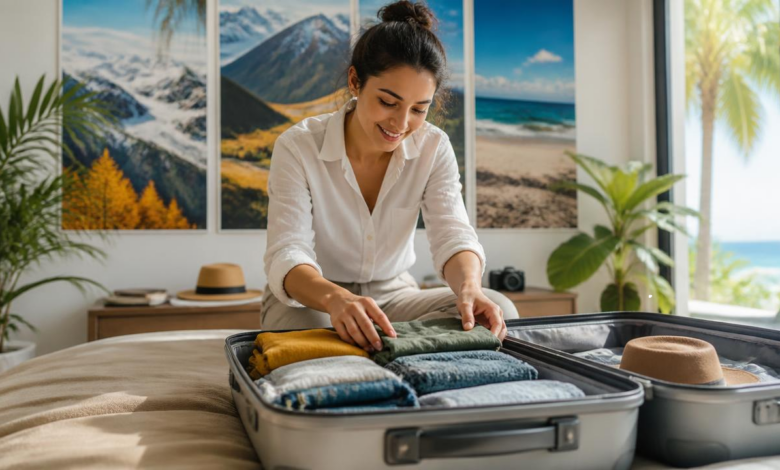
Travel often becomes intricate when an itinerary spans varied environments, like a warm city, a breezy coast, a cool mountain, or even a rainy interlude. Effective **packing strategies for multi-environment journeys** are less about overpacking and more about making smart choices. The primary goal is to remain comfortable, avoid baggage hassles, and keep your bag light enough for easy movement throughout your trip.
If you have ever prepared for sunshine only to find yourself shivering during a chilly evening in the mountains, you understand the importance of **multi-climate packing**. A well-planned system allows you to manage diverse weather conditions without needing a completely different outfit for every stop. Consider it like assembling a flexible travel kit that adapts to your plans seamlessly.
This guide explores **versatile travel packing**, focusing on layering techniques, smart footwear choices, essential accessories, toiletries, and optimal organization methods for varying climates. To further reduce weight, these concepts can be combined with insights from Master the Art of Minimalist Packing.
Preparing for Diverse Climates: Essential Research
Before selecting a single item, delve into your trip’s specifics. Examine each destination carefully, not just the country. A capital city might be hot by day, while a nearby mountain region turns cold after dusk. Factors like coastal humidity, desert dryness, altitude, and wind significantly influence what “comfortable” truly means.
Understanding Your Destination’s Nuances
Consult reliable sources for recent and average weather patterns, such as AccuWeather. Focus on daily highs, nighttime lows, rainfall, wind, and humidity. This provides a realistic overview for packing effectively for both hot and cold weather within a single trip, moving beyond general assumptions.
Activity-Based Packing and Airline Rules
Mapping out your activities is also beneficial. A business dinner, a museum visit, a beach stroll, a long train journey, and a mountain hike each demand different things from your attire. Intelligent packing for varied climates begins by identifying which moments genuinely require specialized gear and which can be managed with flexible basics.
Airline baggage regulations are crucial, particularly if your route includes regional or budget carriers. Weight restrictions can quickly reshape your packing decisions. Knowing your limits early allows you to prioritize **travel essentials for changing weather** without wasting space on “just in case” items you might not use.
The Core of Versatile Packing: Mastering Layering
The most effective approach to packing for a trip with different climates is layering. Instead of packing heavy, single-purpose outfits, build versatile combinations. **Layering strategies** enable you to add warmth in colder conditions and reduce bulk when temperatures rise, keeping you adaptable without overpacking.
The Foundation: Base Layers
Begin with a base layer, which sits directly against your skin and should manage moisture efficiently. Merino wool and high-quality synthetic fabrics are popular choices due to their quick-drying, odor-resistant properties, and ability to regulate body temperature. In warm weather, they minimize stickiness, while in cooler conditions, they help retain warmth.
Adding Warmth: Mid Layers
Next is the mid layer, your insulation piece. This could be a fleece, a thin sweater, or a lightweight insulated jacket. It should provide warmth without being bulky. A compressible mid layer is especially useful for **light packing on multi-environment** trips, as it can be easily stored in your bag when not needed.
External Protection: Outer Layers
Your outer layer offers protection from wind and rain. A lightweight waterproof shell is often more practical than a heavy coat, as it can be worn over other layers as conditions change. This makes it a smart investment in **all-weather packing** and a fundamental component of climate-adaptive clothing for travel.
Essential Items for Your Climate Chameleon Wardrobe
When assembling a **travel wardrobe for different climates**, fabric selection is more important than quantity. Quick-drying, wrinkle-resistant, and odor-resistant materials are highly valuable. You want clothes that can be hand-washed in a hotel sink, dry overnight, and still look presentable the next day.
Clothing: Smart Fabric Choices and Capsule Approach
Neutral colors simplify outfit planning. Black, navy, gray, olive, beige, and white blend well across various settings. This is where a capsule approach truly excels. For guidance on creating such a system, explore The Capsule Wardrobe for Travelers for more outfit-building ideas.
The Power of Neutral Colors and Adaptable Pieces
Choose tops that lend themselves well to layering. A short-sleeve shirt, one or two long-sleeve tops, and a breathable base layer can cover a wide range of conditions. Bottoms should be equally versatile. Dark trousers, leggings, or travel pants often transition smoothly between flights, city walking, and casual dinners.
Consider convertible or multi-use items. A shirt dress can function as daywear, dinner attire, or a beach cover-up. A scarf can serve as a shawl, blanket, or temple covering. **Climate-adaptive clothing** emphasizes these crossover pieces that perform effectively in more than one environment.
Footwear: The Art of Two Pairs
Shoes are often the most challenging packing decision due to their weight and bulk. Most travelers find success with two pairs. The first should be a supportive walking shoe or sneaker, capable of handling long days, varied terrains, and changing temperatures. Water resistance is a beneficial extra feature.
The Role of Socks
The second pair depends on your itinerary. For warm destinations, sandals with proper support are superior to flimsy flip-flops. For wet or cold areas, lightweight boots might be more appropriate.
Socks are easily underestimated. A combination of moisture-wicking socks for active or cold days and lighter pairs for heat provides greater comfort than packing random extras. Good socks reduce blisters, enhance warmth management, and help one pair of shoes perform better across very different settings.
Accessories: Small Items, Big Impact
Accessories are where experienced travelers often gain a quiet advantage. A compact hat, sunglasses, a buff, a scarf, gloves, or a foldable tote can resolve significant comfort issues without occupying much space. These items frequently prove more important than an extra shirt.
A scarf is one of the smartest additions for **multi-environment packing**. It adds warmth on a bus, protects from the sun, covers shoulders in religious sites, and elevates a simple outfit. In mixed itineraries, this kind of versatility is exactly what you seek.
Sun protection is vital in cool places as well as hot ones, particularly at altitude or near water. Sunglasses with UV protection and a cap or brimmed hat deserve permanent spots in your bag. If weather exposure is a concern, a small sunscreen stick also travels conveniently.
Smart Techniques for Efficient Packing
Rolling vs. Folding: A Practical Guide
The truth is, both rolling and folding are effective. Use rolling for softer items like T-shirts, leggings, and casual pants; it often saves space and keeps clothing visible. Reserve folding for structured pieces such as blazers, collared shirts, or garments that wrinkle easily.
The better question is not which method universally triumphs, but which works best for each item in your bag. A mixed system typically yields the best results. Smart packing tips prioritize making your clothes easy to access, protect, and rewear, rather than rigid rules.
Embracing the Capsule Wardrobe Mindset
A capsule wardrobe is one of the most effective answers to **how to pack for different climates**. Start with a small collection of interchangeable clothes, ensuring every top coordinates with every bottom. Add one insulating layer and one weatherproof layer, and your outfit possibilities multiply quickly.
This method reduces decision fatigue during your journey. You spend less time contemplating what to wear and more time enjoying your destination. It also minimizes the chance of bringing items you never use, a common packing mistake.
Maximizing Space with Packing Aids
Yes, **packing cubes** are valuable for multi-environment trips. They keep categories separate, facilitate faster unpacking, and simplify transitions between climates. You can designate one cube for warm-weather items, another for cold layers, and a small one for underwear or sleepwear.
Compression cubes or bags can be particularly useful for bulkier insulation layers. However, be cautious not to over-compress and exceed airline weight limits. If you are refining your organization system further, our guide to Health & Hygiene Abroad: Essential Packing complements this planning well.
Wear your bulkiest items while in transit whenever feasible. A jacket, boots, or thick sweater can consume significant luggage space. On flights or train rides, these pieces can double as comfort layers, saving room while keeping you warm in heavily air-conditioned cabins.
Beyond Clothes: Gear for Every Environment
Tech and Gadgets: Staying Connected and Protected
The right tech should enhance your trip, not fill half your bag. A universal adapter, a charging cable organizer, and a reliable power bank usually suffice for most needs. For remote work or extended transit days, compact noise-canceling earbuds can be a worthwhile addition.
Protecting electronics from the environment is also important. A simple dry bag, waterproof pouch, or zip-top bag can shield your phone and documents from rain, on boats, or in dusty conditions. This is especially helpful when an itinerary shifts from urban transit to beach days or mountain hikes.
Personal Care and Health: Prepared for Anything
Toiletries require the same flexible thinking as clothing. Bring travel-size products, solid alternatives where possible, and refillable containers that suit your routine. A small moisturizer, lip balm, and gentle cleanser can work across dry planes, cold air, strong sun, and humid cities.
A basic first-aid kit earns its place on almost every trip. Include personal medications, pain relief, adhesive bandages, blister care, antiseptic wipes, and anything specific to your needs. The best **travel essentials** often prevent minor discomforts from escalating into trip disruptions.
Pre-Trip Planning: The Final Touches
A robust packing list for diverse weather conditions starts several days before departure, not the night before. Lay everything out and critically evaluate each item. Ask if it serves at least two purposes, works with multiple outfits, or fulfills a genuine need that cannot be covered otherwise.
The Practice Pack and Empty Space Rule
Then, perform a practice pack. This step is incredibly revealing. Perhaps your “essential” third pair of shoes does not fit, or your jacket is bulkier than anticipated. These small discoveries are precisely what make **versatile travel gear** planning truly effective.
Leave a little empty space in your bag. This room is useful for souvenirs, snacks, wet clothing, or items you might acquire because local conditions necessitate them. Overfilling your luggage from the outset often creates more stress than security.
Considering Laundry Access
It is also wise to consider laundry access. If your trip extends beyond a week, packing for seven days and doing laundry once is often simpler than carrying two full weeks of clothing. This is a straightforward yet powerful tactic for **minimalist packing** across changing environments.
Your Climate Chameleon Packing Checklist
Use this as a starting point, then customize it for your specific route and activities.
Core Clothing
– 3 to 5 tops that layer well
– 2 to 3 bottoms that mix easily
– 1 base layer for temperature swings
– 1 insulating mid layer
– 1 waterproof or windproof outer layer
– 1 sleepwear set
– 1 compact outfit for dressier moments
Footwear and Accessories
– 1 walking shoe or sneaker
– 1 secondary pair based on climate
– Moisture-wicking socks
– Hat or cap
– Scarf or buff
– Sunglasses
– Gloves if cold is possible
Toiletries and Health
– Travel-size liquids or solid alternatives
– Prescriptions and first-aid basics
– Sunscreen and lip balm
– Hand sanitizer
– Reusable water bottle
Tech and Organization
– Universal adapter
– Power bank
– Charging cables
– Packing cubes
– Waterproof pouch or zip bags
– Digital and printed copies of key documents
Frequently Asked Questions About Multi-Environment Packing
What is the best way to pack for hot and cold weather in one trip?
Employ a layering system. Pack breathable base pieces, one insulating layer, and one weatherproof outer shell. This combination effectively handles the broadest range of conditions without requiring separate wardrobes for each destination.
How can I pack light for multiple climates?
Choose neutral, mix-and-match clothing, limit your shoes, and bring items that serve more than one purpose. Access to laundry also helps. Packing light becomes easier when you design outfits around flexibility rather than individual daily needs.
What kind of fabrics are best for versatile travel?
Merino wool, technical synthetics, and other quick-drying fabrics are generally the most practical. They regulate temperature more effectively, dry faster after washing, and stay fresher longer than many traditional travel clothes.
Are packing cubes really worth it for multi-environment trips?
For most travelers, yes, they are. Packing cubes significantly improve organization, simplify unpacking, and make it easier to locate both warm-weather and cold-weather gear. This is especially beneficial when you transition between environments quickly.
Should I bring specific gear for rain, snow, or extreme heat?
If your forecast strongly indicates such conditions, then yes. A packable rain shell, sun-protection layers, or compact cold-weather accessories can make a substantial difference. Tailor your gear to the actual trip rather than preparing for every conceivable scenario.
Final Thoughts: Embrace the Climate Chameleon Mindset
The most intelligent **packing strategies for multi-environment journeys** do not rely on more luggage. Instead, they depend on making smarter choices. By combining thorough research, strategic layering, adaptable fabrics, and efficient organization, you can navigate vastly different climates with less weight and reduced stress.
That is the true climate chameleon mindset: stay prepared, remain comfortable, and ensure every item in your bag genuinely earns its place.