
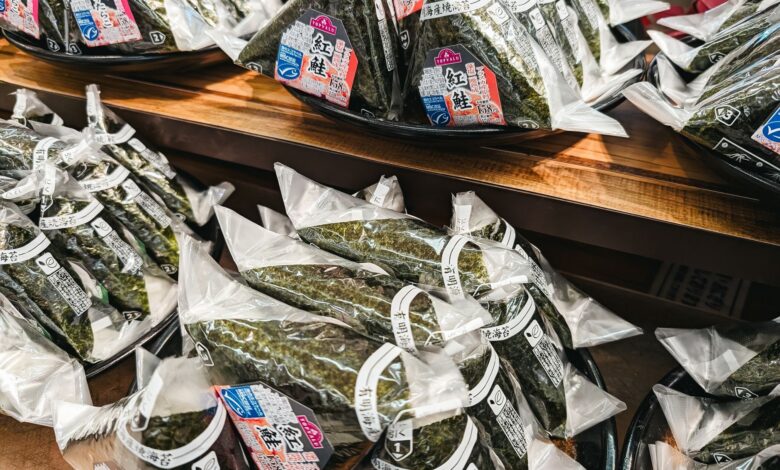
While ¥1000 per day at a Japanese convenience store will provide for 3 real meals (and little else), the ¥1000 figure is more of a working floor than a viable budget and the options on the shelf will either drive you over or keep you under that amount. For reference, japan-guide estimates that the daily food floor for the most budget-conscious traveller to Japan is approximately ¥2000 when including all cheap food options and restaurants.
Japanese convenience store food prices have also been inconsistent over time, including their prices being inconsistent within the year 2025. Based on a report from the Mainichi, one of the rice balls wrapped in seaweed purchased from 7-Eleven saw an increase in price from ¥128 to ¥165 over a period of two months in 2025, which was attributed to both a spike in rice prices due to a bad harvest and bad yields of seaweed. This indicates that using an old figure, which was based on an experience two years ago, there could be a large discrepancy between what that number was at that time and what it currently is now. It all comes back to the basic question: do you consider this to be a meal?
What ¥1,000 a day actually buys at a Japanese convenience store
The price point for ¥1,000 does not correspond to any typical prices in Japan (chains; authorities; CVA). So it’s not posted anywhere by any chain or civil authority as a daily allotment of food for any traveller, but rather is included on a traveller’s itinerary based on travel blogs. The estimates and rules stated below were accurate as of 20/09/2026. The tax rules on the sale of all food products in Japan are established by the National Tax Agency and the prices for konbini food are set in store by the chains themselves. Because of constant price changes, it is advisable to verify the prices and tax information for konbini food on both the shelf label and the National Tax Agency website.
The answer to whether your ¥1,000 will get you what you expect depends not on how much cash is in your wallet, but on the food that is available on the shelves at the konbini. Various forms of rice-based konbini foods are measures for consumption in hours rather than days. For example, FamilyMart onigiri and bento had a 19-hour period from the time they were cooked until the time they needed to be consumed, according to a report by Nikkei in September 2025. Subsequently, FamilyMart announced that this period would change; as of September 2025, they have developed a method that allows them to shorten that time by an additional two hours on approximately 70 rice items — omusubi, bento, sushi, etc. — where chilled rice items and three states in the southern region remain excluded from this policy.
In addition, stores will often further adjust the time period of availability based on their own sales strategy. For instance, 7-Eleven Japan states that all of their onigiri, bento, sandwiches, sweets, and bread will be removed from sale two hours prior to their printed sell-by date. Therefore, while the final salmon variant of rice ball for sale had two hours remaining until its sell-by date when it was pulled from sale, it can be regarded as “fresh.”
A convenience store window that is too small cannot be replenished through weekly deliveries which is why FamilyMart has been delivering rice around three times per day — FamilyMart has begun reducing those deliveries and starting from “Mid September 2025” for Ishikawa/Toyama/Fukui, FamilyMart will deliver rice twice per day; and starting on “9 June 2026,” about 1,300 FamilyMart locations in Tohoku and Niigata will also receive rice twice per day. FamilyMart has successfully reduced the number of deliveries from three to two by increasing the time it takes for items to get to customers.
This is how you can calculate a convenience store day: your food comes off a shelf that has been restocked every day; you know the price of items on the shelf at the time you are hungry. When you spend ¥1,000 in a typical convenience store, you will receive three small servings/plates of food and won’t have any extras left over. Which three items you buy depends solely on which items you choose to pick up, so we will now look at the cost breakdown of items available.
What each item costs: the building blocks of a day’s meals
Most konbini (convenience store) guides leave people with a list of items they would like to have, but that doesn’t work on a budget, as every item would require its own price point.
This list was taken from FamilyMart’s own website (this is a chain). Below is a list of all the tax-included prices FamilyMart provided on their national rice-ball page as of 20 September 2026.
| Item family | What you actually get | Price, tax included |
|---|---|---|
| Plain salt rice ball | Rice and salt, no filling | ¥149 |
| Standard hand-wrapped rice ball | Tuna mayonnaise, pickled plum, kelp | ¥198 |
| Premium hand-wrapped rice ball | Salmon, spicy cod roe | ¥235 |
| Large rice ball | Roughly double the standard size | ¥298 |
| Two-rice-ball pack | Salmon and tuna mayonnaise together | ¥388 |
| Rice balls with side dishes | The closest thing to a tray meal | ¥598 |
While each of the prices listed are not all very useful, what these prices provide is a range of prices, or a spread. The cheapest rice ball available at FamilyMart is four times more expensive than the most expensive rice ball on the same shelf, so people’s habit of buying rice balls at konbini will typically cost them more than the price of rice balls in Japan. Therefore, two people buying the same “rice ball” can easily be ¥150 apart in price before either of them purchases a drink.
While the above prices can provide some insights into rice-ball pricing at FamilyMart, it is important to remember three things about the prices listed. First, price varies by region; therefore, these prices should be viewed as price bands, not as an exact price list. Second, all of these prices were taken from FamilyMart’s page on one specific date; therefore, the prices for the same products will change very frequently. Finally, while this table contains only rice ball prices, hot food, sandwiches, drinks, and all products sold in the heated display case are excluded from this table.
If you think in foreign currencies, you will only need to convert one time and keep track of the date on which you did. As of 11 September 2026, the Fed’s official published rate of 153.71 yen per US dollar results in ¥1,000 being approximately equal to $6.50 and ¥198 being approximately equal to $1.30. However, estimating these amounts does not remain accurate after a few weeks due to the fluctuating exchange rates. Thus, you should remember the Japanese Yen amounts.
Fitting breakfast, lunch and dinner inside ¥1,000
You can build the arithmetic off the published prices above but rebuild using your own selections.
The ¥1,000 day
| Meal | Build | Cost |
|---|---|---|
| Breakfast | Plain salt rice ball | ¥149 |
| Lunch | Large rice ball | ¥298 |
| Dinner | Two-rice-ball pack | ¥388 |
| Drink | One bottled drink | about ¥150 |
| Total | about ¥985 |
That is actually what ¥1,000 gives you: 4 rice balls and 1 drink. That’s clear on the line; it is a day of rice with neither hot nor green foods and only 1 drink. The drink line here is an allowed amount rather than a published amount because drink pricing is not part of the list checked here.
With a slight push, the number breaks. Move breakfast to a standard-filled rice ball, then move lunch to a rice ball with sides set and you get ¥149 + ¥598 + ¥388 = ¥1,135 before you even have anything to drink.
The comfortable day
| Meal | Build | Cost |
|---|---|---|
| Breakfast | Standard filled rice ball | ¥198 |
| Lunch | Rice balls with side dishes | ¥598 |
| Dinner | Large rice ball plus a standard one | ¥496 |
| Drinks | Two | about ¥300 |
| Total | about ¥1,590 |
The difference between those two days is roughly ¥600; that ¥600 gets you one completely-composted meal and another drink. This decision really puts you in a difficult position; you are going to struggle to spend a comfortable amount of money on Japanese food for the day. Around ¥1,500 is when a konbini day will not feel like rationing.
Your own three-meal worksheet
Complete this page prior to your flight, using the price table above for whichever rice shelf items you choose, and use your own best guess for drinks and hot cooked foods. Three columns, one line per column, and a total that you can argue with.
| Slot | What you would actually buy | Price from the table | Your figure |
|---|---|---|---|
| Breakfast | |||
| Mid-morning drink | not in the table | ||
| Lunch | |||
| Something hot | not in the table | ||
| Dinner | |||
| Evening drink | not in the table | ||
| Daily total | |||
| × nights in Japan |
There are two rules for what makes it work. You need to list the food you actually would eat (rather than what you think you can afford). You will give up on a budget because you hate the idea of a budget before day 3. The “not on the table” section of your food list is left blank until you have had a real shelf – you can fill them all in on your first morning at home and re-total – that one change is worth more than all the numbers in this article.
The dollars worked totals above are estimates based on three pieces of information for this guide: the national tax included price published by one company’s chain as of 20 September 2026, the average number of rice-shelf items consumed in a meal, a very rough estimate of drink allowances or what people spend on drinks. These dollars worked totals do not serve as an official standard, an industry benchmark, or a survey of what people travelling typically spend.
The change to every line in every table is based on something almost no one talks about.
The shelf price already includes tax — and eating in-store changes what you pay
When you see a price on a shelf in Japan, that’s what you will be charged. Retailers like FamilyMart quote the total including tax on their shelves. FamilyMart’s rice-ball page includes the tax-inclusive pricing of ¥184 and the pre-tax pricing of ¥198 for each rice ball. The reason that the price appears higher in the table is that it is the tax-inclusive price. Therefore, you do not need to mentally calculate the tax that will be added to the price at the register.
Beneath this system is a two-tiered tax system. Japan’s National Tax Agency maintains a record of standard consumption tax rates at 10% and a reduced consumption tax rate at 8%. The reduced consumption tax rate applies to food and beverages. The reduced consumption tax rate does not apply to alcohol and dining out; therefore, a consumer will pay a different tax on a bento and a beer purchased in the same transaction at the same register.
You should become familiar with this information before you go; it will be one of the few prices in Japan that you as a traveller have the power to influence. In April 2026, the agency released a revised version of Question 52 on its [individual-cases Q&A] “Frequently Asked Questions” page about convenience stores. In essence, if a convenience store serves you food on a tray or in any type of dishware that has to be returned (for example, after eating), it is considered a food service and does not qualify for the reduced tax rate. The only exceptions to this rule are hot snacks and bento boxes that can be either eaten at the store or taken out. If a customer is getting a hot snack or bento to go, the convenience store should confirm with the customer what the customer’s intent is for that product before applying the appropriate tax rate. Since most convenience store business is takeout, the agency believes that convenience stores should not be required to ask every single customer: posting a notice saying “Please Let Us Know If You Are Going to Use the Eat-In Area” will suffice in establishing intent.
| Where you eat it | Rate that applies | What it means at the till |
|---|---|---|
| Taken away | 8% reduced rate | The shelf price, unchanged |
| Eaten at the store’s eat-in counter | 10% standard rate | Slightly above the shelf price |
| Anything alcoholic, anywhere | 10% standard rate | Outside the reduced rate entirely |
According to 7-Eleven, each 7-Eleven store may vary slightly when it comes to eat-in areas. On the English service page of 7-Eleven’s website, some locations have an eat-in area, and items purchased with the lower tax rate at an eat-in area are subject to a 10% tax. The difference between the reduced tax rate of 8% and the full rate of 10% is only about 2% on each purchase. At the present price ($598) for a set, that is only about $11 — a minimal expense. However, the main reason to be aware of this is that it is your choice, and it recurs with every purchase you make. If you do not intend to use an eat-in area, simply pay the shelf price and go to the park bench.
One boundary, because it catches people out. This is not the tax-free shopping scheme advertised to visitors. That is a separate arrangement for goods you take out of Japan, not a discount on lunch.
Konbini, supermarket or restaurant: when each one pays off
In Japan, the konbini (short for convenience store) has a whole floor devoted to prepared foods. It’s not just a single section of the store.
For those who wish to shop for groceries while in Japan, instead of buying every meal already made, you may want to consider shopping at the supermarket. Professional grocery markets will undercut the price of the konbini by having set times for markdowns of leftover lunches at approximately 2 PM and prepared food items at approximately 7 PM starting at 10-20% off the regular price, and going as high as 50-70% off the regular price as they get closer to their closing time. There is no excess in the konbini with regard to this practice as all items available in the supermarket will eventually be reduced as they approach their being no longer usable. However, the downside to this practice is that generally supermarkets that normally sell products at their regular prices are scarce in the areas of larger cities; most first time visitors to Japan will likely spend their time in the downtown area of the larger city, therefore unavailable regular priced supermarkets is a major disadvantage to your shopping in this part of Japan. japan-guide
Also, you do not have to look too far away from the konbini as your best options for lower-priced restaurants are not as hard to find as you might think according to the information provided on budget-guide and other websites. Lunch set menus at most restaurants are priced at around ¥1,000 ($10) per person, and it is also very rare for people to pay more than ¥1,000 ($10) per person for all meals at fast-food restaurants. Therefore, when looking at a konbini tray priced at ¥598 ($6), comparing that to a ¥1,000 ($10) meal prepared to order, that price is really not as extravagant as the spreadsheet would lead you to believe.
| Channel | Genuinely best for | Real reason not to |
|---|---|---|
| Konbini | Any hour, anywhere, fixed printed prices | Highest per-item price of the three; rarely anywhere to sit |
| Supermarket | The afternoon and evening markdown run | Hard to find in central city districts |
| Cheap restaurant | One hot, composed meal for roughly ¥1,000 | Fixed opening hours; a menu you may not be able to read |
The most reliable plan is seldom entirely composed of konbini usage. When breakfast or meals are at inconvenient times, supermarkets/lunch sets will take on 1 meal a day. This reflects how long-term visitors to Japan use konbini, as outlined by expert user posts on the Tripadvisor Japan forum (which is a great resource for visitors to Japan) regarding reservations for Osaka and Tokyo. In 2021, one poster mentioned that when they travel to Japan they seldom eat at konbini (buy their meals) but rely on the convenience of the stores for meals at times such as very early morning, for example, if they needed to get to the airport at 5:30 am. This is based on a regular visitor’s experience, rather than a general sampling, and represents the same pattern that pricing indicates.
There is also a significant drawback to using a konbini rather than cooking for yourself. There is little more than pre-packaged salads, and the way to eat is not available from the konbini. For example, eating nothing but rice balls for a week is a way to budget, but it’s not a way to experience Japan.
How to spend less without eating worse
Discount stickers are a reality, and what people are saying about them online is wrong.
FamilyMart’s own announcement of 3 March 2025 sets the scheme out precisely. Its markdown stickers come in exactly seven denominations — ¥10, ¥20, ¥30, ¥50, ¥100, ¥120 and ¥150 — rolled out nationwide from 11 March 2025, starting in the Tokai region. That is a fixed yen ladder, not a percentage. The widely repeated “30–50% off” framing does not survive contact with it: the largest sticker, ¥150, on a ¥598 set is about 25%, while the same sticker on a cheaper item is proportionally far better value. The underlying system is older and wider — the release records that the company’s barcode markdown system has run since July 2021 and is used in more than 90% of its stores.
There are three limitations to this savings program: first, discounts are available only at select store locations, including FamilyMart; second, the announcement indicates that rollout dates will differ by store, and some FamilyMart locations may not have discount stickers at all; and third, the purpose of the discount stickers is to clear stock before the expiration date, so the discount cannot be claimed during the mid-day hours when the consumer may be the hungriest, i.e., at noon. Finally, while the announced FamilyMart discount sticker program is one specific example of a chain’s discounting program, other chains will also implement their own discounting programs and set their own terms.
It simplifies the guideline. Stickers may eliminate one day already from your budget, but cannot serve as your budget. Plan to pay full price for all items, and consider any item that is reduced in cost (it’s like extra cash) as a bonus for the evening. The best way for you to get a reliable discount instead of getting one through luck is to utilize the grocery store markdown guide previously provided as a resource for you to use to plan.
In practice: where to eat, how to pay, what to avoid
To be able to utilize a budget effectively, the budget must be able to be used for a purpose; this is usually confirmed by a physical expenditure of that budget. There are a couple of practicalities that can help with this.
The first, and probably most critical, aspect to determining the place of expenditure will be the place of food consumption. While a small eat-in area exists, it is not widely available; most visitors (particularly long-term residents) appear to use one of the following methods when eating in: the local park bench, a hotel room, or a discreet location just outside the store. It is recommended to plan to take your food home or to where you are going to eat rather than relying on eating in-store.
Heating food is free, but you need to let the store know that you wish to have your food heated. Almost all stores of the chain 7-Eleven have their uses for microwave ovens, and the employees at 7-Eleven will ask at the point of sale if you wish to heat your items. Please note that there are some items that cannot be heated. Simply nodding your head will be sufficient for your food to be heated; there is no need to verbally respond. The most common error that visitors make with regard to heating their food is that they may assume that a bento box that is on display will be served hot, when in fact it is already prepared and waiting to be served cold.
The third practical point is that you should sort out your budget before arriving at 7-Eleven locations. The service page for 7-Eleven visitors confirms that you can pay at 7-Eleven stores using credit cards, QR codes, and other payment options; Seven Bank ATMs have a multi-language display, and many locations have ATM machines capable of converting various foreign currency denominations into yen without the need for an ID or passport. Additionally, 7-Eleven advises customers to not plan their day around any specific ATM for withdrawal, as they may not be in service for maintenance at specific times.
‘So, two smaller bags will have to suffice. You pay extra for plastic bagging and can only obtain the bags when specifically asked to, so by using a folded tote every week, you’ve offset the cost of two bags. Cutlery is supplied at no charge, but you need to request it during checkout, or wait for it to be offered.
Before your flight, check with your bank’s app to ensure your card has been approved for international ATM withdrawals and is aware of your travelling status. If your card is blocked upon your arrival, none of the pricing listed above will be applicable.
Which of the three chains to choose (and when it doesn’t matter)
What follows does not contain a Taste Test, but rather compares the published information as stated by the companies, and should be considered as research-based analysis.
On the basis of verifiable evidence, the three chains have operational differences but no culinary differences. 7-Eleven publishes the most visitor-oriented information with an English language service site to provide English speakers with an overview of the services they provide, including payment options, yen withdrawals from overseas credit cards, currency-exchange machines, and tax-free stores. This company has also clearly stated its consume-by and sales-deadline policy. FamilyMart publishes the most detailed price and discount policy information; it has a complete national price list showing tax-inclusive prices, and a well-documented seven-step markdown process for its merchandise, including rice-cooking modifications and delivery updates. Lawson’s publicly available comparable information is not verified at this time, and therefore cannot make any assertions about this company in either direction.
It should be noted what is and is not established by the above information. People who are looking for an English-Language explanation or cash can use 7-Eleven. People who want to create a budget can use FamilyMart. The information does not inform anyone on which chain has better tasting rice balls, therefore this guide will not invent an answer.
FamilyMart has a legitimate reason for not placing too much emphasis on this option because of their announcement regarding the markdown stickers which state that they are delivered to different stores throughout the country and it is not possible to expect every store nationwide to receive stock three times a day due to the previously noted changes. The amount of time that you would have spent walking past a closer store to go to that logo is small compared to the value of going to the store and getting nothing in return. The disparity between the two options of walking to the nearest store versus taking a longer route to get to a logo is more significant among individual branches than it is among brands.
What changes in 2027 (and what to check before you travel)
All prices mentioned in this article have an expiration; and for the first time, the expiration date has been announced.
On September 15, 2026, two government agencies (Japan’s National Tax Agency and Ministry of Finance) announced the opening of a dedicated site that detailed a temporary reduction to the consumption tax for food and drink for the two-year period of April 1, 2027, through March 31, 2029, as a result of a governing body decision made on that date. A separate attaché report from the U.S. Department of Agriculture’s Agricultural Attaché describes the consumption tax reduction on grocery food as being reduced from eight percent to one percent for the two-year period and retaining the current consumption tax rate of ten percent for eating out. This tax reduction is the first time Japan has reduced its consumption tax since 1989.
It is important to note that statements included in any status update are simply statements. The announcement made by the Japan National Tax Agency as of September 20, 2026, does not constitute law. The Japan National Tax Agency website states that the proposal will only go into effect if a bill is introduced into the National Diet and is passed. Therefore, anyone claiming that there will be a consumption tax of one percent on food and beverage items in Japan in April 2027 is basing that claim on a Cabinet decision and not statute law.
If the bill does pass, the difference in tax treatment between takeout versus eat-in (which is noted in the tax section above) will expand from a two percent difference to a nine percent difference, resulting in a significant difference between the two methods of consuming food. In the event that the bill is amended or delayed, there will be no change to the tax table referenced above.
The pre-departure check is narrow and specific. Open the agency’s rate-reduction site, see whether the page still describes the measure as pending or now describes it as in force, and note the date you looked. That one page tells you which version of the arithmetic here applies to your trip.
What’s Worth Your Time
In Japanese convenience stores, ¥1,000 will buy you about four rice balls and a drink per day, which is essentially the bottom of your budget, but not the best way to budget because at somewhere around ¥1,500 everything changes from being a rationing experience for every meal. The most beneficial thing you can do for yourself with that ¥1,000 budget limit is to fill in the chart above with what you can buy for each of the published price points instead of simply looking at a newspaper article stating what was purchased for ¥1,000 daily; as these prices change daily and you will have no idea what you can really get with that amount of money. The best way to do this is to check the agency’s own website on the current tax situation before you take off, so you’ll know which foods to spend extra money on versus those you can eat cheaply (i.e. sandwiches or chicken). If you do not do this, you will have a rude awakening at the checkout on day three, after your initial month of spending has been “spent.”
Frequently asked questions
Is it cheaper to buy a bento at a supermarket than at a convenience store?
Yes, and especially later in the day, as reported by japan-guide, prepared food at supermarkets in Japan began to be discounted from around 19:00 hours by approximately 10 – 20% plus discounts that may be as much as 50 – 70%. However, supermarkets where products are full price are limited within the core commercial districts of many of the larger cities in Japan.
Is a two-rice-ball pack better value than buying two rice balls separately?
Yes, but not as much as you might expect. When looking at FamilyMark’s published prices for the national averages, the sushi-n-tuna-mayo pack sells for ¥388 which is ¥45 cheaper than purchasing each of those products separately at ¥235 and ¥198 respectively. When comparing the same price for two regular fillings at ¥198 each, there is little difference in value.
Can I use a foreign credit card to get yen at a convenience store?
7-Eleven states that Seven Bank’s ATMs located in 7-Eleven stores allow you to withdraw yen from a credit card, through a multilingual user interface, and in some of its locations, they also have foreign currency exchange machines that do not require identification. However, the company cautions that these machines may be out of service for repairs.
Will food really be taxed at 1% in Japan from April 2027?
There has been no final determination yet. On September 15, 2026, the National Tax Agency and Ministry of Finance released their proposal on the plan’s timeline which would take place between April 1, 2027, and March 31, 2029, but the agency has stated that the plan is contingent upon the passing of a bill by Japan’s National Diet. Before your trip to Japan, it is advisable to check whether a vote/decision has occurred.